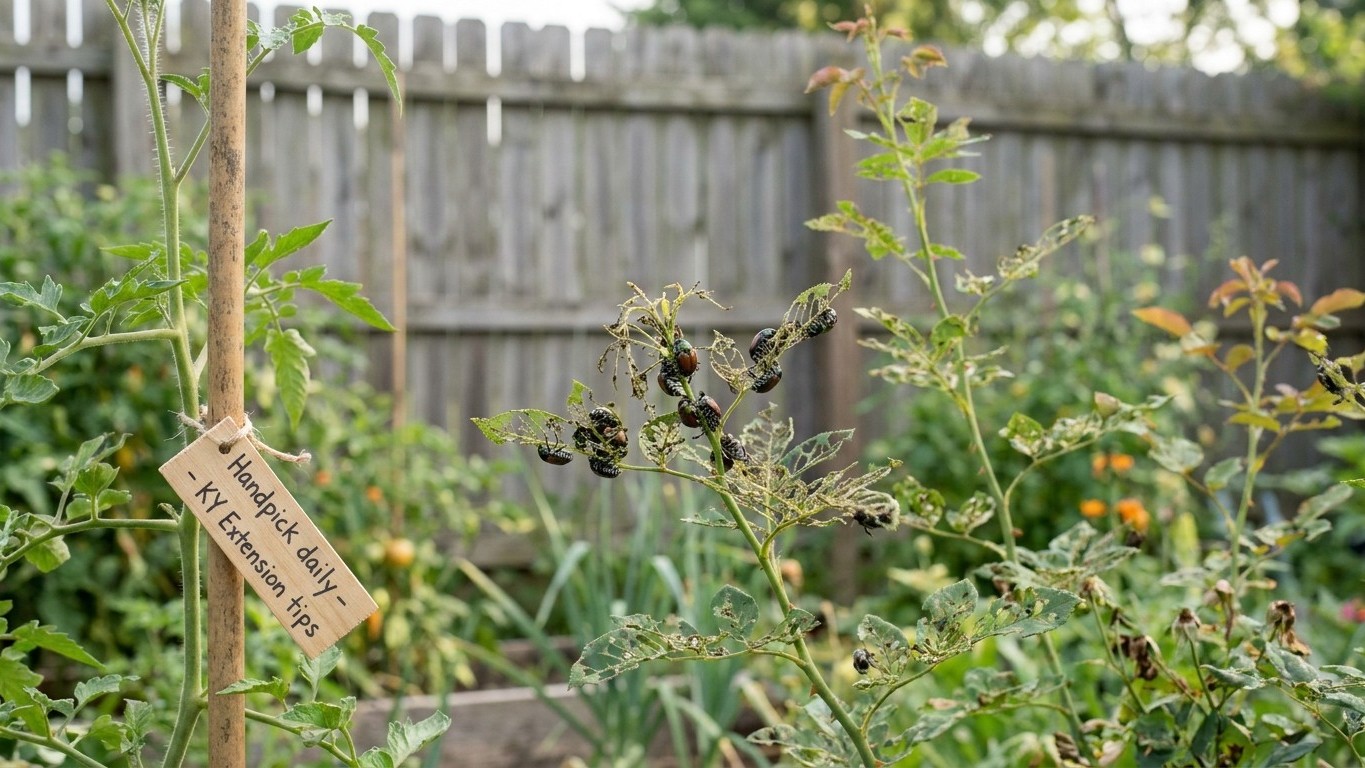

Kentucky gardens see real pest pressure from late March through September, with the University of Kentucky Extension Entomology’s ENTfact series naming ten insects that account for most of the calls county offices field each year. Eastern tent caterpillar opens the calendar in early April, and by mid-summer gardeners are juggling squash bug outbreaks in the vegetable patch alongside Japanese beetle infestations, spotted cucumber beetle pressure on cucurbits, its close relative the striped cucumber beetle, squash vine borer tunneling into stems, brown marmorated stink bug at the same time, bagworm showing up on evergreens and shrubs, and Fall webworm Kentucky tents appearing on hardwoods as summer winds down. Walk the garden twice a week starting in early spring and check leaf undersides, not just the tops, so you catch the early stage before it does the damage.
What Kentucky gardens actually deal with

A silk tent wedged into the crotch of a wild cherry or crabapple branch is the whole story in miniature: catch it while the black, white-striped caterpillars are still clustered inside during the cool morning hours, and you can pull the tent by hand and be done. Wait until afternoon, once they’ve fanned out to feed, and the same tree can lose its leaves within days. Timing the check to early morning, not the calendar, is what actually decides whether this stays a five-minute job or becomes a spray.
Eastern tent caterpillar

Look for a black caterpillar with a fine white stripe down its back and pale blue spots along the sides, feeding in groups inside a silk tent built into the crotch of a wild cherry, crabapple, or ornamental fruit tree. The caterpillars, not the tent itself, do the damage, stripping branches of leaves in a matter of days once they’re active. Pruning out small tents by hand in the early morning, when the caterpillars are clustered inside, controls light infestations without any spray.
Azalea lace bug

The damage shows up as pale, stippled patches on azalea leaves, with small dark spots of excrement on the underside where the insects feed. Adults are tiny and lacy-winged, easy to miss until the stippling is already obvious from a few feet away. Azaleas planted in full sun carry heavier infestations than those in part shade, so moving a chronically stippled shrub is sometimes the more lasting fix.
Bagworm

The bag itself, built from silk and bits of the host plant, is the giveaway: a small spindle hanging from a juniper or arborvitae twig that looks enough like a pinecone to fool most people the first year. The larva inside does all the feeding, and a heavy population can brown out an entire evergreen before anyone notices the bags weren’t always there. Hand-picking and destroying bags before mid-June removes the next generation before it hatches.
Striped cucumber beetle

A small yellow beetle with three black stripes running the length of its back, feeding on cucumber, squash, and melon seedlings as soon as they emerge. Beyond the chewed leaves, this beetle carries bacterial wilt, so a healthy-looking vine can collapse within a week of the beetle’s first visit. Floating row cover over young seedlings, removed once flowering starts, keeps the beetle off the plant during the window when it does the most harm.
Spotted cucumber beetle

Slightly larger than its striped relative, yellow-green with eleven black spots, and just as willing to feed on cucurbit seedlings and transmit the same wilt organism. It tends to arrive a little later in the season and range more widely across the garden, feeding on corn and beans as well as squash family crops. The same row cover strategy used for striped cucumber beetle works here.
Squash bug

Adults are gray-brown, shield-shaped, and about 5/8 inch long, laying neat clusters of bronze eggs on the undersides of squash and pumpkin leaves. Both nymphs and adults feed by sucking sap, and a heavy population causes whole leaves to wilt and blacken as if the plant had been scorched. Checking leaf undersides weekly and crushing egg clusters before they hatch does more than any spray applied after nymphs are already established.
Fall webworm
The web is built over the tips of branches rather than tucked into a crotch, which is the easiest way to tell it apart from eastern tent caterpillar at a glance. Inside, pale yellow-green to gray caterpillars covered in tufts of whitish hair feed together, skeletonizing leaves within the web. Pruning out webbed branch tips while the nest is small handles most home cases.
Squash vine borer
The adult is a day-flying moth that looks like a wasp, orange and black or metallic green with clear hind wings, easy to mistake for a beneficial insect until you see it land on a squash stem. The larva, a cream-colored caterpillar with a brown head, does the real damage by tunneling inside the stem, and a plant that wilts suddenly in mid-summer despite regular watering is the classic sign. Slitting the stem lengthwise to remove the borer and mounding moist soil over the wound can save an individual vine, though prevention with row cover before moths arrive works better.
Japanese beetle
A metallic green head and thorax with coppery wing covers make this one of the easiest Kentucky pests to identify at a glance, especially when a dozen are clustered on the same rose bloom. Adults skeletonize leaves between the veins, leaving a lace-like pattern, and feed on flowers and fruit as well as foliage. Hand-picking into a jar of soapy water in the cool of the morning, when the beetles are sluggish, is more effective over a season than most people expect.
Brown marmorated stink bug
A mottled brown, shield-shaped bug about 5/8 inch long, identifiable by the light banding on its antennae and around the abdomen’s edge. It feeds on a wide range of vegetables and fruit, leaving pale, sunken, or discolored patches where it punctures the skin to feed. Numbers build through the season and this insect also moves indoors in fall looking for a place to overwinter, which is often a gardener’s first clue it has been active outside all along.
Telling damage apart

Insect damage, disease, and a watering problem can look alike from ten feet away, and treating the wrong one wastes a season. Chewed leaf edges with visible frass (the dark, granular droppings insects leave behind) point to a caterpillar or beetle feeding at night or early morning, while damage with no frass and no visible insect is more often disease or environmental stress.
- Ragged holes with chewed edges: a chewing insect, likely still nearby, check undersides of nearby leaves
- Fine white or yellow stippling across the leaf surface: a sap-feeder like lace bug or spider mites, not a chewing pest
- Sudden wilting of one stem while the rest of the plant looks fine: check the stem base for a borer entry hole
- Sticky, shiny residue on leaves: usually a sap-feeding insect excreting honeydew, sometimes followed by black sooty mold
- Yellowing that starts at leaf margins and moves inward with no chewing: more often a watering or nutrient issue than a pest
A plant that wilts evenly across the whole canopy on a hot afternoon and recovers by morning is behaving normally, not showing pest damage. A plant that wilts on one side, or one stem at a time, while the soil is moist is the pattern that says look for a borer before you reach for anything else. Disease tends to show as spots or blotches with a defined edge and often a yellow halo, which chewing and sucking insects don’t leave behind.
When each one shows up
Spring into early summer
Eastern tent caterpillar is the season’s first arrival, with the University of Kentucky Extension Entomology’s ENTfact calendar, tracked near Louisville, putting activity from early April through mid-May. Bagworm follows close behind, active from mid-May through mid-June, and this is the window to catch bags while they’re still small enough to hand-pick. Squash bug adults fly into gardens as vine crops start putting on real growth, typically late May into early June by the same Louisville-area tracking, so seedlings that looked fine in April can have their first squash bug eggs within weeks of transplant.
Midsummer
Fall webworm has two generations noted in the Louisville-area record, one from late May into June and a second from mid to late July, so a garden that seemed clear in June can see fresh webs again a month later. Squash vine borer moths are on the wing from mid-June through mid-August, which means row cover needs to go on before mid-June, not after the first wilted vine shows up. Japanese beetle activity runs July through August, overlapping with the tail end of vine borer flight and making midsummer the busiest stretch of the year for most Kentucky vegetable gardens.
Late summer
Brown marmorated stink bug peaks in early August by the same tracking, right as tomatoes and peppers are loading up with fruit worth protecting. All of these windows come from monitoring done near Louisville, and the extension service notes that timing shifts across the state, running earlier in the warmer west and later in the cooler eastern counties. A gardener in Kansas dealing with a drier, more continental climate sees a noticeably different rhythm for some of the same pests, which is covered in Garden Pests in Kansas: What Shows Up, When, and How to Stop It.
What actually works
Prevention beats intervention for nearly everything on this list, and it starts before the pest ever shows up. Rotating squash family crops to a different bed each year reduces the carryover of squash bug and cucumber beetle populations that overwintered nearby. Row cover installed at transplant and removed only once flowers need pollinating keeps cucumber beetles, squash bugs, and vine borer moths off the plant during the exact window they do the most damage.
Encouraging what already helps
Parasitic wasps, ladybird beetles, and lacewings take a real bite out of caterpillar and beetle populations if you let them, which means holding off on broad-spectrum insecticides that kill beneficial insects along with the pest. Leaving a strip of flowering plants near vegetable beds gives those predators and parasitoids somewhere to live between meals. This is the same logic behind pest management recommendations in Garden Pests in Louisiana: What Shows Up, When, and How to Stop It, where similar humid-summer conditions favor the same trade-off between spraying and encouraging predators.
When intervention is warranted
Hand-picking works well for Japanese beetle, bagworm, and eastern tent caterpillar because all three are large enough to see and slow enough to catch. For squash bug and cucumber beetle, checking leaf undersides for egg clusters and crushing them is more effective over a season than most sprays, since it stops the next generation before it ever hatches. Insecticidal soap and horticultural oil work on soft-bodied nymphs and lace bugs but do nothing against squash vine borer larvae once they’re inside the stem, so timing any spray to the adult moth stage is the only version of that approach worth trying.
Popular home remedies like garlic spray, dish soap alone, or planting marigolds as a blanket repellent have little evidence behind them for the pests on this list. Marigolds may deter a narrow set of soil pests in some situations, but they won’t stop a squash vine borer moth from finding a zucchini plant across the yard.
What control costs
Hand-picking costs nothing but time, and for Japanese beetle, bagworm, and tent caterpillar that time investment, a few minutes every few days during the active window, is genuinely the cheapest and most effective option for a home garden. Row cover has an upfront material cost but gets reused for several seasons if stored dry, which makes it cheap on a per-year basis even though the first purchase feels like the priciest option on the list.
| Method | Money cost | Time cost | Repeat frequency |
|---|---|---|---|
| Hand-picking | None | Low, a few minutes several times a week | Ongoing through the pest’s active window |
| Row cover / barriers | Moderate upfront, reusable | Low, install once, remove for pollination | Reinstall each season, replace after a few years |
| Biological controls (beneficial insects, habitat) | Low to none | Low, mostly habitat planning | Ongoing, builds over multiple seasons |
| Targeted sprays (soap, oil, timed insecticide) | Moderate, repeat purchases | Moderate, correct timing matters | Multiple applications per season, often weekly during outbreaks |
Sprays are the most expensive option once you count repeat applications across a season, and they’re also the option most likely to be wasted if timed wrong, since several of these pests, squash vine borer especially, are only vulnerable at the adult or early-larval stage. Biological controls cost the least in dollars but the most in patience, since a garden’s predator population usually takes more than one season to build up to the point where it’s doing noticeable work.
Local help
The University of Kentucky Extension Entomology office tracks pest outbreaks across the state through its ENTfact series and identifies specimens for home gardeners through county offices. Find your county’s contact and submit a sample or photo through the state extension service rather than guessing from a photo online, since local outbreak conditions can shift what’s active in a given week. For more on gardening elsewhere in the state, see the full set of Kentucky guides.
Look Closer at a Common Kentucky Pest
If webbed, silvery tents have started showing up on the tips of your tree branches, you’re likely dealing with a pest that follows a very predictable calendar here. Kentucky gets two separate waves of activity from this insect each year, and knowing which wave you’re in changes how you should respond. For the full breakdown of when fall webworm appears and how to stop it, University of Kentucky Extension Entomology has tracked this two-wave pattern closely enough that it’s now the single most useful piece of timing information a home gardener can have. The page walks through why the late May through June wave behaves differently from the mid to late July wave, and what that means for whether you should act right away or just keep watching. Rather than treating every webbed branch the same way, you’ll be able to match your response to the actual point in the season you’re seeing it, which saves both effort and unnecessary spraying.
Common questions
Do I need to spray every week all summer to keep these pests down?
No, and weekly spraying on a fixed schedule usually does more harm than good by killing off the beneficial insects that would otherwise keep populations down on their own. Most of the pests on this list respond better to targeted timing, catching the vulnerable stage, than to a routine spray calendar.
My squash plant wilted overnight, is it too late to save it?
Check the stem near the soil line for a soft spot or a small hole with sawdust-like frass before assuming the plant is lost. If a vine borer is inside, slitting the stem to remove it and mounding moist soil over the wound sometimes lets the plant recover, but a plant with multiple entry holes rarely bounces back.
Are the bags on my juniper actually bagworm or something else?
If the bag is spindle-shaped, made of silk and bits of the plant it’s hanging from, and about 1 to 2 inches long, it’s almost certainly bagworm. Old, empty bags can persist on the plant for a year or more after the insect inside has died, so an evergreen covered in bags isn’t necessarily under active attack that season.
Why do I keep finding Japanese beetles on my roses but nowhere else in the yard?
Japanese beetle adults are drawn to roses, grapes, and a handful of other favored plants over nearly everything else in a typical yard, which is why damage can look concentrated even when the overall population is large. Hand-picking the beetles off those preferred plants in the morning, when they’re least active, reduces the number available to spread to less-preferred plants nearby.