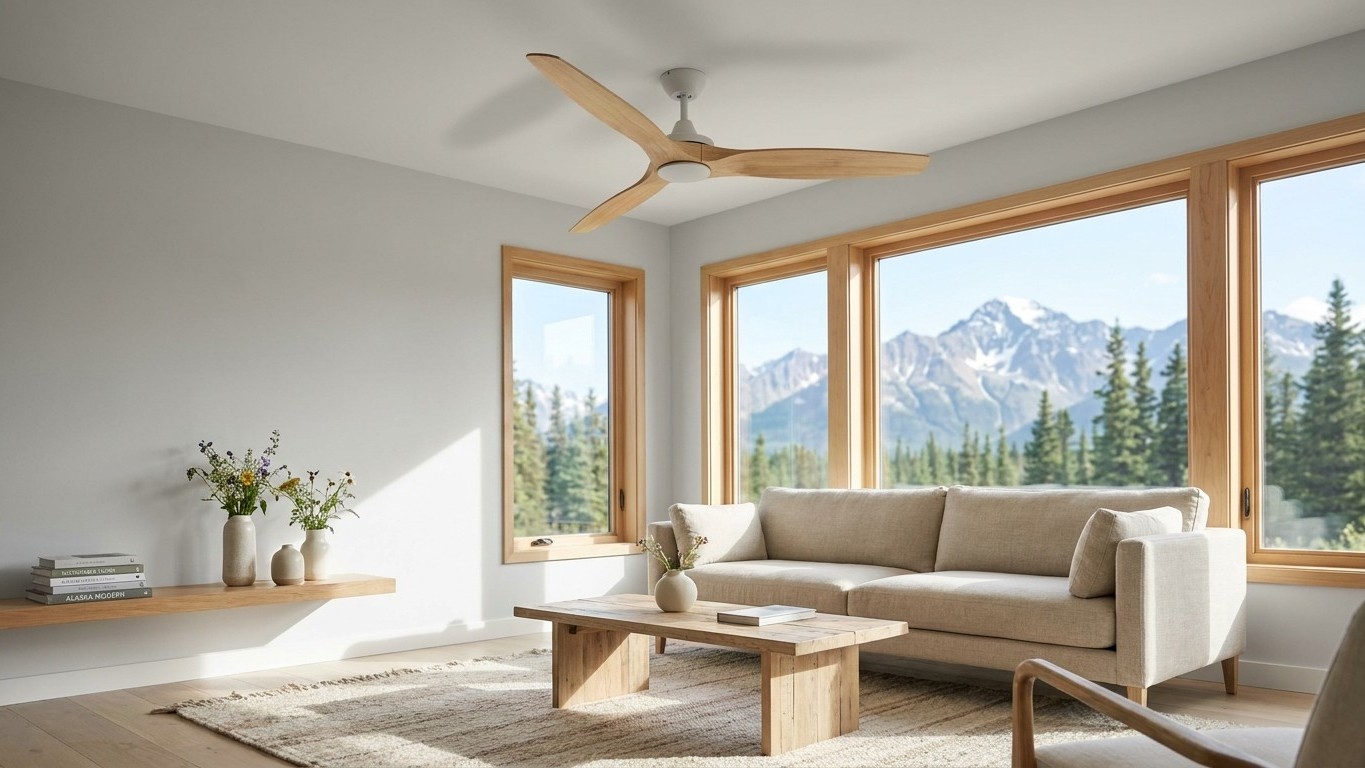

Nearly every home in Louisiana runs some form of air conditioning, and most of that cooling comes through a central system built into the house rather than a window unit propped in a sill. Ninety-three percent of homes use air-conditioning equipment of some kind, seventy-six percent of them through a central unit, and a smaller share fills the gap with individual equipment room by room.
What homes in Louisiana actually cool with
The Energy Information Administration’s 2020 Residential Energy Consumption Survey lays out the full picture: 93% of Louisiana homes use air-conditioning equipment, 76% run it through a central system, 25% rely on an individual unit (a ductless mini-split, a window or wall unit, or a portable model), and 87% also keep a ceiling fan running alongside whatever does the actual cooling.
The gap between 93% and 76% is the part worth sitting with. It’s the share of households cooling their homes without whole-house ductwork, roughly one in four. In some states that gap swallows almost the entire story: Connecticut posts 90% with air conditioning but only 34% central, meaning most Connecticut homes on AC lean on window units or mini-splits. Louisiana sits closer to Alabama’s split of 94% overall and 81% central. Three out of four Louisiana homes cool through ductwork, and the remaining quarter fills in with equipment that never needed a system built into the walls.
None of this is a recommendation, it’s a record of what got installed and when. Central air spread through Gulf South subdivisions with ducting already drawn into the plans, and it stayed the default because retrofitting ducts into a house that never had them is expensive work most owners never take on. The individual-unit quarter tends to be older homes built before central air was standard, add-on rooms an existing system was never sized to reach, or rentals where a window unit was the cheaper fix.
Worth flagging for anyone comparing this page against a neighboring state: the survey doesn’t publish every figure everywhere. A category marked “Q” means the sample was too small to report reliably, not that zero households use that equipment. Louisiana’s headline numbers here are all published in full.
How much cooling the year actually asks for
NOAA’s climate normals, tracked at the New Orleans reference station over 1991-2020, put the count at 70.7 days a year reaching 90 F or higher. That’s a day count, not a temperature reading, it’s not claiming summer averages 90 degrees, it’s counting how many days out of 365 the thermometer actually crosses that mark at one specific station.
Seventy days is roughly ten weeks a year where an air conditioner isn’t just keeping a house pleasant, it’s working against a genuine heat load, and it’s why a neglected or undersized system in Louisiana shows its weak points faster than the same system would in a state where 90-degree days are rare.
Here the equipment mix and the heat load actually line up rather than pull apart. Louisiana runs hot, 70.7 days a year above 90 F, and Louisiana runs mostly central, at 76%. That’s not coincidence so much as a long pattern: decades of heat load this heavy built central air into new construction as a baseline rather than an upgrade. That’s a different story from a mild state where central air is common mainly because a forced-air furnace already had the ductwork, or a hot state where an older housing stock still leans on individual units. Louisiana’s numbers point the same direction the climate does.
What this figure doesn’t do is describe humidity, or predict how any single July will feel on a given block. It’s a long-run normal, not a forecast, and it says nothing about moisture in the air, which is a separate measurement covered next.
Wet heat or dry heat, and what it changes
Summer in Louisiana is wet by any reasonable read of the rainfall numbers. NOAA’s monthly normals for the same reference station put summer precipitation at about 21.3 inches across June, July and August, out of 63.4 inches for the full year. July is technically the driest summer month at 6.79 inches, with June at 7.62 and August at 6.91. Those are precipitation totals, not a humidity reading, they say how much rain falls, not how much moisture hangs in the air on a given afternoon, and the two don’t convert into each other even though they tend to move together here.
That distinction matters because an air conditioner does two separate jobs, and only one shows up on a thermostat. It lowers temperature, which a reader feels within minutes. It also pulls moisture out of the air, and that takes run time, the coil needs sustained contact with humid air to condense moisture out and drain it away. In a dry summer, nearly all the work is the temperature part, and a slightly oversized unit just wastes electricity. In a wet one, a large share of the job is drying, and an oversized unit skips that part entirely: it satisfies the thermostat fast, shuts off, and never runs long enough to dehumidify, leaving a room that reads cold but feels clammy.
Louisiana’s summer rainfall total puts it firmly in the wet category, which changes what matters day to day more than the temperature figure does.
- Favor run time over speed. A system cycling less often but running longer pulls more moisture out than one that blasts cold air and shuts off quickly.
- Use the fan setting deliberately. Keeping the blower on “auto” rather than “on” lets condensed moisture drain off the coil between cycles instead of blowing back into the room.
- Resist sizing up. A bigger unit sounds like more comfort, but in a wet-summer state it usually means more short cycles and less dehumidification, not more.
These are 1991-2020 normals from one reference station, not a forecast for a specific yard. A spot with more shade, a slope, or proximity to open water will run wetter or drier than the regional average, and a plain rain gauge kept for a season is what actually settles the question for a given property.
Sizing a room unit, from the published chart
ENERGY STAR publishes a chart matching room size to cooling capacity, built for a single room air conditioner rather than a whole-house system. Louisiana’s individual-unit share, 25% of homes, is exactly the segment this chart serves: the window unit cooling an add-on room, the portable running in a converted attic space, the mini-split serving one bedroom.
| Area to be cooled (sq ft) | Capacity needed (BTU/hr) |
|---|---|
| 100 up to 150 | 5,000 |
| 150 up to 250 | 6,000 |
| 250 up to 300 | 7,000 |
| 300 up to 350 | 8,000 |
| 350 up to 400 | 9,000 |
| 400 up to 450 | 10,000 |
| 450 up to 550 | 12,000 |
| 550 up to 700 | 14,000 |
| 700 up to 1,000 | 18,000 |
| 1,000 up to 1,200 | 21,000 |
| 1,200 up to 1,400 | 23,000 |
Read this as a starting point published by ENERGY STAR, not a substitute for a load calculation. It doesn’t scale in a straight line, doubling the square footage doesn’t double the BTU figure, so there’s no reliable way to interpolate between rows or extend the chart past its last line. The jumps get larger as rooms get bigger mainly because a larger room usually brings more window area and more exterior wall to work against, not just more air volume to move.
This table has no bearing on a central system. A ducted unit covering an entire house is sized through a contractor’s load calculation that accounts for insulation, window placement and duct layout room by room, a process this chart doesn’t attempt. For the 76% of Louisiana homes running central air, this table simply isn’t the relevant reference. It matters most for the individual-unit quarter, the spare bedroom, the sunroom, the converted garage, where one published number can actually settle the question. And buying bigger “to be safe” backfires here: an oversized unit is a fault, not a margin, it satisfies the thermostat fast and never runs long enough to do the dehumidifying work covered above, leaving a Louisiana room cold but sticky.
What actually needs looking after here
Because three out of four Louisiana homes run central air, duct condition matters here more than it would in a state built mostly on window units. ENERGY STAR is direct about the scale of the problem: “In a typical house, however, about 20 to 30 percent of the air that moves through the duct system is lost due to leaks, holes, and poorly connected ducts.” That’s conditioned air paid for and then lost into an attic or crawlspace before it reaches a vent, a major reason a system can run constantly while a room still never quite cools. This applies to ducted, central systems specifically, a home running window units or mini-splits has no ducts to leak from, which is worth stating up front given how common individual equipment still is here.
The one habit that applies to every type of cooling equipment in the state, ducted or not, is the filter. ENERGY STAR’s instruction is specific: “Inspect, clean, or change air filters once a month in your central air conditioner, furnace, and/or heat pump.” Once a month, not once a season, and it covers all three pieces of equipment together, which matters for anyone assuming filter care is only a furnace chore. Skipping it has a real cost: “Airflow problems can reduce your system’s efficiency by up to 15 percent.” That’s a system in good working order, still drawing full power, delivering noticeably less cooling for it.
A seasonal pass through Louisiana’s cooling equipment, ahead of the stretch of 90-degree days covered earlier, comes down to a short list:
- Check or change filters on the once-a-month schedule above, more often during the heaviest weeks of summer.
- Have duct connections and insulation checked if the system is central and the home is more than a few years old.
- Confirm the fan setting stays on “auto” rather than “on,” so moisture drains off the coil between cycles.
- Clear debris from an outdoor condenser unit and keep airflow around it unobstructed.
Once a month is the single figure worth writing down from this page. For a closer look at any one piece, ductwork, central systems, or a specific individual unit, the equipment guides elsewhere in this section cover the details this page only summarizes.