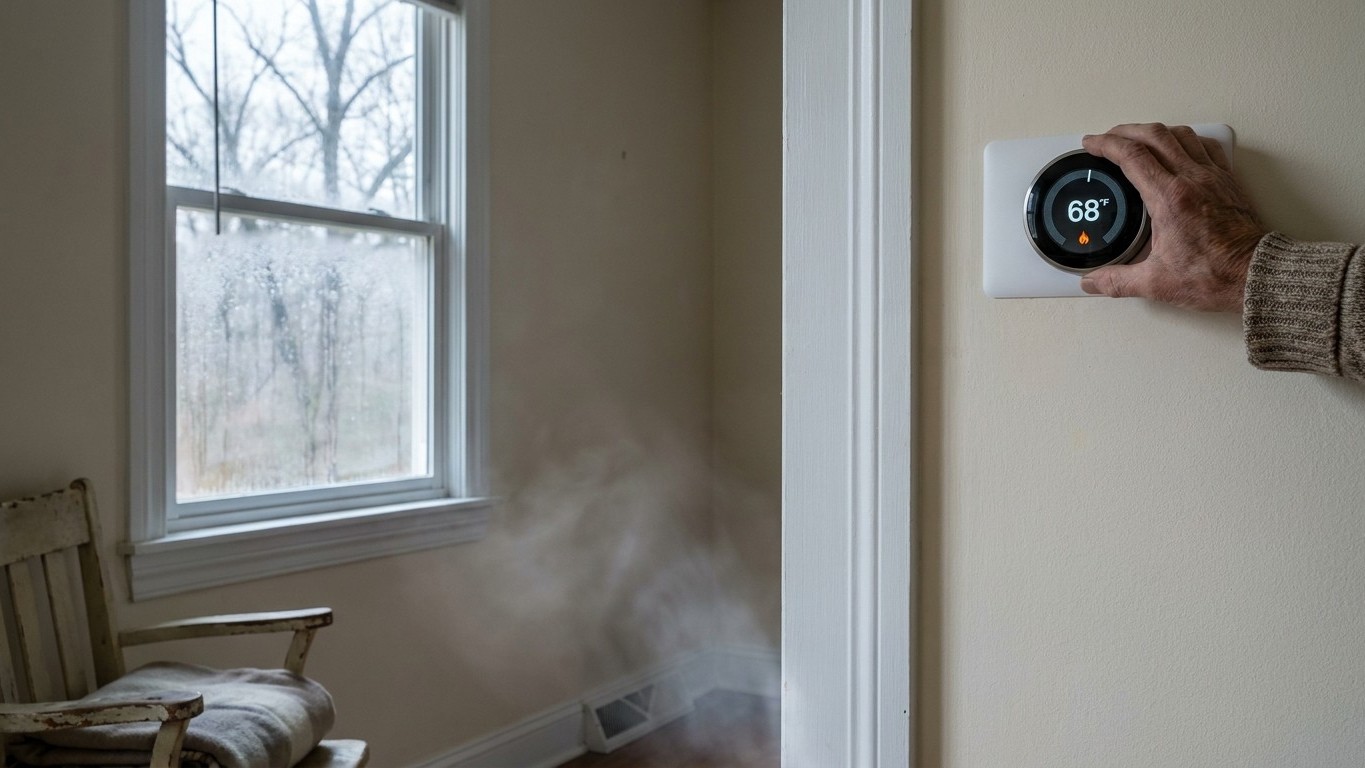

Louisiana winters rarely bite hard, but they linger long enough to matter. A house here doesn’t need to survive a deep freeze so much as it needs to handle months of damp, chilly air that keeps the thermostat working overtime from November into March. Here’s what that actually costs in wood, time, and equipment strain.
How cold it gets, and for how long

The coldest month in Louisiana, using New Orleans as the reference station, has an average daily minimum of 46.1°F. That’s the NOAA Climate Normals figure for 1991-2020, and it’s the number that actually decides how a house behaves in winter, not the record low that shows up in a news headline once a decade.
A mean minimum in the mid-40s tells you something specific: this isn’t a climate of hard freezes and burst pipes so much as a climate of persistent, penetrating chill. Forty-six degrees doesn’t sound dangerous. But a house sitting in that range for weeks at a stretch, often with high humidity riding along, loses heat differently than a house in a dry cold snap. Damp air feels colder than the thermometer suggests, and it makes a furnace or heat pump run in long, low cycles rather than short bursts.
That distinction matters for equipment choice. A heating system sized for occasional deep cold, the kind you’d want in the upper Midwest, is often overkill here. What Louisiana homes actually need is a system that handles steady, moderate demand without short-cycling itself into inefficiency. Heat pumps, which struggle in true sub-zero climates, tend to do well in a state where the coldest month rarely dips much below the mid-40s.
For anyone still supplementing with a wood stove or fireplace insert, that same mild-but-persistent pattern shapes how much fuel gets burned and how fast. A stretch of 46-degree nights doesn’t demand roaring fires. It demands steady, moderate ones, which changes how a household should think about wood supply for the season.
What a cord of wood is worth here
A cord of well-seasoned hardwood delivers about 20 million BTU, according to Michigan State University Extension. That’s an average, not a guarantee, and it swings depending on species and how dry the wood actually is. But it’s the number worth anchoring to before buying anything.
The word “cord” itself is where most firewood buyers get shorted. A cord isn’t a truckload, a rick, or a vague pile. It’s a specific volume: a stack measuring 4 feet by 4 feet by 8 feet, which works out to 128 cubic feet.
| Measurement | Value |
|---|---|
| Cord dimensions | 4 ft x 4 ft x 8 ft |
| Total volume | 128 cubic feet |
| Heat content (seasoned hardwood) | ~20 million BTU |
MSU frames that BTU figure in terms a homeowner can actually use: one cord of seasoned hardwood is roughly equivalent to 145 gallons of #2 fuel oil, or 215 gallons of LP gas. In a climate like Louisiana’s, where the coldest month sits near 46°F rather than deep into the teens, a cord bought in fall can realistically stretch across most of a mild heating season for a household using wood as a supplemental source rather than a sole one.
None of that holds if the wood is wet. Seasoning time is where the real value of a cord gets made or lost, and it deserves its own look.
How long wood takes to dry in Louisiana
Firewood needs to burn at 20 percent moisture or less to deliver its full heat value. Green wood, fresh off the tree, can run over 60 percent moisture, per MSU Extension. That gap between 60 percent and 20 percent is not a minor detail. It’s the difference between a fire that heats a room and one that mostly heats itself.
Every bit of water inside a log has to boil off before the wood releases usable heat. That’s simple physics, but it has a real cost: burning green or under-seasoned wood means a chunk of every log’s energy goes toward evaporating water instead of warming the house. The practical result is a fire that struggles to catch, produces less heat per log, and throws more smoke.
There’s a second cost that shows up later, in the chimney. Wood burned too wet produces more creosote, the sticky residue that builds up in a flue and raises the risk of a chimney fire. A household burning under-seasoned wood all winter will typically need a chimney sweep sooner than one burning properly dried wood, and probably needs to schedule inspections more often as a result.
MSU’s guidance is that split, stacked green wood generally reaches that 20 percent target after one full summer of drying, provided it’s stacked in a way that lets air move through the pile. Split and stacked matters here. Rounds left whole, or wood piled without airflow, take considerably longer and may never fully season before winter arrives. There’s one named exception worth knowing: red oak dries slower than most other hardwoods because of its cell structure, so it needs extra time beyond that one-summer benchmark. Louisiana’s humid, hot summers help the drying process along compared to cooler, damper climates, but they don’t erase the need for proper stacking and airflow. Nobody should assume wood is ready just because a season has passed; it depends on how it was stacked, not just how long it sat.
Where to check before you buy
Louisiana stretches from the coastal parishes up into the northern hill country, and elevation, exposure, and local humidity all shift the numbers above. The 46.1°F figure and the drying guidance in this article reflect New Orleans as the reference point, not every corner of the state equally.
Before buying a cord or planning a season’s wood supply, it’s worth checking with the LSU AgCenter, Louisiana’s land-grant extension service. They can speak to which hardwood species are actually available and well-suited in a given parish, since availability varies a good deal between the piney hills up north and the bottomland hardwoods closer to the coast.
Burn restrictions are worth checking too, and not just once. Air quality advisories and open-burning rules are set at the local or parish level in Louisiana, and they change from year to year based on conditions like drought or ozone alerts. A rule that applied last winter isn’t guaranteed to apply this one. Calling ahead, or checking with a local fire authority or the AgCenter directly, beats assuming last year’s information still holds.