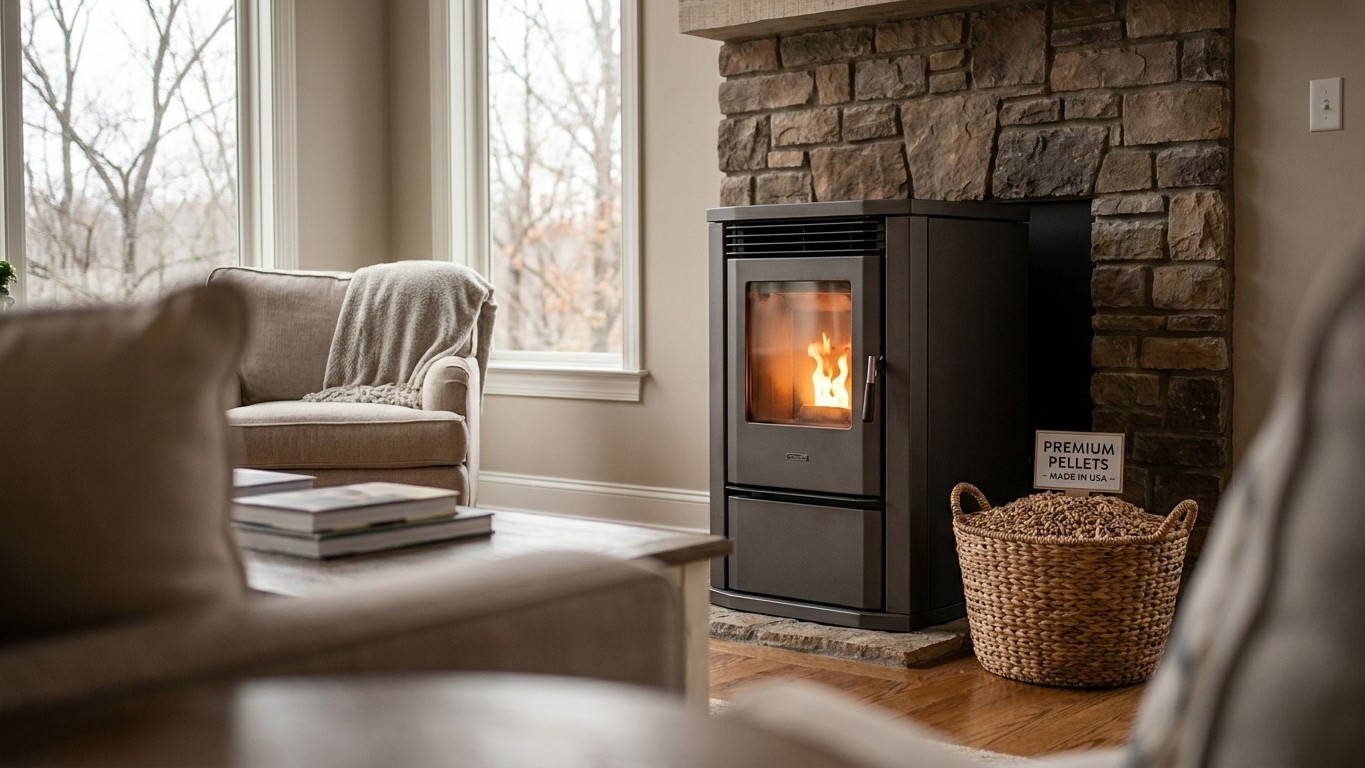

In Louisiana, a pellet stove is best understood as supplemental comfort heat, not a furnace replacement. The state’s heating demand is short and mild compared to most of the country, so the stove earns its keep on cold snaps and shoulder-season evenings rather than carrying a house through a real winter. What changes that answer is where in the state you are, how the house holds heat, and what you’re using for backup when the power drops.
How hard the winter works here

At New Orleans Intl AP, the reference station for southeast Louisiana, the 1991-2020 climate normals put annual heating degree days at about 1,176 (base 65 F), against 3,206 cooling degree days. That ratio tells the real story: this is a cooling climate first, a heating climate second. For comparison, a lot of the Midwest and Northeast runs 5,000 to 7,000 heating degree days a year. Louisiana’s number is a fraction of that, which is the single biggest fact shaping any decision about heating equipment here, pellet stove included.
Depth and length are two different measurements, and it’s worth keeping them separate. The heating season at New Orleans runs about five months, starting in November (the first month whose normal mean temperature, 62.4 F, drops below the 65 F heating base) and ending in April, when the mean climbs back above 65 F. January is the peak, with about 350 degree days that month alone, more than double February’s 226. So the season is moderately long, stretching across five calendar months, but it’s shallow. Cold does show up, and it comes in bursts, but it doesn’t sit on the state the way it does farther north.
Because the degree-day figure is low, the honest answer is that a pellet stove in most of Louisiana functions as a zone heater and an ambiance piece, useful for the living room on a 35-degree January night, not as the thing standing between a household and a cold house. That’s not a knock on the appliance. It just means the sizing, the fuel budget, and the expectations should match a mild climate, not get borrowed from a guide written for Minnesota or Maine.
One more thing to flag: New Orleans Intl AP is one station on the Gulf Coast. Louisiana is a long state, and the northern parishes around Shreveport sit at a meaningfully higher latitude and further from the moderating effect of the Gulf. A household up there should expect a colder, longer heating season than these numbers show, and should treat the New Orleans figures as a floor, not a statewide average.
How many tons a winter takes here
Nobody can hand you a tons-per-winter number for your specific house, but you can build a reasonable estimate from a few fixed facts. A bag of pellets weighs 40 pounds, and fifty bags make a ton, so a ton is 2,000 pounds of fuel. How many of those bags get burned depends directly on how much heat the house actually needs to lose to the outside air, which is exactly what the degree-day figure above measures. Fewer degree days means fewer bags, all else being equal, and Louisiana’s 1,176 sits at a fraction of what colder states report.
What “all else being equal” hides is three variables that can move consumption by a wide margin even between two houses in the same neighborhood:
- How well the house holds heat — an older, drafty house with single-pane windows loses heat far faster than a tightly sealed, well-insulated one, and burns through pellets accordingly.
- Whether the stove is the only heat or a supplement — a household running the stove alongside a central furnace or heat pump, using it mainly in the evenings or in one room, burns a fraction of what a stove-only household does.
- The setting it runs at — a stove dialed to a low or medium burn rate to take the edge off a room uses noticeably less fuel per hour than one run wide open to heat a larger, open floor plan.
No source publishes a tons-per-winter figure by state or city, and for good reason: two houses on the same block, built the same year, can differ by a factor of two once you factor in insulation, air sealing, and how the household actually uses the stove. Any number offered as a Louisiana-specific average would be invented, not measured.
The method that actually works is to count bags. Track how many you burn through your first winter, from the day you start the stove in November through the day you stop it in April, and that number becomes your baseline. It accounts for your house, your habits, and your local weather in a way no published estimate can. For the national math behind the bag-to-ton-to-BTU chain, and a walkthrough of how other households size their first-year purchase, see the site’s main guide on how many pellets a winter takes.
Buying and storing them in this climate
Timing matters more than it sounds. Louisiana’s heating demand starts building in November and peaks in January, so the smart window to buy is before that stretch, ideally over the summer or early fall when demand is lowest and pellets tend to be cheapest. Wait until a cold snap actually arrives and you’re competing with everyone else who waited too, which is exactly when shelves thin out and prices firm up. Buying ahead of the season isn’t just about convenience; it’s about not paying the premium that shows up whenever a hard freeze hits the Gulf South and sends people scrambling for fuel.
Storage is where Louisiana’s climate works against you in a specific way. Wood pellets are compressed sawdust, held together by the natural lignin in the wood itself rather than any added glue or binder. That means moisture is the enemy: pellets that absorb humidity swell, soften, and eventually crumble back into sawdust, losing both their shape and a good share of their heat value. In a state where summer humidity runs high for months at a stretch and where a concrete garage floor can sweat condensation even when it isn’t raining, that’s not a minor risk. Bags stored directly on a slab, in a shed without airflow, or anywhere near a damp exterior wall are vulnerable long before the burning season even starts.
The practical fix is the same one used anywhere humidity is a concern: keep bags off the floor on a pallet, store them in a dry interior space rather than an uninsulated outbuilding, and avoid stacking them against an exterior wall that could carry moisture through. If you’re comparing sources or shopping around, compare by the price per ton, the one figure that actually lets you set two offers side by side; bag counts and bundle deals vary too much to compare directly. For the full rundown on identifying quality pellets and avoiding degraded fuel, and for storage setups suited to different climates, see the site’s national guides on pellet storage and pellet quality.
What a winter outage means here
A pellet stove isn’t a wood stove with a hopper bolted on. It depends on electricity to run the auger that feeds fuel into the firepot and the fan that pushes heat into the room. Cut the power, and the stove goes cold no matter how full the hopper is. That single fact is the main practical tradeoff against a wood-burning stove, and it matters more the harder the winter outside.
In Louisiana’s case, the degree-day figure actually softens this risk somewhat: with a mild heating season centered on New Orleans, an outage during a cold snap is more likely to mean an uncomfortable evening than a genuine heating emergency, since outdoor temperatures rarely stay dangerously low for long. That said, the state’s real power-reliability risk isn’t winter cold, it’s hurricane season overlapping with the shoulder months, and outages here can run longer than a typical winter storm knockout elsewhere. A pellet stove owner in Louisiana should plan around outage duration, not just outage timing.
Worth knowing what most Louisiana households actually lean on day to day: EIA survey data show 57% of homes here use a furnace as their main heating equipment and 21% use a central heat pump, with natural gas as the fuel in 33% of homes and electricity in 62%. Steam or hot-water boilers and fuel oil or kerosene systems weren’t reported in numbers high enough to publish, and the propane estimate was suppressed as unreliable, which means propane heating exists here but the survey can’t put a reliable number on it. So the realistic fallback for most households during a stove-side outage is whatever furnace or heat pump they already run, gas or electric, not a wood-burning backup.
Sizing a generator or a battery to ride out an outage isn’t something to guess at from a state average. Check the wattage rating printed on your stove’s data label, and use that figure, not a rule of thumb, to size any backup power. For a fuller walkthrough of running a pellet stove through a power cut, see the site’s national guide on pellet stoves and outages.