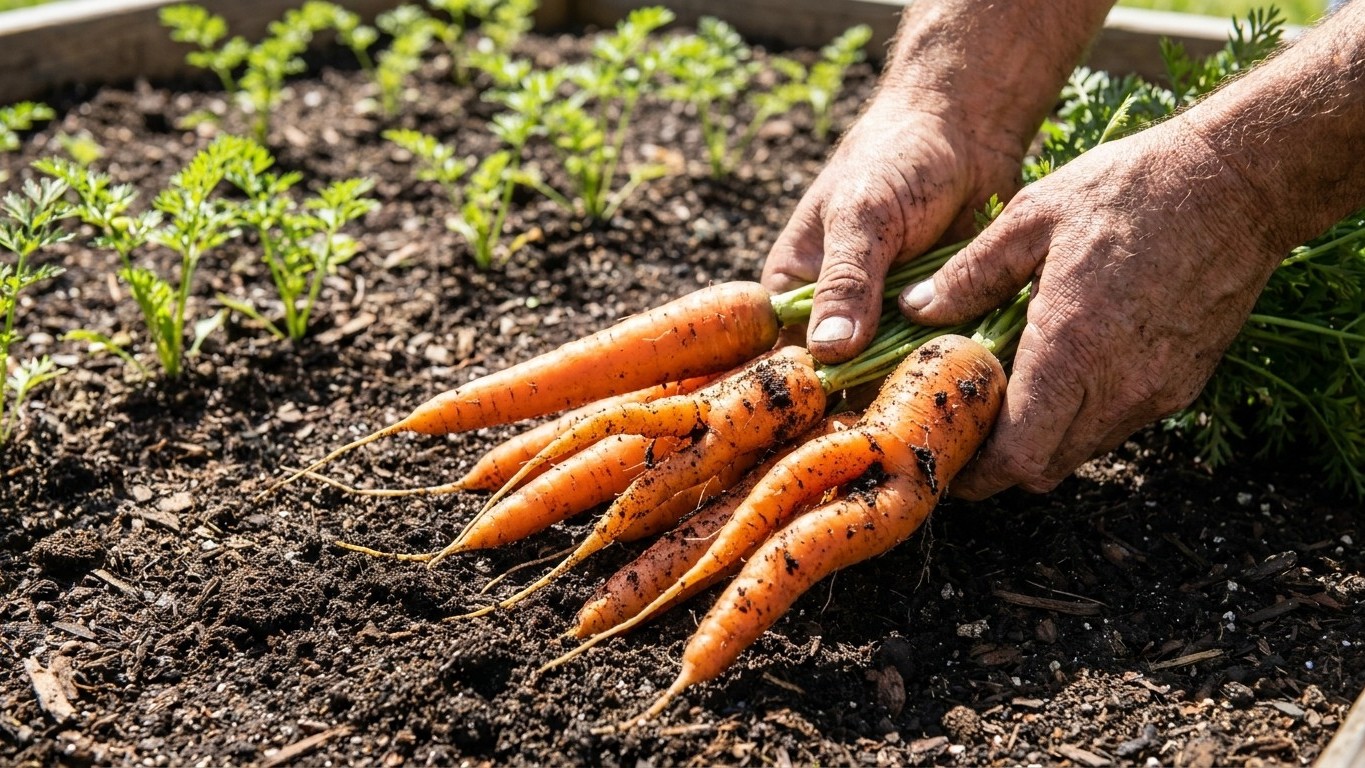

Louisiana gardeners sow carrots by counting back 70 to 100 days from the day they want to pull them, straight from the seeding date, since carrots go into the ground once and stay there. There’s no fixed statewide last-frost date to anchor that count from here; check your own local frost window before you pick a sowing day. What shapes the outcome more than the calendar, though, is what’s under your boots: the state’s dominant ground runs sandy and acid, and that changes how a carrot grows more than a week either way on the schedule.
The short answer
The soil USDA lists as representative of Louisiana is the Ruston series, an Ultisol, meaning it’s old, heavily weathered, and leached of a lot of what plants want. The surface runs slightly acid, with a pH around 5.5, and it’s low in organic matter, sitting near 1.8 percent. Texturally it breaks down to roughly 65 percent sand, 11 percent clay, and 24 percent silt, and it drains well.
That texture is actually good news for a root crop that hates resistance. Utah State University Extension is blunt about what carrots want: deep, sandy, well-drained soil rich in organic matter, with heavy or rocky ground the main cause of a forked root. Ruston’s sand-heavy, low-clay profile is closer to that ideal than what a lot of states start with. A carrot dropped into this kind of ground has a decent shot at growing straight rather than splitting into two skinny legs around a rock or a clay clump.
The catch isn’t texture, it’s fuel and pH. With organic matter under 2 percent and a surface that leans acid, this soil is short on the steady nutrition and moisture-holding capacity carrots use to size up evenly. Working in compost ahead of sowing does double duty here: it feeds a naturally hungry soil and it holds water more evenly through a Louisiana summer, which matters when uneven moisture is what actually splits a carrot root, not just heavy clay. Double digging is less urgent on ground this sandy than it would be on a true clay soil, but loosening the top layer still helps a root push down without meeting compaction.
None of this describes every backyard in the state. Louisiana spans hundreds of mapped soil series, and river-bottom ground, hill country west of the Mississippi, and any lot a builder has cut, filled, or compacted will read nothing like the Ruston profile above. Where a garden does sit on heavier alluvial clay, the forking risk Utah State University Extension warns about is real, and the fix is the same one they name: generous compost and double digging, or skip the argument with the native ground entirely and build a raised bed filled with a lighter mix. Treat the Ruston numbers as a regional starting point, not a reading of your own dirt.
The test that settles it in your own garden
The only way to know what you’re actually planting into is to go dig, right where the carrot bed will sit.
- Dig a hole as deep as your shovel will go, and look at what comes up. Note how far down you hit rock, a hardpan layer, or a sharp color change, since that depth is roughly how far a carrot root will be able to travel before it hits something it can’t push through.
- Pull out a handful from the top layer and squeeze it damp between your fingers. Sandy soil falls apart and feels grainy; clay-heavy soil holds a ribbon shape and feels slick; a loam sits somewhere in between and crumbles loosely.
- Check for stones and clumps by hand, sifting through the loosened soil. Anything a carrot tip could snag on, from gravel to a chunk of old clay, is a candidate for forking later.
- Fill the hole with water and watch what happens. Water that vanishes quickly points to sandy, well-drained ground closer to the Ruston profile; water that sits for a long stretch points to heavier, poorly drained soil that will need raised beds or heavy amendment before carrots go in.
- Repeat the dig in more than one spot in the bed. Soil can change texture within a few feet of itself, especially near a foundation, a driveway, or an old fill line, so one hole isn’t the whole story.
What goes wrong here
- Forking in heavy ground. Where a garden sits on clay-rich soil rather than the sandier state norm, roots meet resistance and split around it. Utah State University Extension’s fix is direct: work in plenty of compost and double dig the bed, or sidestep the native soil altogether with a raised bed.
- Poor germination in a hot spell. Carrot seed is small and sits shallow, and it dries out fast once temperatures climb, especially in sandy ground that drains as quickly as Louisiana’s representative soil does. A light mulch layer over the row and a habit of checking the seedbed daily until seedlings appear keeps that top inch from crusting dry between waterings.
- Splitting from uneven water. A carrot that gets a heavy soak after a dry stretch tends to crack, since the root grows fast to absorb the sudden moisture and the skin can’t keep up. Watering on a steady schedule, rather than letting the bed dry out and then flooding it, keeps growth even through the root.
- Low vigor in nutrient-poor, acid ground. With organic matter around 1.8 percent and a surface pH near 5.5 in the state’s representative soil, carrots can come up thin and pale where the bed hasn’t been amended. Compost worked in ahead of sowing addresses both the fertility gap and the acidity at once.
Common questions
Does Louisiana’s typical soil make carrots fork?
Not from texture alone. The Ruston series that represents the state is sandy and well drained, which is close to what carrots prefer. Forking shows up where a garden sits on heavier, clay-rich ground instead, which is common in river-bottom areas.
How many days do carrots need from sowing to harvest?
Utah State University Extension counts carrots from the seeding date, not from a transplant, since the crop is sown directly where it will grow. Expect roughly 70 to 100 days from seed in the ground to a pullable root.
What’s the fix for clay-heavy garden soil in this state?
Work in a generous amount of compost and double dig the bed before sowing, or build a raised bed and fill it with a lighter mix so the root never has to fight the native clay.
Is the state’s representative soil the same as what’s in my yard?
Likely not exactly. It’s one series among hundreds mapped across Louisiana, and it describes the surface horizon of a mapped soil, not a worked garden bed. Dig your own test hole before trusting any statewide figure.