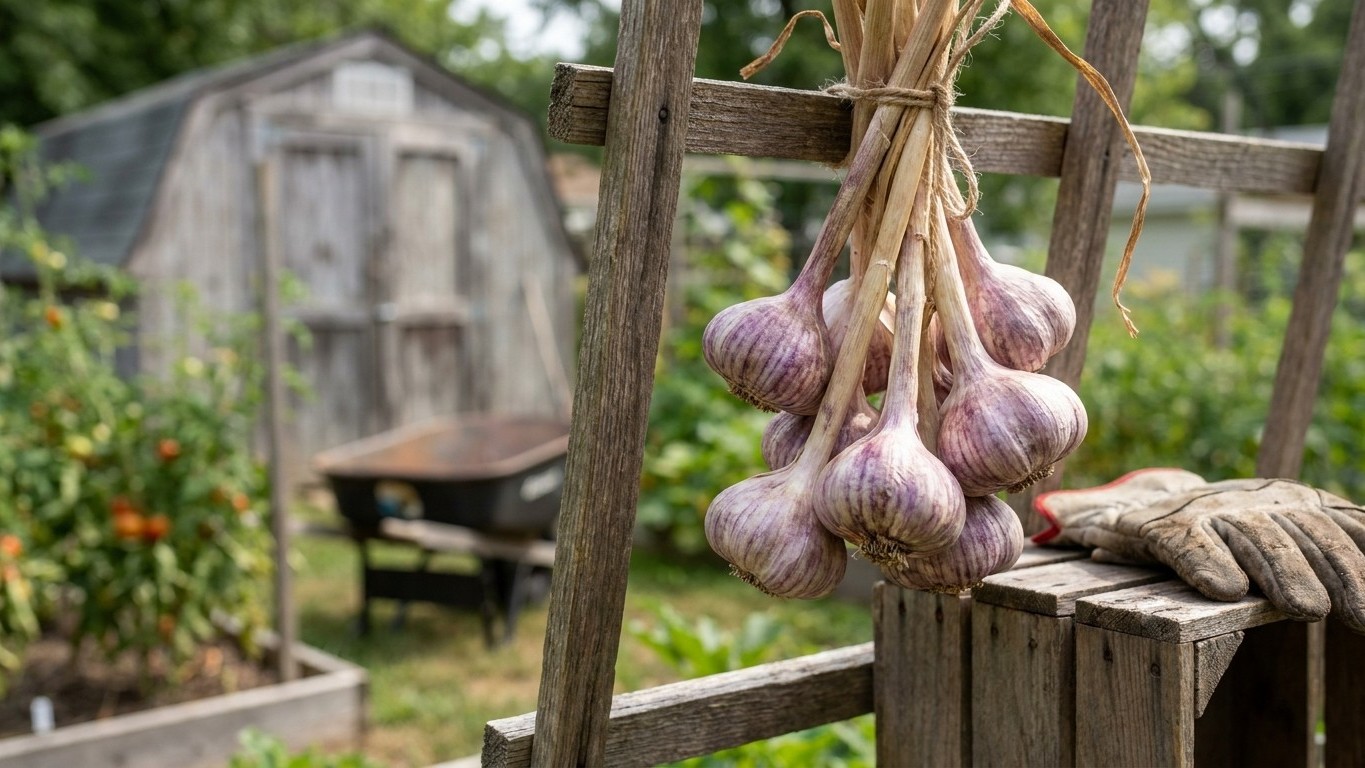

Garlic in Louisiana comes out of the ground earlier than gardeners in cooler states expect, usually as summer heat starts climbing hard, not by the calendar. The signal is the plant itself: lower leaves browning while upper leaves stay green. Pull too late in this climate and bulbs split or rot in humid soil before you even get them curing.
When garlic is ready to lift in Louisiana
Garlic grown here follows the same basic arc as everywhere else: planted in autumn, lifted the following summer. What changes in Louisiana is the pressure on both ends of that cycle. The autumn planting window is tied to the first fall frost, and in this state that date is not a fixed marker on the calendar. According to NOAA NCEI’s 1991-2020 Climate Normals, the first fall frost at 32F falls somewhere between December 17 and January 8, based on the 30 to 70 percent freeze probability band. That’s a midpoint, not a safe date, and in roughly one year out of seven no 32F freeze happens at all in south Louisiana. North Louisiana sees frost far more reliably than the southern parishes do.
That matters for harvest timing because garlic in this state isn’t waiting out a frost the way it does further north. Summer heat, not cold, is the factor that ends the growing season. Louisiana’s early, intense warm-up pushes bulbs toward maturity faster than gardeners moving south from Tennessee or Kentucky usually expect, and it can catch first-time growers off guard when the plants look done weeks before they thought harvest would arrive.
Reading the plant, not the date
The reliable cue is foliage, not a day on a calendar. When the lower third to half of the leaves have gone brown and dry while the upper leaves are still green, the bulb has stopped putting on size and is ready to come up. Waiting for every leaf to collapse usually backfires here: bulb wrappers loosen in the heat and humidity, cloves separate, and what should have been a storage bulb turns into one that needs to be used within days.
Loosen the soil with a fork well outside the bulb’s perimeter before pulling. Yanking by the stem in Louisiana’s often-compacted clay soils snaps necks and bruises bulbs, and a bruised bulb is a bulb that won’t make it through curing, let alone winter storage.
Curing it, and where to hang it here
Curing is what turns a freshly dug bulb into something that stores. The bulb needs to dry down slowly in a spot that’s warm, shaded, and moving air, until the outer wrappers papery over and the neck tightens. In Louisiana, the obstacle isn’t finding warmth. It’s finding warmth without the humidity that comes with it.
A closed garage or a shed with no airflow is the wrong choice here. Louisiana summer air trapped indoors without ventilation stays damp enough that bulbs can mold before they cure, especially if they went into that space with any soil moisture still clinging to the roots. A covered carport, a screened porch, or a barn bay with a box fan running across the bulbs works better, because the airflow matters more than the temperature once the space is out of direct sun and rain.
Setting up the space
Bulbs cure best off the ground, spread out rather than piled, with roots and tops still attached. Braiding or bundling and hanging works if the space has enough air movement to reach every bulb, not just the ones on the outside of the bunch. Elevated screens or mesh trays let air pass underneath as well as over the top, which speeds drying in Louisiana’s sticky air far more than a flat table surface does.
Check bulbs partway through curing for any that feel soft or show dark, wet spots at the neck. Those need to be pulled out and used immediately. In this climate, one soft bulb sitting against dry ones for a few extra humid days can spread rot before you notice.
Storing it through a Louisiana winter
Once the necks are dry and papery and the outer skins rustle rather than feel damp, trim the roots and tops (leaving an inch or two of neck if you plan to braid) and move bulbs to storage. The mistake a lot of Louisiana gardeners make here is thinking about winter storage the way someone in Minnesota would: worrying about cold. That’s not the risk in this state.
Because the region barely freezes, per the same NOAA NCEI data showing a fall freeze skipped entirely in roughly one year in seven in south Louisiana, an unheated shed or garage doesn’t get cold enough in winter to hurt garlic. What it does get is humid, and humidity is what shortens storage life. Bulbs held in a damp shed will soften and sprout faster than bulbs held in a dry closet inside an air-conditioned or heated home, even though the shed is technically cooler.
A dark, dry interior space, an inside closet, a pantry shelf away from the stove’s steam, a climate-controlled utility room, works better here than the traditional root cellar or unheated outbuilding that gets recommended in colder-climate guides. Mesh bags, paper bags, or loosely woven baskets that let air circulate beat sealed plastic containers, which trap the humidity Louisiana air already has plenty of.
Check stored bulbs periodically through the winter and pull any that start softening or sprouting so they don’t affect the rest. Bulbs held aside for the next planting should be kept separate from the ones set aside for eating, so a sorting mistake doesn’t cost you next year’s seed stock.
What goes wrong here
Most garlic problems in this state trace back to moisture, not cold and not, based on what’s documented for this territory, insect pressure on the bulb itself. LSU AgCenter’s pest documentation for home gardens in this region centers on other crops, including cowpea curculio, crape myrtle bark scale, fall armyworm, leaf-footed bug, pepper weevil, pickleworm, squash bug, squash vine borer, tomato pinworm, and vegetable weevil. None of those are documented as garlic bulb pests here. That’s worth noting precisely because it points the finger where it belongs: at humidity and heat management, not at bugs in the bin.
The most common failure is curing garlic in a closed, humid space and finding mold on the wrappers a week or two in. The fix is airflow, always, before anything else. If the space you’re using doesn’t move air, the bulbs will hold moisture no matter how warm it is.
The second common failure is leaving bulbs in the ground too long once the heat has already turned on for the season. Split bulbs, loose wrappers, and cloves that have started to separate from each other are all signs of a harvest that happened too late for Louisiana’s compressed spring-into-summer window.
The third is storing cured garlic somewhere that feels cool but stays damp, a shed, an unconditioned garage, an outdoor closet. Bulbs there soften and sprout months earlier than bulbs kept in a dry indoor space, even if the outdoor spot never comes close to freezing.
Gardeners in this state who want localized planting-date and variety guidance can check the LSU AgCenter for parish-level extension support.
Common questions
Can hardneck garlic grow well in south Louisiana?
South Louisiana’s mild winters mean cold exposure is limited compared to northern states, and the region rarely sees a hard freeze at all in some years, per the NOAA NCEI data above. This favors softneck types over hardnecks in the southern parishes; north Louisiana’s more reliable cold gives hardnecks a better shot.
What happens if I harvest garlic too late in Louisiana?
Bulbs left in the ground once summer heat sets in tend to split, loosen their wrappers, and separate into individual cloves underground. Those bulbs don’t cure or store well and should be used quickly rather than saved for winter.
Do I really need to cure garlic given how humid it is here?
Yes, curing is more necessary in a humid climate, not less. Skipping it or rushing it in a damp, closed space is what leads to mold and rot. The goal is airflow and shade, not skipping the drying step altogether.
Where can I get planting dates specific to my parish?
The LSU AgCenter extension service publishes parish-specific guidance for home vegetable gardeners across the state, including regional differences between north and south Louisiana.