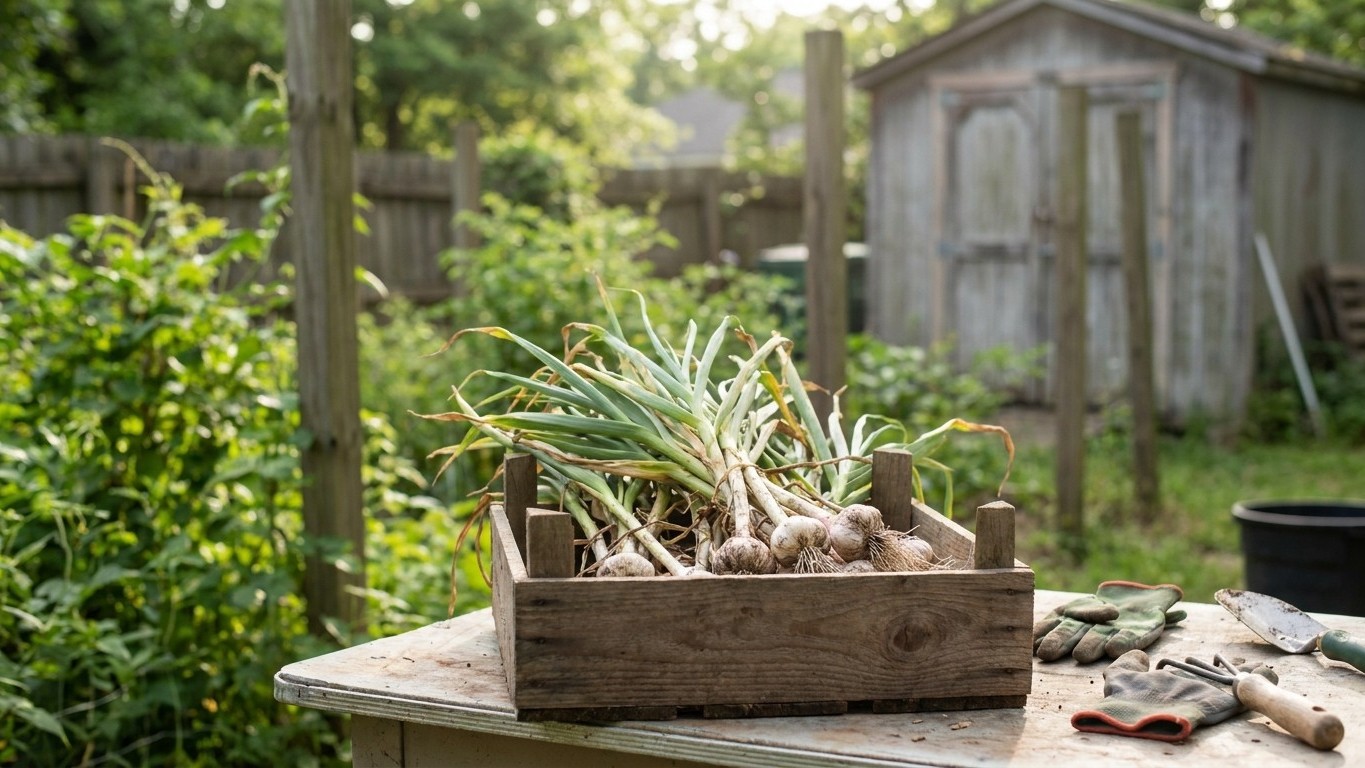

Garlic goes into Louisiana ground from late November through mid December, timed off the first fall frost that NOAA’s 1991-2020 Climate Normals place between December 17 and January 8 near New Orleans. That date is a midpoint the freeze doesn’t reliably keep: the same station records no 32°F freeze at all in roughly one year out of seven. Loosen your bed and get cloves planted by December’s second week rather than waiting on a hard freeze that may never show up this far south.
The short answer for Louisiana

Standing there looking at that bed, you’re probably asking the same thing every Louisiana gardener asks: is it too early, or already too late? It’s neither, most likely — garlic here goes in the ground anywhere from late November through mid December, well before any real freeze shows up. So the one thing to do today is loosen and drain that soil now, so it’s ready the moment you’re within that window, instead of holding cloves back and waiting on cold weather that this far south might not fully arrive at all.
- Softneck: Early Red Italian, Inchelium Red, Italian Late, Lorz Italian, set out late November to mid December.
- Hardneck: Bavarian Purple, Blue Music, Chesnok Red, Duganski, Fall Festival, Georgian Crystal, Georgian Fire, German Red, German White, Ivan, same late November to mid December window.
That window moves for two reasons. First, the frost date itself is a range, not a day. NOAA’s normals show a 32°F freeze occurring in only 86.8 percent of years at the New Orleans-area station, so roughly one year in seven skips a freeze entirely, and in about half of all years the first freeze lands later than the midpoint given here. Second, the New Orleans figure describes the coast, not the whole state. A grower in the hill country of north Louisiana works from a colder, more consistent pattern and should pull NOAA’s normals for a station closer to home before locking in a date.
Working it out for your own garden
The arithmetic behind that window is simple even though the climate underneath it is not. Start from your local frost midpoint, then count back roughly three to four weeks to land on a set-out date that gives cloves time to grow roots before winter’s coldest stretch, whatever that stretch turns out to be. Near New Orleans, NOAA’s 1991-2020 Normals put that midpoint at December 17 to January 8. Counting back three to four weeks from the early end of that range lands in late November, and counting back the same three to four weeks from the late end lands in mid December, which is exactly the catalogue window used above.
Growers outside the New Orleans area need their own frost figure before running this arithmetic themselves. Pull the normals for the station nearest your own parish and repeat the same three-to-four-week count back, rather than borrowing the New Orleans window wholesale.
Local features that shift the count
Louisiana is not one climate, and a few features move local frost timing by roughly two weeks in either direction: elevation, a large body of water, and distance from the coast. Higher ground in the north cools off faster on a clear night than the flat delta soils further south. A large lake moderates the shoreline immediately around it, the way Lake Pontchartrain softens the first cold snaps right on its banks compared with parishes only a short drive inland. Coastal exposure works the other way. Onshore Gulf air keeps the immediate coast the mildest ground in the state, and also the most likely to skip a freeze entirely in a given year.
None of this changes the deeper limit on garlic here. The University of Georgia Extension, publication C854, states garlic needs six to eight weeks of temperatures below 40°F after planting for the clove to split properly into a bulb. Measured at the New Orleans-area station, that count comes to zero weeks in an average winter. Counting back from frost gets the planting date right. It does not supply cold the season doesn’t have, and no adjustment to that date fixes the shortfall on its own.
What changes across Louisiana
South Louisiana, from the New Orleans area down through the coastal parishes, has the mildest and least reliable winters in the state. NOAA’s 1991-2020 Normals for the New Orleans-area station show a 32°F freeze in only 86.8 percent of years, which means a coastal grower should expect a freeze-free winter roughly once every seven years and should not plan a planting date around a freeze showing up at all.
North Louisiana, the hill country around Shreveport and Monroe, runs on a different pattern. Clay soils there hold less of the humidity buffering that softens the coastal marsh, and the ground sits farther from the moderating Gulf, so nights cool off faster and the first freeze tends to arrive earlier and more consistently than at New Orleans. A grower there should check NOAA’s normals for a station near their own parish rather than use the New Orleans window, since the two can run well over a week apart.
Central Louisiana, the corridor through Alexandria and the Kisatchie hill country, sits between those two patterns, colder than the coast and milder than the far north. Lake Pontchartrain has its own local effect too, softening the first frosts right along its shore compared with inland Livingston or Tangipahoa parishes only a short drive away. None of these shifts change the six-to-eight-week cold requirement described above, since even north Louisiana’s colder winters run short of that mark most years. What changes is only when the first frost arrives, not whether the season ever gets genuinely cold.
The mistakes this climate punishes
The costliest mistake in a mild Louisiana winter is planting a hardneck variety and expecting it to perform the way it does farther north. Hardnecks such as German White, Georgian Crystal, and Duganski come from stock bred against a real winter, and the six to eight weeks of sub-40°F weather the University of Georgia Extension says they need to split properly, publication C854, simply isn’t there most years at the New Orleans-area station, where the same measure comes to zero weeks. Softnecks such as Early Red Italian, Inchelium Red, Italian Late, and Lorz Italian tolerate that shortfall far better and are the steadier bet for a Louisiana bed most winters. A grower still curious about the hardnecks can compare the full lineup in Garlic Varieties That Suit Louisiana Winters before ordering seed stock.
Disease risk tied to planting timing
Timing also decides which soil-borne diseases have the weather they favor. UC IPM’s Pest Management Guidelines for onion and garlic, UC ANR Publication 3453, publish temperature ranges for four of the main culprits, measured as soil temperature. The counts below use Louisiana’s monthly mean air temperature as a rough stand-in, which lags soil by weeks and swings less from day to day than the mean suggests.
| Disease | Pathogen | Published range | Months in range, Sept-July |
|---|---|---|---|
| Fusarium basal rot | Fusarium oxysporum f. sp. cepae | 59-90°F | 8 months, incl. 2 at optimum |
| White rot | Sclerotium cepivorum | 50-75°F | 7 months, incl. 2 at optimum |
| Pink root | Setophoma terrestris | 75-85°F, optimum | 4 months, all at optimum |
| Southern blight | Sclerotium rolfsii | 86-95°F, optimum | 0 months at optimum |
A count of zero months for southern blight does not mean the disease is off the table here, since infected planting stock carries it regardless of weather; it only means the climate isn’t actively pushing it. Fusarium basal rot sits inside its published range for eight months of the growing season, including the September through November stretch when cloves go in the ground, which is one more reason to plant into loosened, well-drained soil rather than heavy ground that stays wet, and to start with clean seed stock rather than saved bulbs of unknown history.
The second mistake this climate punishes is planting late enough, or shallow enough, that cloves haven’t rooted before whatever cold arrives. Roots need those first several weeks of cool, moist soil to establish before any freeze event, mild or not. A clove planted in late December with only sparse roots going into January is more exposed to a hard freeze than one planted on schedule in late November, even though that freeze may never come at all.
Checking this against your county
Before you commit to a planting date, check current freeze data and any parish-level guidance from the LSU AgCenter, the state’s land-grant extension service, which can connect you with an agent and any variety trials run closer to your own soil.
A local agent can also tell you whether basal rot or white rot has turned up in garlic beds in your area recently, information that doesn’t show up in a climate normal but matters just as much when you’re choosing where in the garden to plant.
Common questions
Can I Plant Garlic in Louisiana in the spring instead of fall?
No. Garlic in Louisiana goes in during autumn and gets lifted the following summer, and a spring planting skips the cool weeks the clove needs to root and begin splitting. Bulbs from a spring planting are usually small and often fail to divide into cloves at all.
Should I refrigerate my garlic before planting since Louisiana winters are so mild?
Some Gulf South growers chill cloves in the refrigerator for several weeks before planting to make up for the cold the season doesn’t reliably deliver, given how far short local winters fall of the six to eight weeks below 40°F that garlic needs. Ask the LSU AgCenter for current guidance on this practice before you try it, since handling and timing details matter.
What happens if I miss the mid-December window?
A clove planted into January can still grow, but it starts with fewer cool weeks to establish roots before spring warmth arrives. Since a hard freeze isn’t reliable here anyway, the bigger risk of a late planting is running out of cool weather before summer heat sets in, not frost damage.
Will a mild winter ruin my garlic crop?
A mild winter hurts bulb size more than a hard freeze would help it, because garlic needs sustained cold below 40°F to split into cloves and Louisiana winters routinely fall short of that. Summer heat after lifting is usually the bigger threat to the crop overall, since garlic here is fighting a shortage of cold, not a surplus of it.
If you follow the almanac, here is when to plant garlic by the moon. It is a tradition, not a proven method.