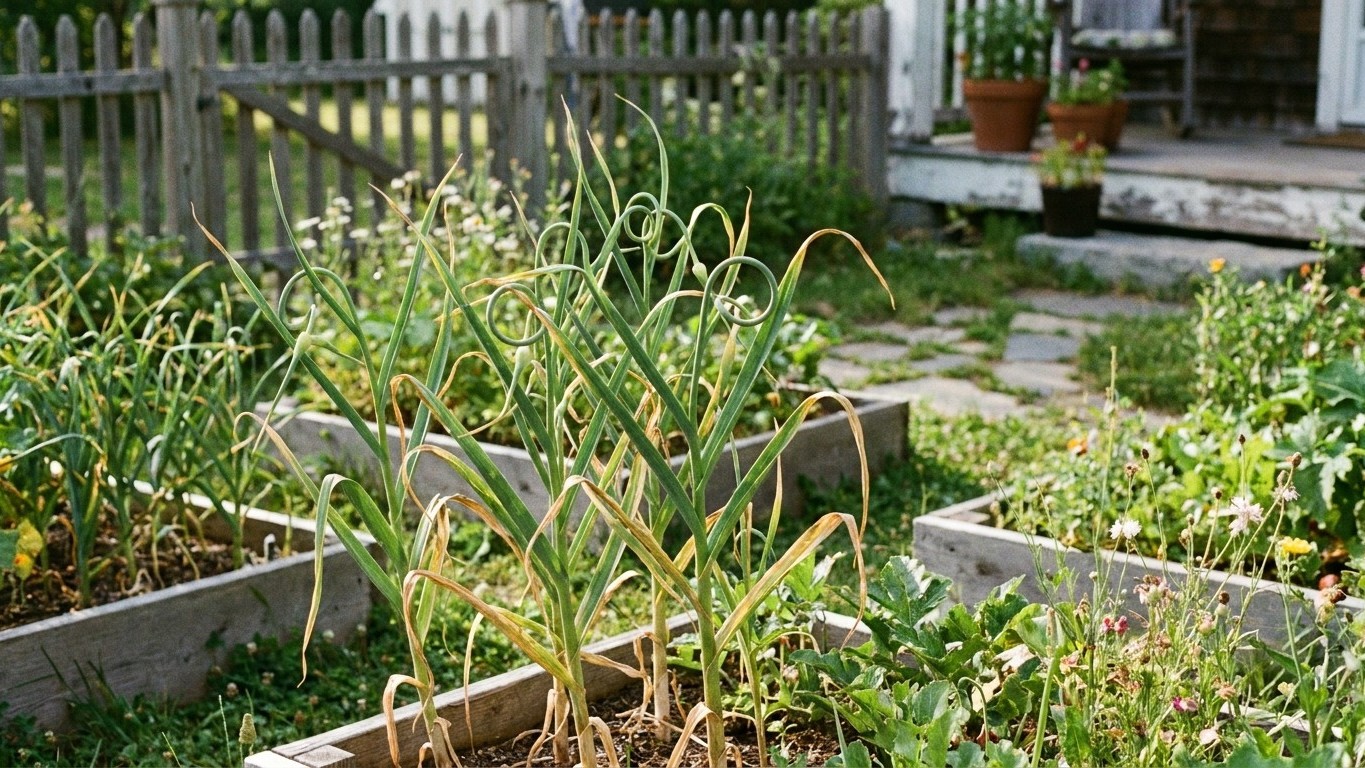

Mid-September in Portland is the moment to get cloves in the ground, three to four weeks before the first fall freeze typically arrives between October 9 and 21. Maine’s winters run cold enough, and long enough, to satisfy any garlic’s chilling needs several times over — the real test is exposure. Bulbs left in wind-scoured, poorly mulched beds can heave right out of frozen soil, which is why hardneck types dominate the varieties that hold up here.
The short answer for Maine

Plant garlic cloves mid-September to late-September, the same window every variety in Maine’s catalogue calls for. That range is anchored on NOAA’s 1991-2020 Climate Normals, which put Portland’s first fall freeze at October 9 to October 21 (NOAA NCEI). Getting cloves into loosened, well-drained soil a few weeks ahead of that freeze gives roots time to establish before the ground goes cold, without pushing top growth that an early hard freeze would burn back.
A frost date is a midpoint, not a guarantee. In roughly half of all years on record, Portland’s first fall freeze arrives after October 21, and in the other half it lands before October 9. Treat the September planting window as the safe target, not a deadline to push right up against.
Winter cold is not the bottleneck. Portland logs 30.4 weeks with mean air temperatures below 40°F each year, according to University of Georgia Extension bulletin C854, which lists six to eight weeks of cold as what a planted clove needs to split into a full head by summer. Maine’s winter clears that bar several times over, so variety choice comes down less to whether a clove will split and more to which type survives an exposed, wind-scoured winter without heaving out of the ground.
That favors hardneck types. Ten of the fourteen varieties commonly planted in Maine, including Duganski, German White and Georgian Fire, are hardnecks descended from stock that overwinters in cold, continental climates. Softnecks such as Inchelium Red and Lorz Italian still work, especially in a sheltered coastal bed, but carry more risk in an exposed inland garden. See Growing Garlic in Maine for the bed prep and mulch steps that come before planting day.
| Variety | Neck type | Set-out window |
|---|---|---|
| Early Red Italian | Softneck | Mid to late September |
| Inchelium Red | Softneck | Mid to late September |
| Italian Late | Softneck | Mid to late September |
| Lorz Italian | Softneck | Mid to late September |
| Bavarian Purple | Hardneck | Mid to late September |
| Blue Music | Hardneck | Mid to late September |
| Chesnok Red | Hardneck | Mid to late September |
| Duganski | Hardneck | Mid to late September |
| Fall Festival | Hardneck | Mid to late September |
| Georgian Crystal | Hardneck | Mid to late September |
| Georgian Fire | Hardneck | Mid to late September |
| German Red | Hardneck | Mid to late September |
| German White | Hardneck | Mid to late September |
| Ivan | Hardneck | Mid to late September |
Working it out for your own garden
The mid-September to late-September window is worked backward from a frost date that itself moves by about two weeks in either direction. NOAA’s 1991-2020 Climate Normals report that range, October 9 to October 21, for Portland specifically. If your own site runs warmer or colder than that reference station, redo the arithmetic with your own likely frost range in place of Portland’s.
Counting back from frost
Start from your area’s expected first freeze, not Portland’s. Subtract roughly a few weeks and you land on your set-out window, the same arithmetic that produces the mid-September to late-September range for the reference city: subtract from October 9 and you land in mid-September, subtract from October 21 and you land in late September. A garden that freezes two weeks earlier than Portland needs cloves in the ground two weeks earlier too.
The six to eight weeks of cold a clove needs afterward to split into a full head, the figure University of Georgia Extension bulletin C854 gives, is a separate clock. It starts on planting day and runs through winter, not from the frost date itself. Because Portland alone logs 30.4 weeks below 40°F in an average year by that same source, there’s slack in this part of the calculation almost everywhere in the state. The tighter constraint is root establishment before the ground locks up, which is why the frost-date arithmetic matters more than the cold-hours arithmetic when you’re choosing a planting day.
For the full walkthrough, including how to adjust week by week for your own site, see When to Plant Garlic in Maine: Counting Back From the First Frost.
What moves the date at your site
Elevation cools a site faster than the surrounding lowland. A large lake holds heat into the fall and can push a nearby garden’s frost date later than a hilltop a few miles off. The coast behaves the same way through the ocean’s thermal mass, staying frost-free longer than inland ground at the same latitude. Exposure matters too. A garden on an open ridge loses heat faster after sundown than one tucked against a hedge or a building, even at the same elevation and distance from the coast. None of these effects are quantified for every town in the data available here, so treat the Portland figures as a starting point and adjust by roughly the two weeks either direction that elevation, a lake, or the shoreline typically buys or costs.
What changes across Maine
Coastal Maine, the stretch NOAA’s Portland station represents, runs the mildest fall and spring in the state. Inland and northern Maine run substantially later in spring and earlier in fall than that coastal reference, because the ocean’s moderating effect fades a short distance from the shoreline.
Aroostook County and the western mountains sit furthest from that coastal buffer and carry the state’s earliest fall frosts and latest spring ones. A grower there working from the Portland-based window in this article should expect to plant closer to early September than late September, shifting the whole range earlier rather than picking a single day out of it.
The Kennebec and Penobscot river valleys sit in between, cooling faster than the coast but not as fast as the northern counties. Local frost pockets form wherever cold air settles into a low spot on a still night, which matters more for garlic timing than the county line on a map. A garden in a valley bottom can run a week or two behind a garden a few hundred feet higher on the same hillside.
None of this changes which varieties survive the winter, since Maine’s cold clears the six-to-eight-week clove-splitting requirement everywhere in the state by University of Georgia Extension’s C854 figures. It changes only the calendar, not the variety list.
The mistakes this climate punishes
The most common failure in a Maine garlic bed isn’t a rare disease. It’s a mismatch between variety and site, or a planting date that leaves cloves too little time to root before winter shuts the ground down.
- Planting a softneck in an exposed, unmulched inland bed and losing it to a hard freeze that a hardneck would have shrugged off.
- Planting after the late-September end of the window because the fall felt mild, then losing cloves to frost heaving once a hard freeze finally arrives with no root system to hold them in place.
- Planting too shallow. A clove sitting close to the surface heaves out of loosening, freeze-thaw soil over winter even if it rooted well in fall.
- Skipping mulch on a new bed. A thick straw layer buffers the freeze-thaw cycles that cause heaving, and it matters more in Maine’s winter than in a milder state’s.
Reading the disease numbers correctly
There’s a quieter mistake: assuming a cold winter rules out fungal disease in seed stock. It doesn’t. White rot, caused by the pathogen Sclerotium cepivorum, has a published air temperature range of 50 to 75°F, and Maine’s growing-season mean air temperature falls inside that range in four separate months, September, May, June and July, according to the University of California’s IPM Pest Management Guidelines for Onion and Garlic (UC ANR Publication 3453). Two of those months sit at the pathogen’s actual optimum. Fusarium basal rot, caused by Fusarium oxysporum f. sp. cepae, has a published range of 59 to 90°F that Maine’s air temperature falls inside during three months of the growing season.
Those thresholds are published for soil temperature, not air temperature, and soil lags behind air by weeks and swings less over a season. A monthly average also hides the daily swing: a month averaging inside a pathogen’s range still holds days well outside it. And the count above comes from one reference station, not the whole state. None of this means Maine’s winter protects a garlic bed from either disease. Both pathogens travel in infected planting stock regardless of climate, which is why buying certified disease-free seed garlic matters more than picking a variety for cold hardiness alone.
Checking this against your county
Every figure in this article comes from a single Portland-area weather station. Your county’s Cooperative Extension office can supply a frost date and soil condition specific to your town, which matters more than a statewide range when you’re settling on a planting day. Contact UMaine Extension for county-level guidance before finalizing your date, especially if you garden in Aroostook, Franklin, or another inland or northern county where the Portland figures understate how early fall arrives.
Bring your elevation, your distance from the coast, and any local frost history you’ve tracked yourself. That combination narrows the range in this article to something closer to a usable date for your own garden.
Common questions
Is it too late to plant garlic in Maine if I missed the September window?
Late is better than never in most years, but expect a smaller harvest. Cloves planted into October have less time to root before the ground cools, and the frost heave risk described above rises the later you go. If the ground isn’t frozen yet, plant anyway and add extra mulch, but don’t count on the same yield as a cleanly timed September planting.
Can I replant cloves from my own garlic instead of buying new seed stock every year?
You can, and plenty of Maine growers do, but it raises the risk of carrying a soil-borne problem like white rot or fusarium basal rot over from one season to the next, since infected cloves don’t always show symptoms before you replant them. Buying certified disease-free stock every few years resets that risk.
Can I grow softneck garlic in Maine, or is it hardneck-only country?
Softneck varieties like Italian Late and Early Red Italian grow here fine, and they’re the ones you braid. They just carry more winter risk in an exposed inland bed than hardnecks do, so give them a sheltered spot and a heavier mulch layer if you want the braid without gaps in your row.
Does “hardneck” mean a variety is more cold-hardy, or is that just the name?
The name refers to the stiff woody stalk hardneck varieties send up through the center, not directly to cold tolerance. In practice, though, hardneck types were bred from stock that overwinters in harsh continental climates, which is part of why growers in cold states lean on them anyway.