
In New Orleans and the rest of south Louisiana, potatoes go into the ground weeks before anyone’s last frost passes, not after it. NOAA’s 1991-2020 Climate Normals put that freeze date, for a station near New Orleans, somewhere between January 18 and February 8. But frost isn’t really the limit down here. Soil temperature is what starts the clock, and summer heat is what ends the season early.
The short answer
NOAA NCEI’s 1991-2020 Climate Normals, drawn from station USW00012916 near New Orleans, place the last spring freeze in a window between January 18 and February 8. That’s the 30 to 70 percent probability band for a 32°F freeze, meaning there’s real spread from one year to the next, and the station only sees a freeze at all in 86.8 percent of years. Roughly one year in seven, south Louisiana never freezes. The fall version of that same window straddles the New Year, which tells you how mild this climate runs compared to most of the country’s potato-growing regions.
That unreliability is exactly why counting back from frost, the standard method used almost everywhere else, doesn’t work cleanly here. Potatoes are planted as soon as soil reaches 50°F, which lands 14 to 21 days before the last frost date, according to Utah State University Extension and the University of Maine Cooperative Extension. Apply that math to the New Orleans-area window and soil-based planting falls in very early January for a lot of home gardens, sometimes before the calendar year even turns over in the way gardeners in colder states expect.
North Louisiana sees a noticeably more dependable freeze pattern than the coast, but the exact date for that region isn’t part of the station data used on this page, so it won’t be guessed at here. What matters for reasoning through any Louisiana parish is the same: check the soil, not the frost forecast, and treat the frost window as a loose guide rather than a hard trigger.
The bigger constraint for the whole state, coast to hill country, is the other end of the season. Tuber set and fill shut down once soil temperatures climb above 90°F, per both extension sources, and no amount of irrigation reverses that. In south Louisiana, where summer heat arrives early and stays late, that ceiling does more to define the planting calendar than any frost date ever could.
What actually decides it
Soil temperature, not the calendar
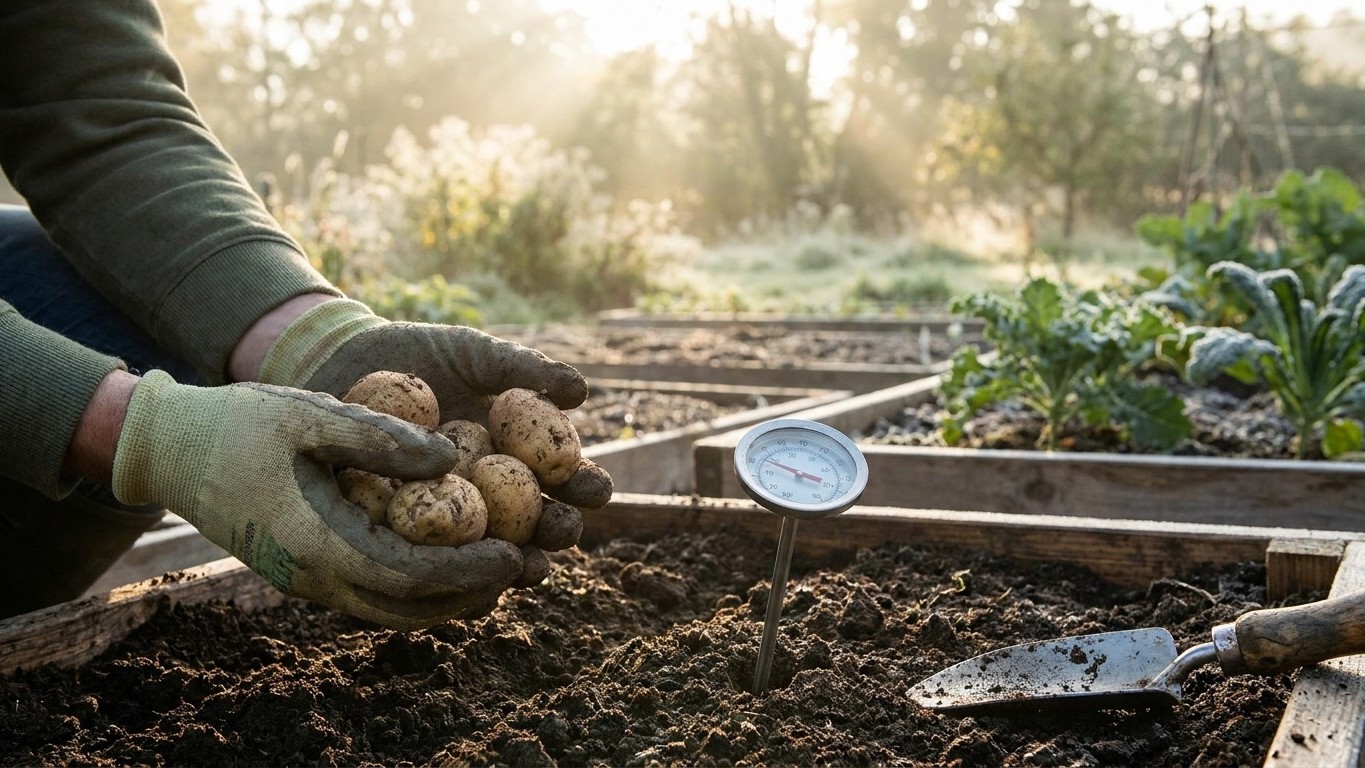
Potatoes are planted once soil reaches 50°F, a threshold that typically arrives 14 to 21 days ahead of the last frost date, per Utah State University Extension and the University of Maine Cooperative Extension. That’s a soil reading, taken with a probe thermometer a few inches down, not an air temperature and not a date circled on a calendar. Two properties a few miles apart, one in sandy, well-drained soil and one in heavy clay that holds cold, can hit 50°F on different days even under the same air temperature. That’s the variable a frost-date chart can never capture.
The heat ceiling that ends the season
The mechanism that actually governs a Louisiana potato crop sits at the other end of the thermometer. Above 90°F soil temperature, tuber set and fill are inhibited, according to both extension sources, and that inhibition doesn’t respond to extra watering. This is the fact that should reorganize how anyone in a hot-summer state thinks about potatoes: the crop isn’t limited by how late you can plant in spring, it’s limited by how fast summer heat closes the window behind you. A gardener two counties over from any weather station can apply this same ceiling without needing local frost data at all, because it’s a soil-temperature rule, not a location-specific date.
Why the frost record barely applies here
With a freeze occurring in only 86.8 percent of years at the New Orleans-area station, and the fall frost window sliding across the New Year, south Louisiana’s climate record behaves less like a hard boundary and more like a probability cloud. That reshapes the whole planning exercise. Instead of asking “when is my last frost,” the more useful question in this climate becomes “how many weeks do I have between soil hitting 50°F and soil crossing 90°F,” because that gap, not the frost date, is the entire growing window a spring-planted potato gets.
How to do it
- Start checking soil temperature with a probe thermometer, a few inches deep, in the weeks leading into the NOAA last-frost window for the region.
- Wait until the soil reads a consistent 50°F rather than acting on a single warm afternoon.
- Buy certified seed potatoes rather than grocery-store tubers or leftover seed from a prior season; uncertified stock carries virus that grocery potatoes are never screened for.
- Select a season class, early, mid-season, or late, based on how much runway exists before soil temperatures are likely to climb past 90°F in the local area.
- Plant 14 to 21 days before the region’s last-frost window closes, using the 50°F soil reading as the real trigger rather than the frost date itself.
- Continue monitoring soil temperature through the growing season as heat builds.
- Dig the crop before soil temperatures settle above 90°F for extended stretches, since tuber set and fill stop once that threshold is crossed and won’t resume with more water.
What goes wrong
- Waiting for a frost date that may never arrive. With a freeze recorded in only 86.8 percent of years at the New Orleans-area station, gardeners who wait for a killing frost as a planting cue can lose weeks or plant too late for the crop to finish before summer heat sets in. Use the 50°F soil threshold instead of waiting on frost.
- Planting by calendar date instead of soil reading. A date that worked one year can fall on cold, wet soil the next, delaying emergence and inviting rot. Check soil temperature directly rather than relying on the same date every season.
- Using uncertified seed potatoes. Seed saved from a grocery bag or a neighbor’s leftover stock frequently carries virus that reduces yield and vigor. Buy certified seed potatoes specifically labeled as such.
- Letting the crop run into 90°F soil. Once soil crosses that threshold, tuber set and fill stop, and extra irrigation doesn’t reverse it. Choose an early season class and dig before summer heat locks in, treating the Louisiana potato crop as a spring harvest rather than a summer-long one.
- Assuming north and south Louisiana share one schedule. The freeze data used here comes from a single station near New Orleans; north Louisiana’s freeze pattern runs more reliably but isn’t part of this data set. Apply the 50°F and 90°F soil rules locally rather than borrowing a coastal frost date for an inland garden.
Common questions
Can potatoes be planted in fall in Louisiana?
The fall frost window at the New Orleans-area station straddles the New Year, which makes fall planting a narrow and unpredictable option in south Louisiana specifically. The extension sources used here focus on the spring soil-temperature rule (50°F to plant, 90°F as the heat ceiling), and that same soil logic applies whenever a fall attempt is considered.
What potato season class handles Louisiana’s climate best?
Neither Utah State University Extension nor the University of Maine Cooperative Extension publishes a maturity-day figure, but both identify season classes: early, mid-season, and late. In a state where soil crosses 90°F relatively early in the year, an early season class gives the crop the best chance of finishing tuber fill before that heat ceiling shuts growth down.
Why does certified seed matter so much?
Uncertified seed potatoes, including grocery-store tubers, commonly carry virus that isn’t visible at purchase but reduces vigor and yield once planted. Certified seed is inspected specifically to screen that risk out, which is why both extension sources treat it as a starting requirement rather than an optional upgrade.
Why did my potato plants stop producing in the heat?
Once soil temperature climbs above 90°F, tuber set and fill are inhibited, according to Utah State University Extension and the University of Maine Cooperative Extension. That’s a heat response in the soil itself, not a watering problem, so more irrigation won’t restart tuber growth once that ceiling has been crossed for an extended stretch.