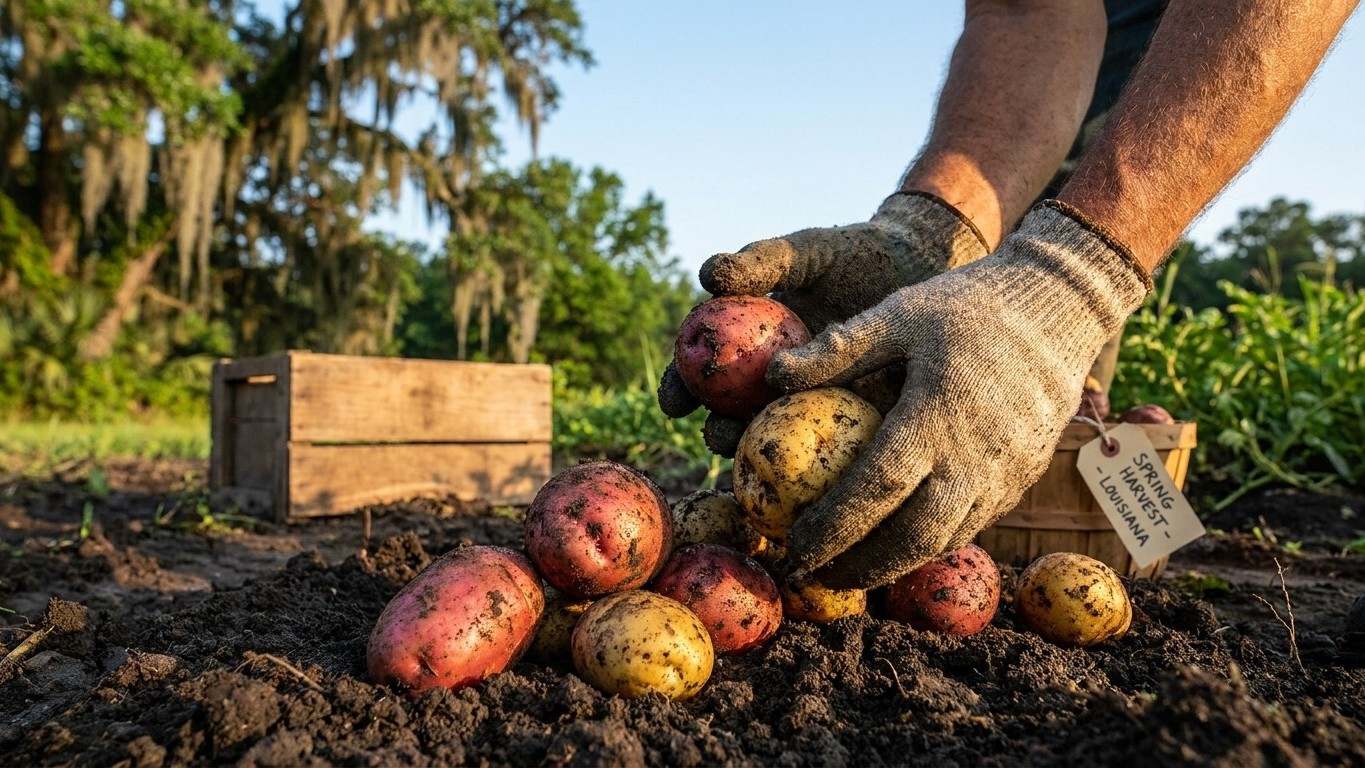

South Louisiana rarely sees a hard freeze at all, and that changes everything about how potatoes are grown here. The reference station near New Orleans averages 70.7 days a year at 90 F or higher, according to NOAA NCEI Climate Normals (1991-2020). That heat load, not frost, is what limits this crop. The short version: plant early, dig before summer, and treat this as a spring-only harvest.
The short answer

Two numbers decide this crop in Louisiana. The first is 70.7, the average number of days per year the New Orleans reference station reaches 90 F or higher, per NOAA NCEI Climate Normals covering 1991-2020. The second is the last spring frost window, which NOAA NCEI puts at January 18 to February 8 for that same station, based on the 30-70 percent probability band for a 32 F freeze.
Read that second figure carefully, because it does not behave like a frost date in most of the country. A 32 F freeze occurs in only 86.8 percent of years at this station. That means roughly one year in seven, south Louisiana gets no freeze at all, and the window itself straddles the New Year rather than sitting in a tidy spring month. Frost, is not the threat here. It barely shows up most years.
Heat is the threat. With over 70 days a year above 90 F, the soil in south Louisiana crosses the threshold that Utah State University Extension identifies as the point where tuber set and fill shut down. Potatoes are a cool-season crop pretending to grow in a climate that does not stay cool for long. Once the ground warms past that ceiling, the plant may still look green and healthy above the soil line, but the tubers underneath stop sizing.
What this means for a Louisiana garden
It means this is a spring crop, full stop. Louisiana growers plant as early as the near-absence of hard freeze allows, push the crop through its bulking phase while the soil is still cool, and get the tubers out of the ground before the run of 90-degree days sets in for the season. For specific guidance on timing that planting window, see When to Plant Potatoes in Louisiana. For guidance on timing that dig correctly, see Harvesting and Storing Potatoes in Louisiana. There is no realistic path to a summer-planted or fall-harvested potato crop here the way there might be in a cooler state. The heat window closes that option.
As for what to plant, both Utah State University Extension and the University of Maine Cooperative Extension classify varieties by season length: early, mid-season, or late, rather than publishing a fixed number of days to harvest, since that figure shifts with soil temperature and site conditions. For a closer look at which cultivars fit this short spring window, see Potato Varieties That Suit Louisiana. Neither source publishes a days-to-maturity number, and a Louisiana grower is better served planning around season class than around a number that will not hold true here anyway. Early-season varieties are generally the safer bet given how quickly the region moves toward its heat ceiling. Both extensions also describe potatoes in terms of use, some suited to baking, some to boiling, and that distinction is more useful at the kitchen end than any label about texture.
When to plant here
The math runs backward from the frost window, not forward from a calendar month. Here is how to work it out for south Louisiana, and how to redo it for any county.
- Start with the last frost window. NOAA NCEI puts it at January 18 to February 8 for the New Orleans reference station, using the 30-70 percent probability band for a 32 F freeze.
- Subtract 14 to 21 days. Utah State University Extension recommends planting potatoes when soil reaches 50 F, which lands 14 to 21 days ahead of the last frost date, not on it.
- Do the subtraction. Counting back from February 8, that puts planting in the neighborhood of mid to late January. Counting back from the earlier end of the window, January 18, pushes planting into early January.
- Check soil temperature directly, not the calendar. A soil thermometer at planting depth is the only way to confirm the ground has actually reached 50 F, since a mild or wet winter can delay that even after the calendar date arrives.
- Plant into that window, not later. Every week of delay eats into the cool period before soils climb toward the 90 F ceiling, and in this climate that cool period is already short.
The arithmetic matters more than the specific dates, because it travels. Pull the local frost data for any county, subtract 14 to 21 days, and that is the planting target regardless of where in Louisiana the garden sits.
What the heat does to the crop
The mechanism is simple and it is the whole story for this state. Once soil temperature climbs above 90 F, tuber set and fill stop, according to Utah State University Extension. The plant does not die. The foliage can stay green. But underground, where the actual crop is forming, growth halts.
This matters more in Louisiana than almost anywhere else in the country, because the New Orleans reference station logs 70.7 days a year above 90 F. That is not a rare spike; it is a routine feature of the local summer, arriving reliably and lasting for months. A potato crop planted too late, or left in the ground too long, runs straight into that wall.
Here is the part gardeners get wrong most often: watering does not fix it. The 90 F threshold is a soil temperature response, not a drought response. A well-irrigated potato bed sitting in 95-degree soil will still stop sizing tubers, because the physiological process that builds the tuber shuts down at that temperature regardless of how much moisture is available. Extra water can keep the plant alive and green longer, which sometimes fools a gardener into thinking the crop is still developing. It is not.
The practical takeaway is that Louisiana growers are working with a spring crop dug before the heat arrives, not a full summer-long season. Given the count of 90-degree days here, there is no window later in the year where conditions cool back down enough to attempt a second planting the way a grower further north might try a fall crop. The math simply does not allow it.
What goes wrong here
- Planting uncertified seed potatoes. Uncertified seed carries viral disease that spreads through the whole planting and reduces yield with no visible warning until the crop is already compromised. Certified seed potatoes, sold through garden centers or extension-recommended suppliers, are tested for exactly this. This is not a minor detail; it is the single biggest gamble a first-time grower can take.
- Planting into cold, wet soil. Because the frost window is so early and so uncertain in south Louisiana, there is a temptation to get seed in the ground the moment a mild stretch appears. But soil that has not yet reached 50 F, and that stays saturated from winter rain, rots seed pieces before they sprout. Waiting for both the temperature and the drainage to cooperate matters more than hitting an exact date.
- Skipping the hilling. Tubers that develop near the surface and get exposed to light turn green and produce solanine, a compound that makes them unsafe to eat. Regular hilling, mounding soil up around the base of the plant as it grows, keeps tubers covered and prevents this. It is a simple, repeated task, not a one-time step.
- Digging too early. With such a short cool window before the heat arrives, some growers dig the moment foliage starts to yellow, assuming the crop is done. But cutting the season short loses size and yield that the plant could still add in the final cool days before soil temperatures climb. The better signal is foliage die-back combined with soil temperature still under the 90 F ceiling, not foliage color alone.
Checking this against your own county
The New Orleans reference station is a starting point, not a fixed rule for the whole state. North Louisiana freezes far more reliably than the south, which shifts both the frost window and the planting date earlier or later depending on where a garden sits. Elevation, local drainage, and even how exposed a site is to cold air pooling can move these figures by a couple of weeks in either direction.
For a county-specific frost window and planting guidance, the LSU AgCenter is the extension service to consult. They can translate the state-wide averages used here into numbers that actually apply to a specific parish, which matters given how much north-south variation exists across Louisiana.
Common questions
Can potatoes be grown twice a year in Louisiana?
Realistically, no. With 70.7 days a year above 90 F at the New Orleans reference station, the summer heat load is high enough and long enough that there is no reliable second cool window later in the year for a fall crop. This is a single spring planting, dug before summer heat sets in.
Does mulching help beat the heat?
Mulch can moderate soil temperature swings and conserve moisture, but it does not change the underlying threshold. Utah State University Extension identifies 90 F soil temperature as the point where tuber set and fill stop, and mulch alone will not keep soil under that ceiling once regional air temperatures push consistently past 90 F for weeks at a time.
Is frost a real risk for Louisiana potato growers?
Less than in most states. NOAA NCEI data shows a 32 F freeze occurs in only 86.8 percent of years at the New Orleans station, meaning roughly one year in seven sees no freeze at all. Heat, not frost, is the factor that actually limits this crop here.
Should I choose an early, mid-season, or late variety?
Given how quickly Louisiana moves toward its heat ceiling, an early-season variety, as classified by Utah State University Extension and the University of Maine Cooperative Extension, gives the crop the best chance to size tubers before soil temperatures climb past 90 F.