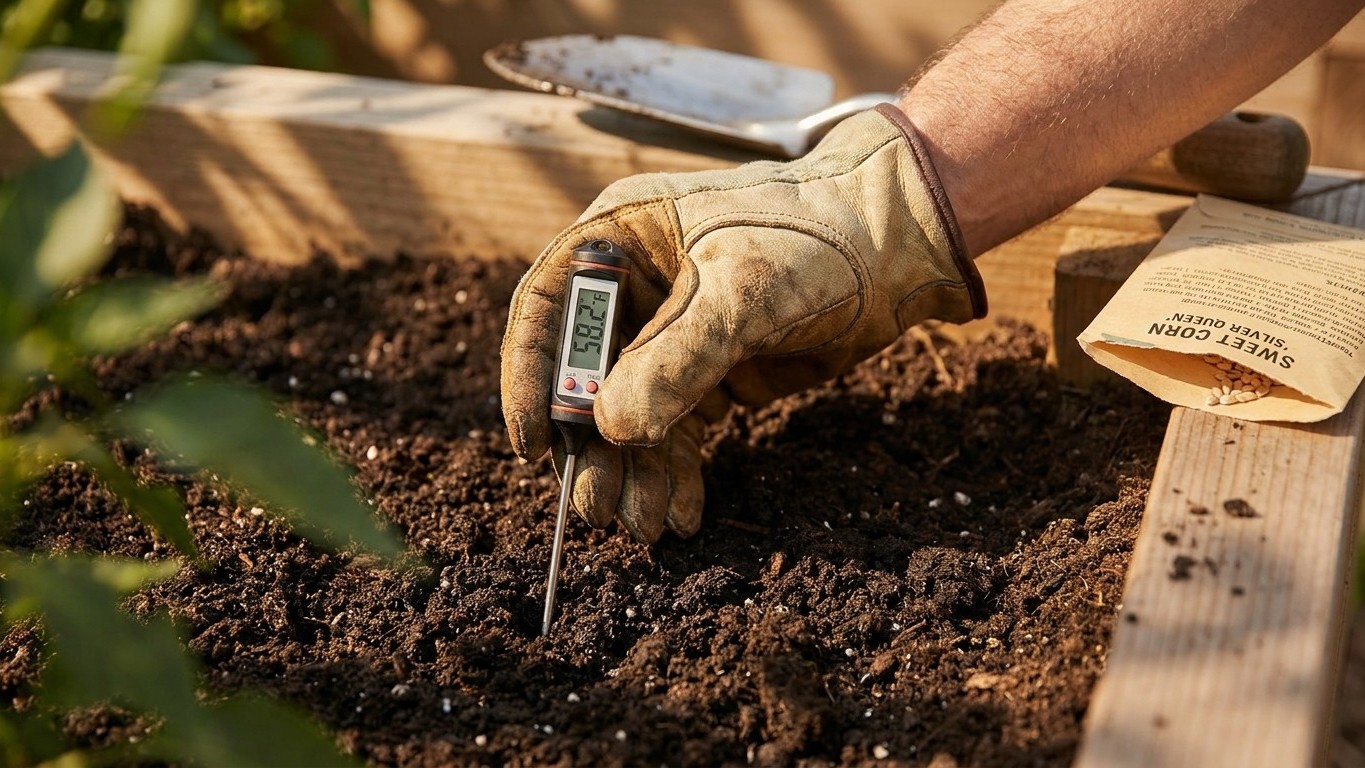

Sweet corn goes into Louisiana ground once the soil holds steady at 60 F, a date that lands well after the last frost. From there, count 60 to 90 days depending on the variety, and that window fits comfortably before the long, freeze-rare fall stretches. The real obstacle isn’t frost here. It’s the stretch of blistering summer that can wreck pollination if timing is careless.
The short answer
Louisiana’s last spring frost falls somewhere between January 18 and February 8, according to NOAA’s 1991-2020 climate normals. That’s an early date by national standards, and it tells only part of the story. Sweet corn seed doesn’t care about frost directly. It cares about soil temperature, and that soil needs to sit at 60 F or warmer before germination happens reliably. Soil lags behind air temperature by weeks, sometimes longer, so the actual planting window opens later than the frost date suggests. Treating the last frost as a green light is the first mistake gardeners make in this state.
Once soil hits that 60 F mark, the clock most growers care about starts: 60 to 90 days from planting to harvest, depending on the variety chosen. Stack that against the other end of the calendar. Louisiana’s first fall frost, per the same NOAA station data, arrives between December 17 and January 8. That’s an enormous gap. A 90-day variety planted as soon as soil temperature allows still finishes with months to spare before any frost risk shows up.
Here’s the twist specific to this state: at that same reference station, the year averages 70.7 days at 90 F or hotter. That’s not a fluke afternoon here and there. That’s more than two solid months of extreme heat load spread across the growing season, and sweet corn pollen is notoriously fussy about it. Tassels shedding pollen during a run of 95-degree afternoons often produce poorly filled ears, gaps in the kernel rows, ears that look fine from the outside and disappoint once shucked.
So the short answer isn’t just “plant after the soil warms.” It’s plant early enough in that post-frost window that tasseling doesn’t collide with the worst of summer, or delay into a second planting timed to tassel after the peak heat has passed. Frost dates barely factor into the decision here. Heat does, and it deserves more attention than most planting calendars give it in this part of the country.
Does a late variety fit here?
Season length isn’t the constraint in Louisiana that it is farther north. With frost-free stretches running from late winter into the following winter, both a fast 60-day type and a longer 90-day type have room to work. The question isn’t whether the calendar allows it. It’s whether the heat load lines up with the plant’s most vulnerable stage.
A 60-day variety
A short-season type planted as soon as soil reaches 60 F has the best shot at tasseling before the hardest run of summer heat sets in. Its whole life cycle, from seed to harvest, compresses into a window that can often dodge the bulk of those 70.7 annual days above 90 F, especially with an early planting date. This is the safer bet for a first planting of the year, and it also opens the door to a second sowing later in the season aimed at cooler fall maturity.
A 90-day one
A longer-season type technically fits the calendar. There is plenty of time between a soil temperature of 60 F and the December-to-January frost window for a 90-day corn to mature, on paper. The problem is what happens in the middle of that span. A 90-day variety planted right when soil first warms will very likely tassel squarely in the hottest weeks of summer, right in the thick of that 70.7-day heat stretch. Pollination during those weeks is a gamble. Ears can come out stunted or spotty even though the plant technically had “enough days.” So no, a late variety doesn’t comfortably fit the Louisiana growing pattern unless the planting date is pushed to steer tasseling around the worst heat, either very early or aimed at a cooler fall finish. Treating the 90-day window as automatically safe here is a mistake worth avoiding.
What goes wrong here
- Soil sown too cold. Planting right on the heels of the last frost date, before soil has actually reached 60 F, leads to seed that rots or germinates unevenly instead of coming up strong. The fix is simple and doesn’t require guesswork: check the soil itself, with a thermometer, rather than trusting the frost date as a stand-in for planting day.
- A variety timed to tassel in peak heat. This is the climate-specific failure that trips up even experienced gardeners moving from another region. A 90-day variety planted mid-spring often ends up shedding pollen during the worst of the 70.7 annual days above 90 F, and the ears show it: thin, gappy, disappointing. The remedy is planning the planting date around the tasseling stage, not just around frost, and leaning toward shorter-season varieties or a fall-timed second sowing.
- Sweetness lost to cross-pollination. This one has nothing to do with Louisiana’s climate at all. It happens whenever su, se, and sh2 type sweet corns tassel at the same time nearby, and the result is starchy, flat-tasting kernels instead of the sweetness the variety was bred for. There’s no published isolation distance to lean on here, so the fix is about timing and planning: grow one type per block, or stagger planting dates enough that different types are never shedding pollen during the same stretch of days.
Common questions
Can sweet corn be planted more than once a season in Louisiana? Yes, and given the heat pattern here, it’s often a smarter strategy than one single planting. An early sowing as soon as soil hits 60 F, followed by a second planting timed so tasseling falls after the hottest weeks pass, spreads out the risk instead of betting everything on one window colliding with a heat spike.
Does 60 to 90 days mean the same thing as harvest timing? No, and mixing these up causes confusion. The 60 to 90 day figure counts from planting and tells you whether the crop fits the season at all. A separate clock, running from when silks first appear rather than from planting day, is what actually signals harvest readiness, generally in the range of 17 to 24 days after silk emergence according to Utah State University Extension. Keep the two figures separate.
How do I know an ear is actually ready to pick? Look for three signs together, not just one. The silks should be dry and browned, the husk should still be moist and green rather than drying out, and a punctured kernel should release milky juice rather than a clear or thin liquid. Any single sign alone can be misleading.
Does north Louisiana follow the same schedule as the south? Not exactly. South Louisiana barely freezes at all in some years, a 32 F freeze shows up in only about 86.8 percent of years at the reference station, meaning roughly one year in seven sees no freeze whatsoever. North Louisiana sees far more reliable frost, so its frost-based planting decisions carry more weight, while in the south, the heat load described above matters more than any frost calculation.