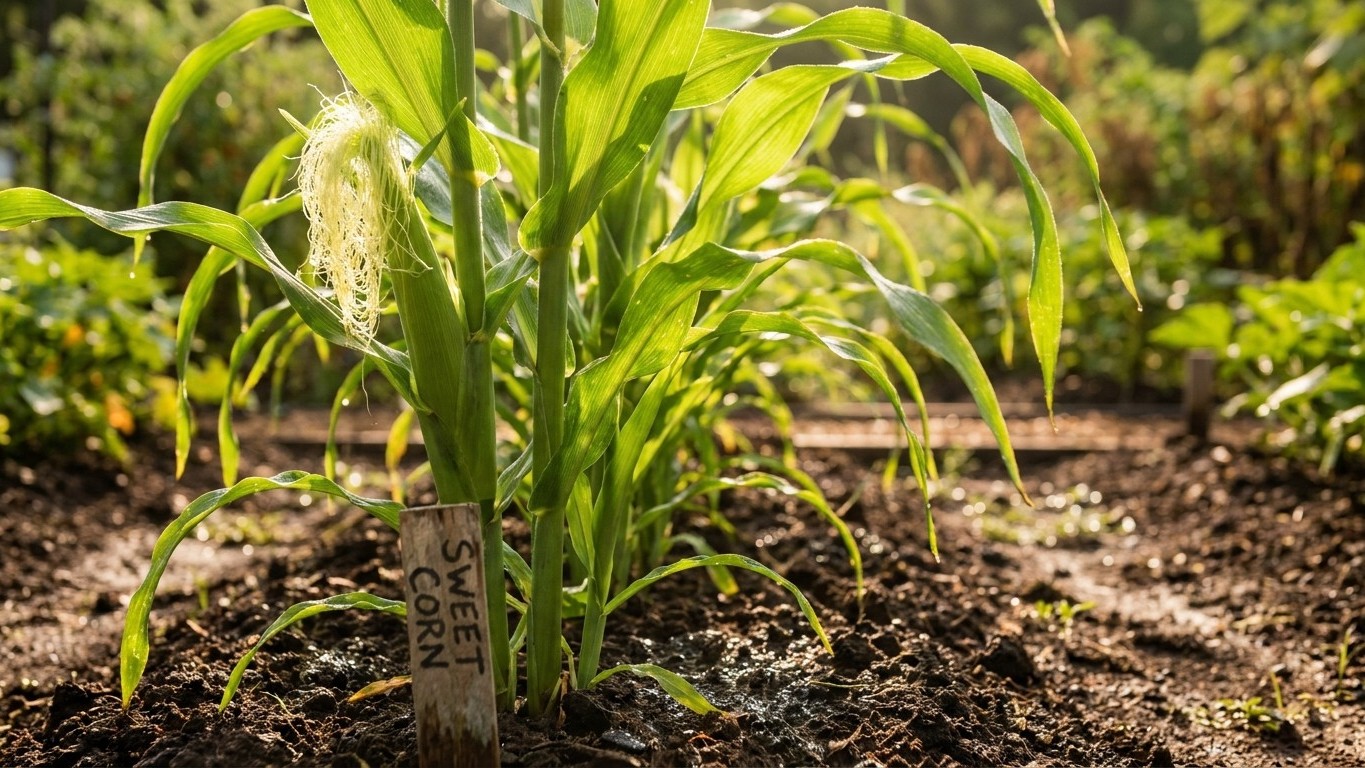

Yes, sweet corn ripens in Louisiana, but frost has almost nothing to do with it. The state’s growing season stretches nearly the whole calendar, so the real question isn’t whether corn has time to mature, it’s whether it tassels before the deep summer heat shuts pollination down. Get the timing right and a 60-to-90-day crop finishes easily.
The short answer
Soil temperature, not the calendar date of the last frost, is what actually starts the clock on sweet corn. And here soil crossing 60 F comes well after that frost passes, not on the same day as it. According to NOAA NCEI’s 1991-2020 Climate Normals for this station, the last spring frost falls somewhere between January 18 and February 8. Soil needs real time after that to climb into the 60s, so growers who drop seed the week frost clears are usually planting into cold, sluggish ground. The FACTS available here don’t publish the exact week soil crosses 60 F, only that it trails the frost date by a stretch of weeks, so treat late February and March as too early to trust without checking the ground itself, not the thermometer outside.
Here’s the part that surprises people who’ve gardened up north: south Louisiana barely freezes at all. That same NOAA station shows a 32 F freeze occurring in only 86.8 percent of years, meaning roughly one year in seven never freezes. The fall side of that window (first frost between December 17 and January 8) straddles the new year, which tells you how compressed and unreliable the cold season really is here. This isn’t a place where you count backward from frost the way growers do in Ohio or Minnesota. The frost dates barely constrain anything.
So does the 60-to-90-day maturity window sweet corn needs actually fit before that eventual, uncertain frost? Easily. With roughly eleven frost-free months on the calendar, there’s no shortage of days between soil warming in spring and the frost risk returning in December. The limiting factor flips entirely: it’s heat, not cold, that decides whether a planting succeeds. This region logs an average of 70.7 days a year at 90 F or hotter, according to NOAA NCEI Climate Normals for the New Orleans reference station. That’s not an average summer temperature, it’s a measure of sustained heat load, and it’s exactly the kind of stretch that stresses pollen and silks if tasseling lands in the middle of it. A planting that fits the frost calendar with room to spare can still fail if it tassels during that 70-day heat stretch.
The practical answer, then: sweet corn ripens here reliably when it’s planted so its 60-to-90-day window lands its tasseling stage before, or just clear of, that peak heat run. Frost dates are almost a footnote in this state. Heat load is the variable that decides success.
Does a late variety fit here?
Maturity length matters less for frost, and more for dodging the region’s heat window. That changes how a 60-day type and a 90-day type each play out here.
A 60-day variety
A 60-day type planted once soil is reliably above 60 F tassels roughly eight to nine weeks later. Depending on how early the ground actually warms, that timing frequently lands ahead of, or at the edge of, the heaviest stretch of the 70.7 annual days above 90 F, rather than dead in the middle of it. The frost calendar gives this variety no trouble at all: with something close to eleven frost-free months in play, there’s ample room on both ends. A 60-day type also opens the door to a second planting later in the season, aimed at finishing before the December-to-January frost risk returns, since the season is long enough to attempt it.
A 90-day variety
The math changes for a longer-season type. Ninety days from planting pushes tasseling and ear fill deeper into summer, right into the stretch of the year carrying most of that 70.7-day heat load. Frost isn’t the obstacle for a 90-day variety here, there’s still plenty of calendar around it, but heat during pollination is. Sustained stretches at or above 90 F can hurt pollen viability and silk receptivity, which shows up later as poorly filled ears even when the plant looked healthy all season. Said plainly: a 90-day variety does not fit this territory well for a standard spring planting. It can only work if the grower manages to time the window so tasseling slips past the hottest run of days, and in a climate logging over 70 such days a year, that’s a narrow target to hit.
What goes wrong here
- Soil sown too cold. Because the last frost date (January 18 to February 8) creates a false sense that planting can start right away, seed often goes into ground that hasn’t actually reached the 60 F sweet corn needs. The remedy is simple: check the soil itself, not the frost date, before planting.
- A variety too late for the season’s heat. A 90-day type maturing into the thick of the 70.7-day stretch above 90 F often sets poorly filled ears, even though the frost calendar had plenty of room left. The remedy is choosing a shorter-season type, or shifting a longer one so its tasseling stage lands outside the hottest weeks rather than inside them.
- Sweetness lost to overlapping tassels, which has nothing to do with climate. Su, se, and sh2 sweet corn types lose their sweetness if they tassel at the same time as each other, regardless of how well the season and heat were managed. The remedy: stagger planting dates so the types don’t tassel together, and keep plantings organized in blocks of three or more rows of the same type, as recommended by Utah State University Extension. No isolation distance is published for this, timing and block planting are what matter.
Common questions
Does Louisiana’s frost date matter for sweet corn at all?
Barely. With the last spring frost falling January 18 to February 8 and the first fall frost not returning until December 17 to January 8, there’s close to eleven frost-free months on the table. A 60-to-90-day crop fits that window without strain. Heat, measured by the 70.7 average days a year above 90 F, is the factor that actually decides success.
How do I know when soil has actually reached 60 F?
The FACTS available here don’t publish an exact calendar date for that, only that it comes after the last frost window closes, sometimes well after. A soil thermometer pushed a few inches into the planting bed is the only reliable way to confirm it, rather than counting days from frost.
Can I plant a second crop later in the season?
The frost-free stretch here is long enough that a second planting, timed to finish before the December-to-January frost risk, is worth attempting, particularly with a 60-day type. Just keep its tasseling stage clear of the year’s hottest run of days where possible.
How do I know when the ears are actually ripe?
Check for three signs together, not just one: dry, browned silks; husks that are still moist and green; and milky juice from a punctured kernel. Any one sign alone can mislead, all three together confirm it’s time to pick.