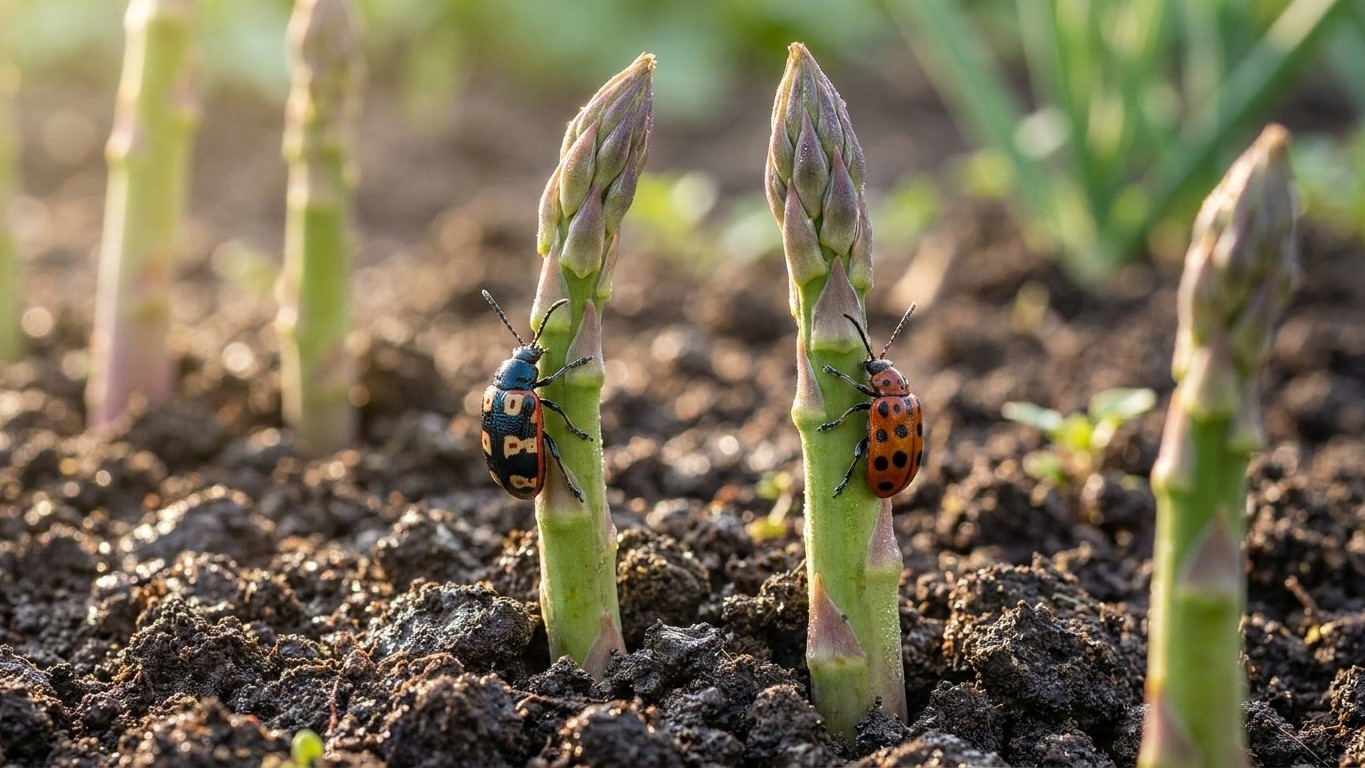

Nothing in the verified record behind this page names an insect, a deer or a vole, and nothing dates when one shows up. A made-up pest calendar would be worse than a blank one. What the record does hold is what an asparagus bed demands of a Maine garden: drainage it can count on, enough water, and a planting window that opens around the last spring freeze. Those three decide whether anything survives to need protecting. The wider picture lives in Growing Asparagus in Maine.
The short answer
An asparagus bed stays where you put it for 10 to 15 years. Utah State University Extension, the only authority this page leans on, sets one condition on the ground: most soils will do provided they are well drained. That is the whole test. Fertility, texture and tidiness can all be argued with, but drainage cannot.
Maine’s official state soil is the Chesuncook series, a Spodosol. That soil order forms under conifers and tends to be sandy, acid and strongly leached. USDA’s representative values for the surface layer of the series read 35 percent sand, 12 percent clay and 53 percent silt, which makes a loam to silt. Surface pH is about 5.1, strongly acid, and organic matter is about 53.0 percent. The series is classed as moderately well drained.
Two cautions on those numbers. The organic matter figure describes a natural layer of forest litter on the mapped surface, and a cultivated bed will not have anything like it. The pH belongs to the series, not to your garden, and the Extension source is silent on soil pH for asparagus, so this page offers no target.
Does the dominant soil drain well enough? Mostly, yes, with an asterisk. Moderately well drained means water leaves, but not instantly, and after a long wet spell it can linger in the root zone. The texture helps, since 12 percent clay is nowhere near the sticky, heavy ground that holds a puddle for a week. For a crop that asks only for drainage, that is a passing grade rather than a top mark.
The asterisk matters more here than for any other vegetable. A heavy soil is normally an annual nuisance you amend each season. With asparagus it is a decision you cannot undo, because the crowns go into 8-inch furrows, nothing is harvested until year 3, and then the bed produces for 10 to 15 years. A bad spot costs you three seasons before it even shows its hand.
A state soil is a starting point, not a diagnosis of one garden. River bottoms, low pockets at the foot of a slope and any ground a builder has scraped or filled can behave nothing like Chesuncook. Dig a hole in the spot you have in mind, fill it after a heavy rain, and see whether water is still standing in it the next morning. If it is, move the bed to higher ground. If nothing better exists, building the bed up above the surrounding grade is a reasonable workaround (my judgment, not something the Extension source covers). A soil test then gives you your own numbers, and Will Maine Soil Hold an Asparagus Bed for Fifteen Years? goes deeper on that choice.
Will the summer here water it for you?
Mostly, on paper. A new bed wants 1 to 2 inches of water every other week for its first two years, then every three weeks after that. The NOAA climate normals for the Portland reference station put summer rain at about 11.2 inches across June, July and August, out of 48.1 inches for the whole year. By month, that is 4.15 in June, 3.43 in July (the driest) and 3.57 in August.
Spread evenly, July’s 3.43 inches works out to roughly 1.6 inches per two weeks, right inside the range the bed asks for. The catch is that rain never arrives evenly. A single thunderstorm can drop an inch in an hour, and much of it runs off instead of soaking in. A dry fortnight in July leaves the bed short even in a normal summer. These are 30-year normals for one coastal station, not a forecast and not a reading from your yard.
The practical routine is to let the weather do what it can and fill the gap yourself:
- Set a rain gauge in the open near the bed. It is the only way to know what your plot actually received, since a slope, a hill or a nearby building changes the total.
- Add up the rain over each two-week stretch during the first two years.
- Subtract that total from the 1 to 2 inches the bed wants, and water the difference. A fortnight with 1.5 inches of rain needs little or nothing, while a fortnight with a quarter inch needs a real soaking.
- Water slowly enough that it soaks in rather than running off, and measure what you apply with a straight-sided can set in the bed.
- From the third year, stretch the interval to every three weeks and run the same arithmetic.
Soil shifts the numbers. A moderately well drained silt holds moisture better than the sandy reputation of its soil order suggests, so rain on a Chesuncook-type ground should stay available a while. A sandier or more gravelly patch of the same state could shed an inch within the day and need watering more often than the rain total implies. The gauge and a trowel check a few inches down will settle that faster than any normal can.
When to put the crowns in
Early spring. That is the Utah State Extension instruction, and it does not tie the date to a frost figure. The anchor comes from the climate side: at the Portland station, NOAA’s 30 to 70 percent probability band for a 32°F freeze puts the last spring frost at around April 22 to May 1. Coastal Portland is the mild end of Maine, so inland and northern gardens run substantially later in spring. The date is an average, which means a freeze after it is entirely possible in any given year.
Read together, early spring on the coast falls around the same stretch as that frost window, and a few weeks or more later as you move inland or north. Beyond that, the source gives no more precise rule, and this page will not invent one. The When to Plant Asparagus Crowns in Maine page is the place to work out timing for your own county.
The crowns go into furrows 8 inches deep. The furrow is not filled in on planting day. You backfill it gradually across the year, adding 2 inches every other month, so the shoots are never buried all at once. Skipping that and levelling the trench in one pass undoes the point of planting deep in a furrow.
Then comes the long wait. No harvest in years 1 and 2, and none in year 3 beyond the schedule: harvest for 4 weeks in year 3, 6 weeks the next year, then 8 weeks. Do not soften that into taking a few spears early. The bed is buying itself a decade or more, and the first cuts are what the crowns can least afford.
Growing from seed is the alternative route to a bed. The source behind this page covers crowns only and gives no sowing dates for seed, so none are offered here. If you are weighing the two routes, that gap is worth knowing before you choose.
Common questions
What actually eats asparagus in Maine?
The sources used for this page do not list pests, so naming them and giving dates would be guesswork. For a reliable answer on insects and wildlife in your area, ask your state’s cooperative extension office. The overview in Growing Asparagus in Maine covers the growing basics.
When can I first cut spears?
Not until year 3. That first season’s harvest lasts 4 weeks, the next 6 weeks, and from then on 8 weeks. The end of the season is marked by an object, not a date: stop cutting when most of the spears coming up are thinner than a pencil.
Which variety should I plant?
Four are named in the Extension source, and only their sex is given. Jersey Giant and Jersey Knight are all-male. UC 157 F1 and Purple Passion are male and female. Nothing is published there about flavor, yield or any reason to prefer one, so any ranking would be opinion.
How do I keep cut spears fresh?
The target is 32 to 35°F with air near saturation, 95 to 100 percent humidity, according to the UC Davis Postharvest Technology Center. The window is narrow on both sides. Above 50°F spears toughen quickly, and at about 31°F or below they freeze and go soft when they thaw. At home, stand the cut ends in water or wrap them damp, since the cut end is where spears lose moisture fastest.