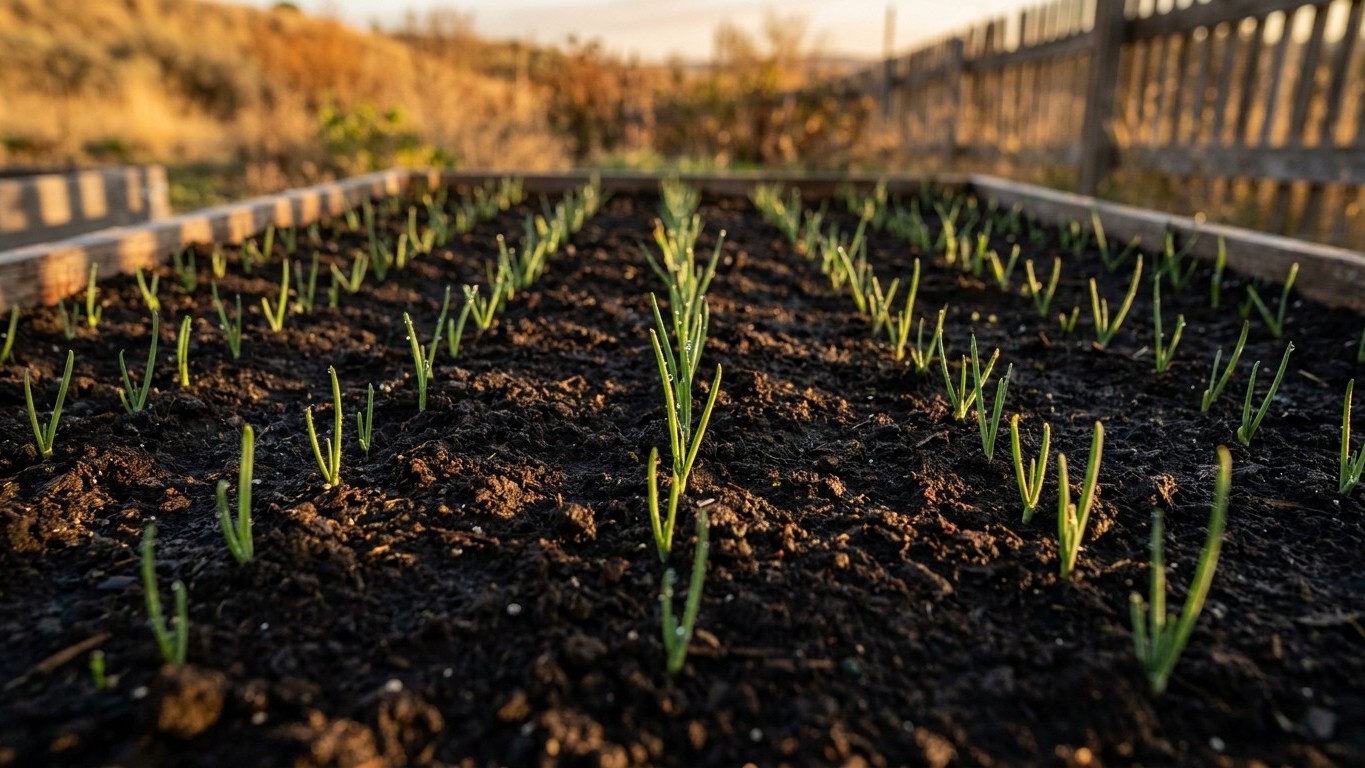

Garlic in Maine loses cloves and leaves to a short list of pests, and most of them arrive on a schedule set by the season rather than the calendar. Voles and wireworms work underground through the first winter. Onion maggots, and the allium leafminer where it has arrived, show up in spring. Thrips and aphids follow in dry early summer. Bulb and stem nematodes can ride in on the seed itself. Every one of those windows hangs on a single anchor date: the first fall frost.
The short answer for Maine
The first fall freeze at the mild coastal end of Maine falls between October 9 and October 21, according to the NOAA NCEI 1991-2020 Climate Normals (the 30-70% probability band for a 32F freeze). Your garlic’s pest calendar starts from that band, because cloves go into the ground around it and the first threats arrive soon after.
Garlic here is planted in autumn and lifted the following summer, so the crop spends most of a year exposed. That year breaks into three waves. The first is the cold-season wave: rodents and wireworms going after cloves that are rooting or sitting dormant under mulch. The second is the spring wave, when new shoots push up and the flies and moths that lay eggs on alliums become active. The third is the summer wave, when bulbs are sizing up and sap-feeders like thrips build up in hot, dry weather.
That October 9 to 21 band is a midpoint, not a safe date. A date in the middle of a probability range means that in one year out of two, the frost falls later. Plan for a late frost as readily as an early one, and expect the pest windows to slide with it.
And Portland is not Maine. The same data carries a caution that coastal Portland is the mild end of the state. Inland and northern Maine run substantially later in spring and earlier in fall, so the dates above are a starting reference, not your answer.
Working it out for your own garden
Step one: find your own frost date
A state is not one climate. Elevation, a large lake and the coast can each move these dates by roughly two weeks either way, and the arithmetic is simple enough to do on paper. Take the Portland band, October 9 to October 21, and shift it for your site. A hillside farm that runs two weeks earlier lands at September 25 to October 7. A garden on the shore of a big lake or right on salt water that runs two weeks later lands at October 23 to November 4. Same method, very different calendars.
To place yourself, look at how your garden behaves against Portland’s. If your neighbors’ tomatoes die weeks before a coastal friend’s, you sit on the early side. Cold air also pools in low spots, so a valley bottom can freeze before a slope a few hundred feet up. This page does not publish a planting offset (how many weeks before or after frost to set cloves). The Maine planting calendar covers that count.
Step two: shift the pest calendar with it
Once you have your frost band, move every pest window by the same number of days. The fall wave begins as the ground cools and mulch goes on. The spring wave begins when snow leaves and shoots emerge, which comes later the farther inland and north you go. The summer wave follows the first sustained warm, dry stretch. This table gives the general order, not exact dates, since no sourced dates for Maine pests are published here.
| Pest | When it hits | What it damages |
|---|---|---|
| Voles and mice | Late fall through winter | Cloves and young bulbs under mulch |
| Wireworms | Fall planting and again in spring | Cloves and bulb bases, worst in beds cut from old sod |
| Bulb and stem nematodes | All season, carried in on seed | Twisted, swollen shoots and soft bulbs |
| Onion maggot | Spring into early summer | Larvae tunneling into the bulb base |
| Allium leafminer | Spring, with a possible second flight in fall, where it has reached your county | Leaves and shoots, with rows of small egg punctures |
| Thrips and aphids | Early to midsummer in dry spells | Silvered, streaked, weakened leaves |
One practical habit follows from the table. Scout at three moments: right after planting, at spring emergence, and in the first hot dry week of summer. Those are the points where a problem is still cheap to fix.
What changes across Maine
The southern coast, meaning Portland and York County, is the mild end. The first freeze comes latest there, so the fall wave starts later and the ground stays open longer. Wireworms and maggots have more time to be active on either side of winter. If the allium leafminer keeps spreading up from the south, the southern counties are where you would reasonably expect it first. Confirm that locally rather than assuming.
Inland and western Maine run colder. In the western mountains, around Franklin and Oxford counties, elevation and cold-air pooling in valleys bring frost earlier, and snow lingers into spring. That delays emergence and compresses the spring pest window. Deep, lasting snow also gives voles a protected corridor above frozen ground, so the rodent risk under mulch does not shrink just because the winter is harsh.
Northern Maine, especially Aroostook County, sits at the far end of the range, with the earliest fall freeze and the latest spring. Cloves must root quickly after planting, and pests that need warmth get a shorter season. Soil-borne problems such as nematodes, though, do not care about a short season. They persist in the bed.
Water changes the picture too. Big lakes such as Sebago and Moosehead hold summer heat and can delay the first freeze for gardens close to the shore. The coast and islands stay moderate in fall, though cold, foggy springs can slow emergence. If your variety choice also depends on where you garden, the Maine varieties guide follows the same regional logic, and the main Maine garlic page gives the wider picture.
The mistakes this climate punishes
Maine winters are cold enough that the costliest errors come from timing and depth, not from exotic pests. Plant too late and cloves have no roots when the ground locks up, so they heave in spring thaws and become easy targets for anything hunting weakened plants. Plant too shallow and the same freeze-thaw cycles push cloves up, exposing them to rodents and cold. Cold winters also reward hardneck types; softnecks are generally less winter-hardy, a point the varieties page handles in detail.
Mulching on a warm day is a quieter mistake. If straw goes down before the ground has cooled, voles and mice treat it as ready-made housing. Waiting until the soil has started to chill, then applying the mulch, gives them less incentive to move in. Thick mulch left too long in spring does the opposite harm, keeping soil cold and wet, which suits slugs and slows the shoots you want up.
Bed history causes the longest-lasting damage. Alliums replanted in the same spot year after year allow nematodes and soil diseases to build up, and some of these persist in soil for a long time. Rotate to a bed that has not held onions, leeks or garlic recently. Be equally careful with seed: grocery-store bulbs are not screened for Maine conditions, and saved cloves from a plant with swollen, distorted growth carry the problem forward. Start with clean seed garlic, and discard any soft or discolored cloves at planting.
Gardeners comparing notes with colder places can read the Manitoba planting calendar and the Manitoba varieties guide. The principle carries over: where winters are harder, root growth before freeze-up matters more than almost anything else.
Checking this against your county
County-level frost dates and confirmed pest reports are not published on this page. University of Maine Cooperative Extension is the place to check them. Ask your local office whether the allium leafminer or bulb and stem nematodes have been confirmed near you, and bring a sample of any damaged plant for identification before you treat anything.
Common questions
What eats garlic over the winter in Maine?
Voles and mice are the usual culprits, tunneling under mulch and snow to reach cloves. Wireworms can also feed on cloves in soil that was recently sod.
Do deer eat garlic?
Deer generally avoid it, which is part of why gardeners tuck it around vulnerable plants. That is a tendency, not a guarantee, and a hungry animal may still pull up young shoots.
Can I plant garlic where onions grew last year?
It is better not to. Onions and garlic share pests and soil diseases, so a bed that held alliums recently can pass problems to the new crop. Rotate to fresh ground when you can.
Is the October 9 to 21 frost date a safe planting guide?
It is a reference point, not a guarantee. It comes from NOAA NCEI 1991-2020 Climate Normals for coastal Portland, and in one year out of two the first freeze falls later. Inland and northern gardens usually run earlier.