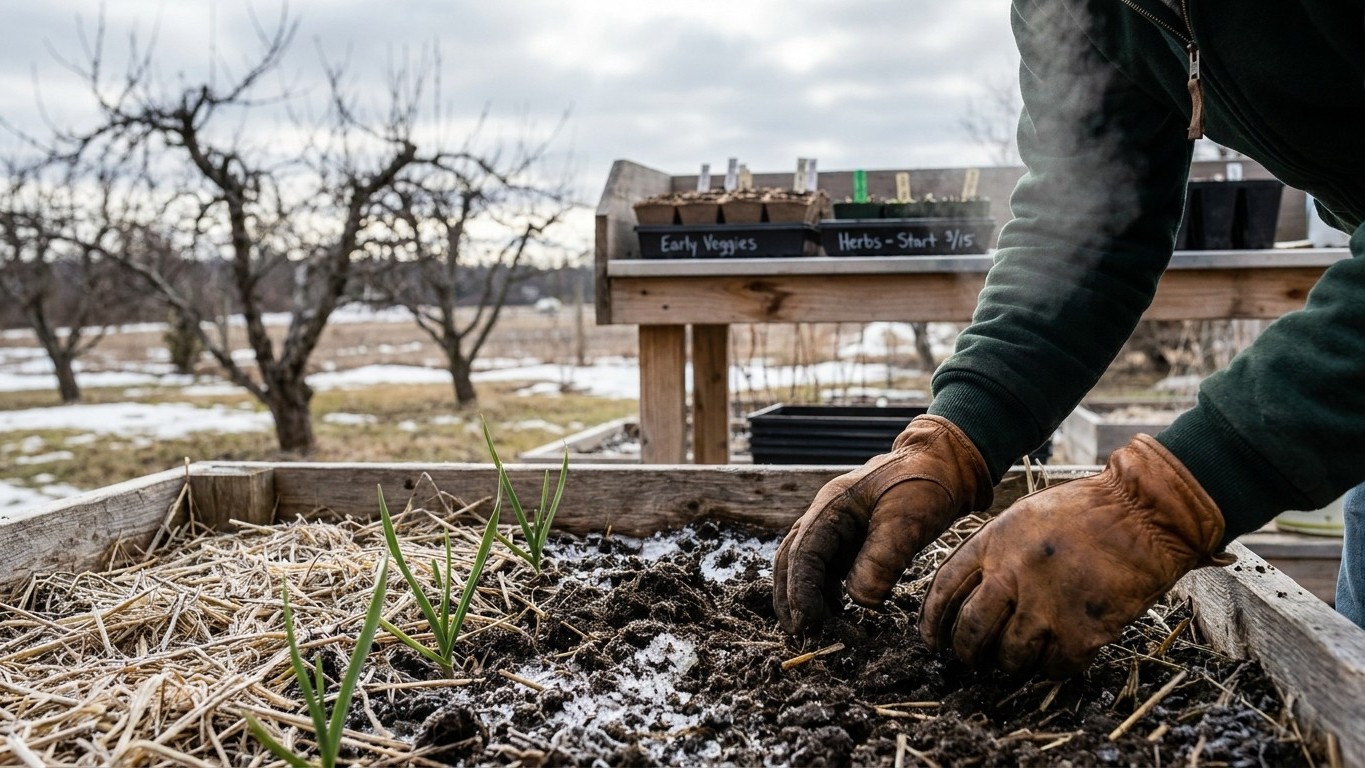

March in Maine is not a planting month for open ground, not for most of the state. The last spring frost doesn’t arrive until April 22 to May 1 even along the mild coast, and inland and northern counties run later than that. The real work this month happens indoors, under cover, and in the pruning yard: seed starting for tomatoes and peppers, dormant pruning of fruit trees, and finishing garlic beds where the soil has actually thawed.
What goes in the ground in March

The calendar says spring is close. The soil disagrees. What decides whether anything goes into open ground is soil temperature and workability, not the date on the wall, and in Maine those two things lag well behind the calendar’s promise. With the last spring frost falling between April 22 and May 1 at the state’s mildest reference point, coastal Portland, March sits six to nine weeks ahead of that window. Inland valleys and the northern half of the state run later still, which means frozen or saturated ground is the normal condition through most of the month.
For the large majority of Maine gardeners, the honest answer is that nothing new goes into open, unprotected soil in March. That’s not a gap in the calendar, it’s a fact of the climate, and padding the list with peas or spinach “because they’re hardy” ignores that hardy crops still need soil you can actually dig.
What does move forward this month:
- Garlic and shallots planted the previous fall keep developing roots wherever the ground has thawed enough to expose the mulch layer; no new cloves go in now, but checking and pulling back winter mulch as shoots push through is worth doing.
- Cold frames and low tunnels can take an early sowing of spinach, mache, or claytonia in the far south of the state if the frame soil inside has warmed, since the structure buys several weeks over open ground.
- Bare-root fruit trees, cane fruit, and dormant shrubs can go in as soon as the planting hole is diggable, which for southern coastal counties may happen late in the month; everywhere else, wait.
- Forcing rhubarb or Belgian endive (chicory) indoors in a dark, cool space gives a harvest while the outdoor bed is still weeks from producing anything.
What to start under cover
Seed starting in Maine works backward from the frost window, not forward from a date on a seed packet. Using the April 22 to May 1 range as the anchor, count the weeks each crop needs before it goes outside, and that tells you when to sow indoors. Gardeners farther inland or north should push these windows later, since their own last frost comes after Portland’s.
| Crop | Weeks before last frost to start indoors | What that means in March |
|---|---|---|
| Onions, leeks | 10-12 weeks | Should already be started; if not, get them in now and accept a smaller bulb size |
| Peppers | 8-10 weeks | Early March is the window for coastal counties |
| Tomatoes | 6-8 weeks | Mid to late March lines up well |
| Broccoli, cabbage | 6-8 weeks | Same window as tomatoes, cooler spot to grow on |
Two mistakes show up every year with this math. Start too early, and by the time the ground and air are actually warm enough to plant out, the seedlings are rootbound and leggy, stretching for light on a windowsill that can’t match outdoor sun. Start too late, and Maine’s short frost-free stretch, bounded by that April 22 to May 1 spring frost and the October 9 to October 21 fall frost, doesn’t leave enough days for a full-size tomato or pepper crop to mature. March is the month to get the math right rather than guess it.
What is ready to pick
Outdoors, March offers little to nothing across most of Maine, and there’s no point dressing that up. Snow cover or frozen ground still sits over most garden beds, and anything left unprotected in the fall is either finished or buried.
What still feeds a household this month comes from what was set up earlier. Kale and leeks left in the ground under a heavy mulch or row cover can still be dug where the soil hasn’t locked solid, and cold tends to sweeten both rather than ruin them. Cold-frame spinach and other greens sown in late winter may be ready for a first light cutting by late March in the mildest coastal spots. Indoors, sprouts and microgreens on a countertop or under a grow light are the most reliable fresh crop of the month, ready in one to two weeks from seed with no dependence on outdoor weather at all.
Stored crops need a check-in now rather than later. Winter squash that felt firm in November can develop soft spots by March; a squash with any give near the stem end should be used first, not saved. Potatoes that have started sprouting in storage are still edible once the sprouts are removed, but they’re declining, and onions that have gone soft or started growing green shoots from the top should be pulled from storage and used before they spread rot to the rest of the bin.
The jobs that matter this month
March carries more weight than the empty planting list suggests, and skipping these jobs costs real ground later in the season.
Pruning and structure
Dormant pruning of apple trees, pears, and cane fruit like raspberries should happen before buds swell and sap starts moving, and March, while trees are still fully dormant across most of Maine, is close to the last clean window before growth resumes. Cutting into a tree once sap is rising invites disease and slows healing. This is also the month to repair raised bed frames, mend fencing that took winter damage, and get stakes and trellis material ready before plants need them.
Soil and seed
Popular seed varieties sell out well before planting season, and ordering now avoids settling for a second-choice tomato or pepper. Soil testing is worth doing as soon as the ground is workable enough to pull a sample, since lab results and any recommended lime or amendment take time to arrive and work into the soil before crops go in. Turning a compost pile that’s been sitting dormant under snow gets air back into it and speeds decomposition before it’s needed for spring beds.
Planning and equipment
Mapping out crop rotation for the coming season, before beds fill up and decisions get made on the fly, prevents the same family of crops from landing in the same soil two years running. Cleaning and sharpening pruners, shovels, and hoes now means no delay once the ground finally opens up, and it’s easier to do this work at a bench in March than in a rush once seedlings are ready to go in the ground.
What not to do in March
Maine can throw a 55 or 60 degree afternoon in the middle of March, and that single warm day causes more planting mistakes than any other trigger. Warm-season crops like tomatoes, peppers, or squash going into ground that’s still cold at root depth will sit stalled or die outright once a hard freeze follows, which it reliably does given a spring frost window that doesn’t close until April 22 to May 1 at the earliest. Air temperature is not soil temperature, and a warm afternoon doesn’t change that the ground six inches down is still near freezing.
The same mild spell tempts gardeners to pull back winter mulch from strawberries, garlic, or perennial beds too early. Once exposed, those crowns lose the insulation that’s protecting them from the next cold snap, and a plant that survived a hard winter under cover can be damaged by a single unprotected freeze in early spring.
Nitrogen fertilizer applied to garden beds in March is largely wasted. Soil microbes that convert nitrogen into a form plants can use aren’t active yet in cold soil, and much of what’s applied simply leaches away before anything is growing to take it up. Holding off until soil has warmed and plants are actively growing gets far more value from the same bag of fertilizer.
Checking this against your own county
A statewide month is a starting point, not an instruction, and Maine’s geography makes that gap wider than most states. Elevation, distance from the coast, and the lake effect around the state’s larger bodies of water can shift frost timing by weeks in either direction, and the difference between the mild southern coast and the colder interior or far north is significant enough to move a planting date from late March into May. The frost figures here come from a single coastal reference station; a garden two hours inland or two hundred feet higher in elevation is working with a different calendar.
For localized guidance, the University of Maine Cooperative Extension publishes county-level planting information and soil testing services that account for these regional differences far better than a single statewide date can.
Common questions
Can I plant potatoes in Maine in March?
No, not in open ground. Potatoes need workable, thawed soil, and with the last spring frost falling between April 22 and May 1 even at the mild coastal reference point, March soil across most of Maine is still frozen or too wet to work. Chitting seed potatoes indoors in a bright, cool spot during March is useful preparation for planting once soil conditions allow.
Is it too early to start tomato seeds in March in Maine?
For most of the state, March lines up well, since tomatoes are typically started six to eight weeks before the last frost. Given the April 22 to May 1 frost window, mid to late March sowing keeps transplants at a manageable size rather than leggy and rootbound by the time they can go outside.
What can I do outside in Maine in March if the ground is still frozen?
Dormant pruning of fruit trees and cane fruit, repairing beds and fencing, cleaning tools, and pulling back mulch cautiously from garlic once shoots appear are all realistic outdoor tasks even when the soil itself isn’t diggable yet.
When should I test my garden soil in Maine?
As soon as the ground thaws enough to pull a sample, which for many parts of the state starts to happen in March. Lab turnaround and the time needed to work amendments into the soil mean early testing gives results back well before planting season arrives.