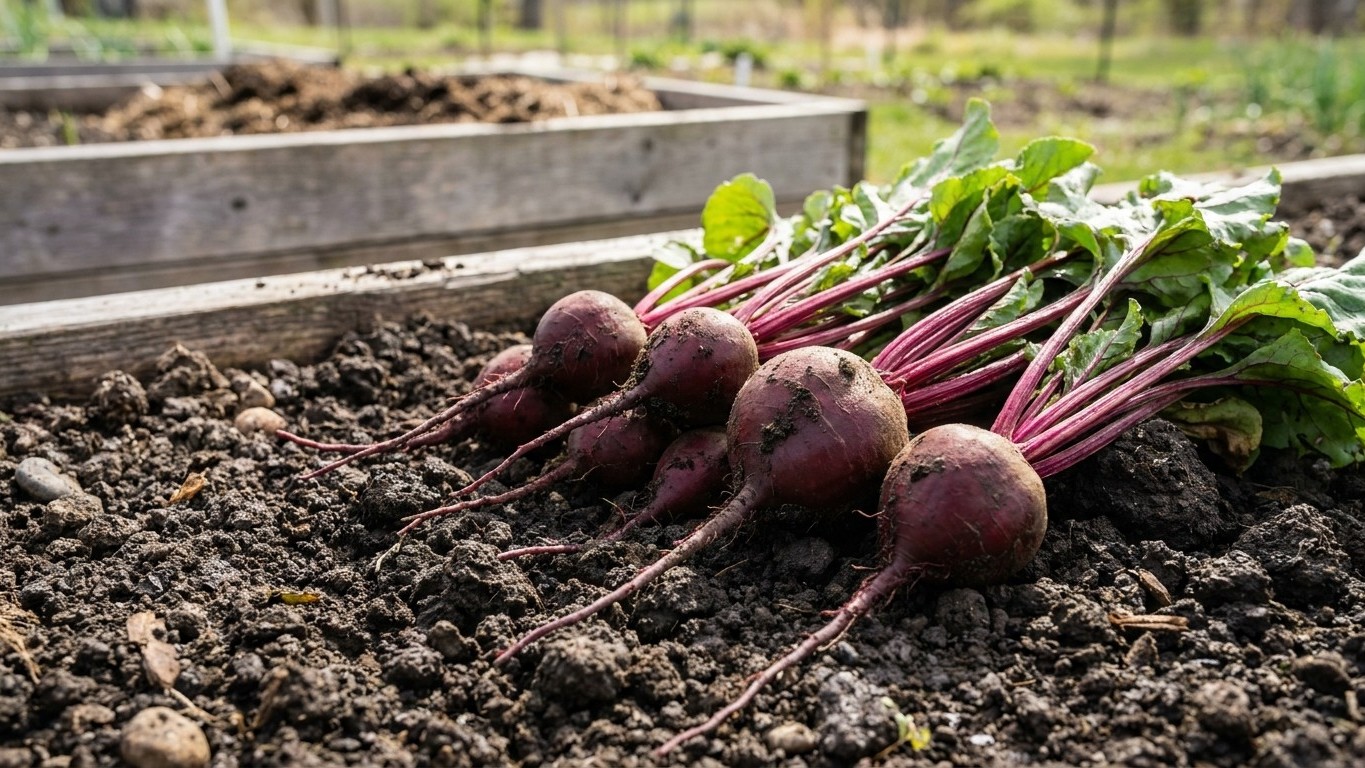

Pull beets 60 to 80 days after seeding, not after sprouting, and pull them before July heat and dry ground turn the root woody. A coastal Portland sowing in early to mid April lands in the ground well before summer. Beets headed for the cellar should be topped, and they should sit at 33 to 36 F. Colder is worse: the USDA’s storage handbook records more black spot and rot at 32 to 34 F.
The short answer
Maine’s official state soil is the Chesuncook series, a Spodosol: sandy, acid, strongly leached ground that typically grows under conifers. USDA NRCS records for the surface horizon show 35 percent sand, 12 percent clay and 53 percent silt, which makes it a loam to silt. It is moderately well drained, with a surface pH of about 5.1 (strongly acid) and organic matter of about 53.0 percent. That last figure tells you the mapped surface is a natural forest-litter layer. A cultivated bed will not look like that.
What does this mean for a beet? Utah State University Extension describes the ideal as deep, sandy, well-drained soil rich in organic matter. Chesuncook is silt-heavy rather than sandy, and “moderately well drained” means water lingers a bit longer than a beet would choose. In a cold, wet spring, that tends to mean slow germination and a root that sits damp. The same silt-rich ground can also form a skin when it dries, which is hard on a seed as small as a beet cluster. Utah State also caps compost at no more than 1 inch of composted organic matter per 100 sq ft, so the answer to heavy ground is restraint, not a pile of amendments. For a closer look at what a beet root meets underground, see Beet Soil in Maine: What the Root Will Meet.
Heat is the other half of the picture. The same Extension source says that heat above 85 F combined with water stress makes the root woody. Portland is the mild end of Maine, though, so a garden inland or to the north will usually see a shorter, later growing season and should expect its own timing. The practical reading is simple: the longer a beet sits in the ground past its window, the more chances a hot, dry stretch has to find it.
One caution about all of the above. A state spans hundreds of soil series, and Chesuncook is the one chosen to represent Maine, not the one in your yard. River bottoms, hill country and any lot a builder has scraped or filled will behave differently. Treat these numbers as a starting point for what the region’s ground tends to do, then get a soil test for your own bed. The pH of 5.1 belongs to the mapped series, never to your garden. If you want the broader growing picture, start with Growing Beets in Maine.
The six weeks that decide it here
The usual advice is to sow beets two to three weeks before the last spring frost. For Portland, NOAA NCEI climate normals put the last 32 F freeze between April 22 and May 1 (that is the 30 to 70 percent probability band). Counting back, the sowing window runs from about April 1 to April 17. Inland and northern Maine run substantially later in spring, so those dates slide forward, sometimes by weeks. Use your own local frost date and do the same subtraction.
Beets are sown in place, so the clock starts at seeding. Sixty to eighty days from an April 1 to April 17 sowing puts the first pulls around the end of May and the last at roughly the first week of July. That is arithmetic from the numbers above, not a published harvest calendar for Maine. A transplant would not change the count, because beets are not transplanted.
Those first six weeks are the ones that matter most. Utah State Extension says water stress during this stretch causes premature flowering, the bolting that sends a beet to seed instead of building a root. Maine springs tend to swing. Snowmelt and mud season keep the ground cold and wet into April, then a warm, windy, dry stretch can arrive in May with little warning. Bolting risk sits in that turn, usually in weeks three to six, when seedlings are established enough to be worth losing but their roots are still shallow. A silt-heavy topsoil that crusts as it dries makes this worse, because the surface looks damp-dark one day and bone-dry the next.
Woodiness is a different failure with a different cause. It comes later, when heat above 85 F meets water stress on a root that is already sizing up. Early thirst makes a beet flower. Later heat makes the root tough. Watering through May does not cure July. The way to dodge the second one is to pull on schedule rather than leave roots in the ground hoping for size. If your sowing was early April, the long end of the 60 to 80 day window lands in early July, which is exactly when the heat starts. The Utah source names five varieties and gives no data on any of them, so there is no good basis here for promising that a particular variety shifts these dates.
Pests also take their share across these weeks. What Eats Beet in Maine, and When covers who shows up and which stage of the plant they go after.
What goes wrong here
Most failures with Maine beets trace back to the ground, the weather swing, or the cellar. These are the ones to plan around, each with its fix.
- Bolting from early thirst. A dry May spell in the first six weeks sends seedlings to flower. Keep the seedbed evenly moist from sowing through week six, and mulch lightly once plants are up.
- Woody roots from later heat. Heat above 85 F with water stress toughens the root. Pull on the 60 to 80 day schedule, keep water steady as roots size up, and do not leave a summer crop to fatten through a hot spell.
- Crusted or soggy seedbed. Silt-rich ground that is only moderately well drained can pack after rain, then seal. Loosen the top few inches before sowing, and consider a raised bed if water stands.
- Too much compost. Utah State Extension caps amendments at no more than 1 inch of composted organic matter per 100 sq ft. More is not better here.
- Assuming your soil is the state soil. The 5.1 pH belongs to the mapped series, not your bed. Test your own soil before adding anything to change it.
- Storing too cold. This is the one that contradicts every other root crop. USDA Agricultural Handbook 66 says more black spot and rot occur at 32 to 34 F than a little warmer. Topped beets belong at 33 to 36 F and 98 percent humidity, and a pit or cellar should stay between 31 F and 41 F. The full text is in the USDA handbook.
- Leaving the leaves on. Bunched beets with leaves last only 10 to 14 days, at 32 F and above 98 percent humidity. Top them first if you want them to keep.
- Storing the small ones. Large roots keep much better because they lose water and shrivel more slowly. Eat the small roots first and save the big ones for storage.
Common questions
How long from seeding to pulling?
Sixty to eighty days, counted from the day the seed goes in. Beets are sown in place, so there is no transplant date to count from. Inland Maine will hit that range later in the calendar than Portland does, because sowing itself happens later.
Is the coldest spot in the cellar best for storing beets?
No. Topped beets keep best at 33 to 36 F and 98 percent humidity. At 32 to 34 F, USDA Handbook 66 records more black spot and rot. The cellar or pit should not drop below 31 F or climb above 41 F.
Should I pull the big beets or the small ones first?
Eat the small ones first and save the large ones for storage. Large roots lose water more slowly and shrivel less, so they keep much better over the weeks ahead. Remove the tops before storing, since beets with leaves attached last only 10 to 14 days.
Does the Chesuncook soil data mean my garden is acidic?
Not necessarily. Chesuncook is Maine’s official state soil, but Maine has hundreds of soil series, and a surface pH of about 5.1 describes the mapped surface layer, not a worked garden bed. A soil test on your own plot is the only way to know your number, and a builder-scraped lot or a river-bottom bed can differ completely from the series that represents the state.