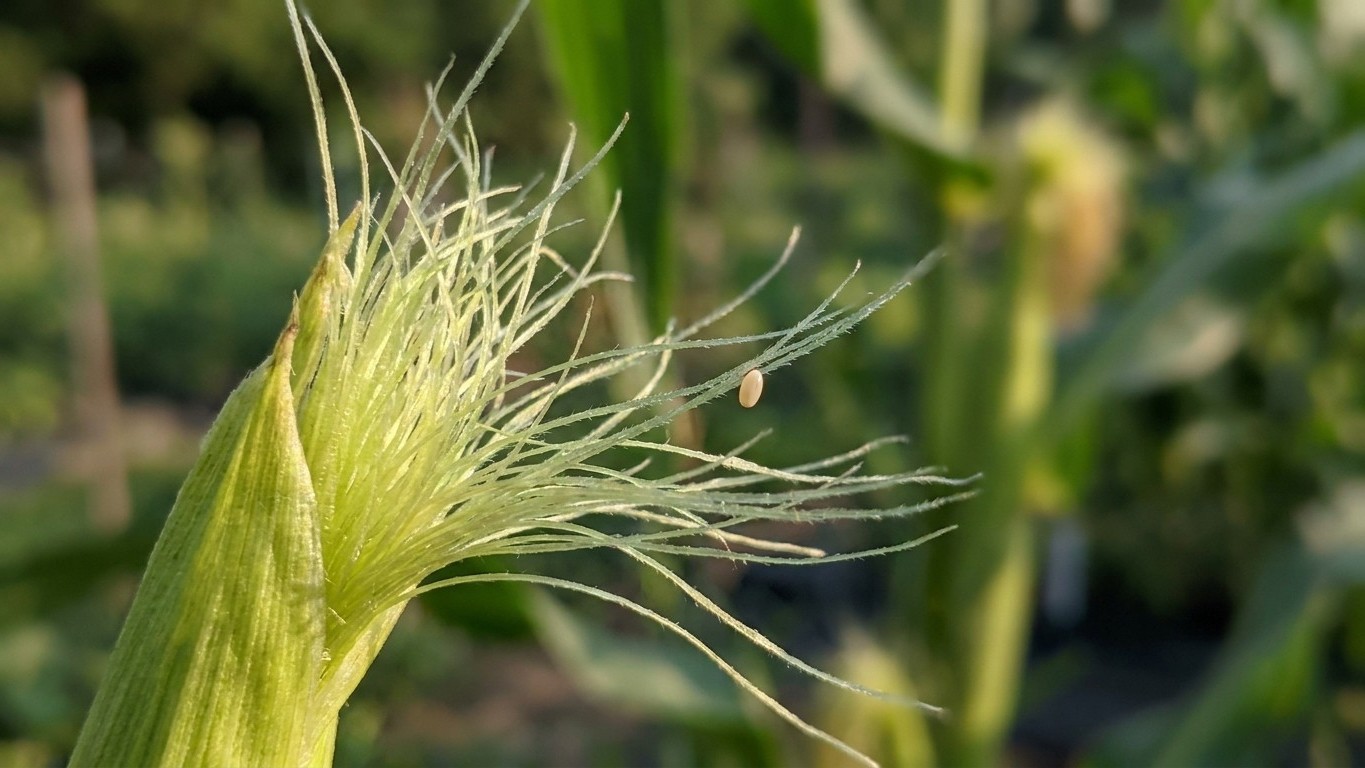

In Maine gardens, the one insect that actually feeds on corn is the seedcorn maggot, and it does its damage underground, right at planting, not once the stalks are standing tall. The University of Maine Cooperative Extension documents several other insects across the state, but most of them belong to trees, squash vines or cabbage-family roots, not corn. Knowing which pest belongs to which crop keeps a slow, gappy corn row from being blamed on the wrong bug.
Which pests attack corn in Maine
University of Maine Cooperative Extension documents ten insect pests found in home landscapes and gardens across the state: Browntail moth (Euproctis chrysorrhoea), Cabbage maggot, Colorado potato beetle, Emerald ash borer, Lily leaf beetle (Lilioceris lilii), Seedcorn maggot (Delia platura), Spotted wing drosophila, Squash vine borer, Striped cucumber beetle, and Winter moth.
Nine of those ten have nothing to do with a corn patch:
- Browntail moth caterpillars feed on the leaves of oak, apple and other hardwood trees, not vegetables.
- Cabbage maggot tunnels into the roots of cabbage, broccoli and radish, a different plant family entirely.
- Colorado potato beetle strips foliage from potato and other nightshades, not corn leaves.
- Emerald ash borer is a wood-boring insect that lives its whole life inside ash trees.
- Lily leaf beetle feeds only on true lilies.
- Spotted wing drosophila lays eggs in soft-skinned fruit like raspberries and blueberries, not grain.
- Squash vine borer bores into squash and pumpkin stems, not corn stalks.
- Striped cucumber beetle feeds on cucumbers, squash and melons.
- Winter moth caterpillars defoliate trees and shrubs each spring, not garden vegetables.
That leaves seedcorn maggot as the only insect on the list that actually eats corn. Its larvae feed on planted seed and the roots of germinating seedlings, underground, before a plant has even broken the surface. They favor cool, wet soil that’s rich in decaying organic matter, which is exactly the condition a garden is in during a chilly, damp spring. The decisive factor is how long the seed sits in soil colder than the 60 F sweet corn needs before it germinates: a fast sprout in warm soil gives the maggot little time to find it, while seed stalled in cold ground is exposed for days.
University of Maine Cooperative Extension does not document a longer list of corn-specific insects for this state, and this page won’t stretch the list to make it seem otherwise.
When each one shows up, and what it does first
The seedcorn maggot’s window is short and specific: it runs from the moment seed goes in the ground until the seedling is up and rooted. Maine’s last spring frost falls between April 22 and May 1 depending on location, but sweet corn shouldn’t go in the ground right at that date, because the soil needs to warm above 60 F first. That gap between frost leaving and soil reaching 60 F is the maggot’s best opportunity, since seed planted into still-cold ground can sit ungerminated for an extended stretch.
What a gardener sees first isn’t the insect. It’s a gap. Rows come up with missing plants, or a seed that never sprouts at all. Sometimes a seedling does emerge, only to wilt and collapse within days, its underground roots already chewed through. There’s no leaf damage to spot from above, because the feeding happens below the soil line.
Once a corn plant is past the seedling stage, rooted and growing several true leaves, it’s effectively out of danger from this insect. Seedcorn maggot doesn’t attack mature stalks, silks or ears. The rest of the season’s calendar belongs to the crop itself, not the pest. Sweet corn needs 60 to 90 days from planting to reach maturity, and that whole span has to fit before the first fall frost, which lands between October 9 and October 21 depending on location. Inland and northern parts of the state lose time on both ends, since spring arrives later there and fall arrives sooner.
Closer to harvest, the clock changes. From the day silks first appear, ears typically need 17 to 24 days before they’re ready to pick, a separate count from the 60-to-90-day planting-to-maturity figure. Ripeness itself is judged by three signs together: dry, browned silks, husks that are still moist and green, and milky juice from a punctured kernel. Any one of those alone isn’t enough to call an ear ready.
If more than one type of sweet corn is planted in the same garden, su, se and sh2 varieties lose their sweetness if they tassel at the same time. The fix is timing and layout, staggering plantings or choosing types that won’t pollinate together, and growing each type in a block of three or more rows rather than a single thin line.
Telling the damage apart from everything else
A missing or wilted corn seedling has more than one possible cause, and digging up the failed seed is the fastest way to sort them out. That single check, pulling the seed or seedling and looking at it directly, decides more than any guess based on the pattern of the row.
| Symptom | Possible cause | What tells it apart |
|---|---|---|
| Seed never sprouts, gaps in the row | Seedcorn maggot feeding underground | Digging up the kernel shows tunneling and a small legless larva inside or nearby |
| Seed never sprouts, gaps in the row | Cold, waterlogged soil (rot) | Kernel is soft, mushy or moldy, with no larva present; often planted before soil reached 60 F |
| Seedling emerges, then wilts and collapses | Seedcorn maggot on the roots | Small maggots visible in the soil right at the base of the stem |
| Seedling emerges, then wilts and collapses | Damping-off (fungal disease) | Stem is pinched dark right at the soil line; no insect present; spreads to neighboring seedlings |
| Whole section of row missing, seed shells scattered on top | Birds or rodents removed the seed | Hulls or shell fragments lie on the surface; no tunneling inside remaining kernels |
None of this replaces an actual look by someone trained to identify it. If digging up a few failed seeds doesn’t give a clear answer, that’s the point to bring a sample, or a clear photo, to a local extension office rather than guess.
What actually works here, and what is a waste of time
Because seedcorn maggot only matters during the brief window between planting and rooted seedlings, timing does more work than any product would. Waiting until soil is reliably above 60 F before planting is the single change that shrinks the risk the most, since it cuts down the days seed spends vulnerable underground.
A few other habits help without needing a name-brand product. Avoiding the incorporation of fresh manure or heavy amounts of decomposing organic matter right before planting matters, since the adult flies that lay these eggs are drawn to decaying material in the soil. Rotating where corn goes from year to year, rather than planting in the same spot that had a heavy infestation, also reduces the odds. A physical row cover placed over the bed right after planting and removed once seedlings are established can help keep egg-laying adults away from freshly worked ground.
What doesn’t help: treating the soil or foliage after seedlings already have several true leaves. By that point the vulnerable window is over, and any treatment aimed at this insect is addressing a problem that’s already passed. Planting extra thick to “outrun” losses doesn’t fix the underlying issue either, since it does nothing about cold, wet soil, it just multiplies the number of seeds exposed to it. This page doesn’t recommend specific insecticides or treatments by name; what’s registered for use in Maine, and how to apply it correctly, is a question for University of Maine Cooperative Extension, not a garden blog.
Where to check this for your own county
University of Maine Cooperative Extension is the authority for this state, and it operates through county offices that track conditions closer to the ground than any statewide list can. What’s documented for Maine overall doesn’t mean it’s present in a specific garden, and the reverse is also true: a quiet season statewide doesn’t rule out a bad year in one particular spot.
Coastal areas around Portland sit at the mild end of Maine’s climate, with an earlier last frost and a later first frost than inland or northern parts of the state. A planting schedule or pest timing that works on the coast can be off by weeks further north, which is exactly the kind of detail a county office can speak to directly.
The next step, if a corn stand is coming up patchy or seedlings are collapsing, is contacting the county office of University of Maine Cooperative Extension with a sample or a photo. That’s a more reliable answer than matching symptoms against a list online.
Common questions
Does seedcorn maggot come back later in the season for a second planting?
The risk is tied to cool, slow-germinating soil at planting time. A second sowing made into soil that’s already warm and fast-draining faces a much shorter window of exposure than the first planting of spring.
Can seedcorn maggot damage corn once it’s a foot tall?
No. The larvae feed only on seed and the roots of very young seedlings underground. Established plants with several true leaves are past the stage this pest attacks.
Do the other nine pests on Maine’s list ever turn up near a corn patch?
They can be present in the same yard, since a garden often sits near trees, cabbage-family crops or squash. But being nearby isn’t the same as feeding on corn: a striped cucumber beetle working the squash bed next to the corn rows is still only interested in the squash.
Where can a pest identification actually be confirmed?
The county office of University of Maine Cooperative Extension is set up to look at a sample or photo directly, which is a more reliable answer than matching symptoms against a general list.