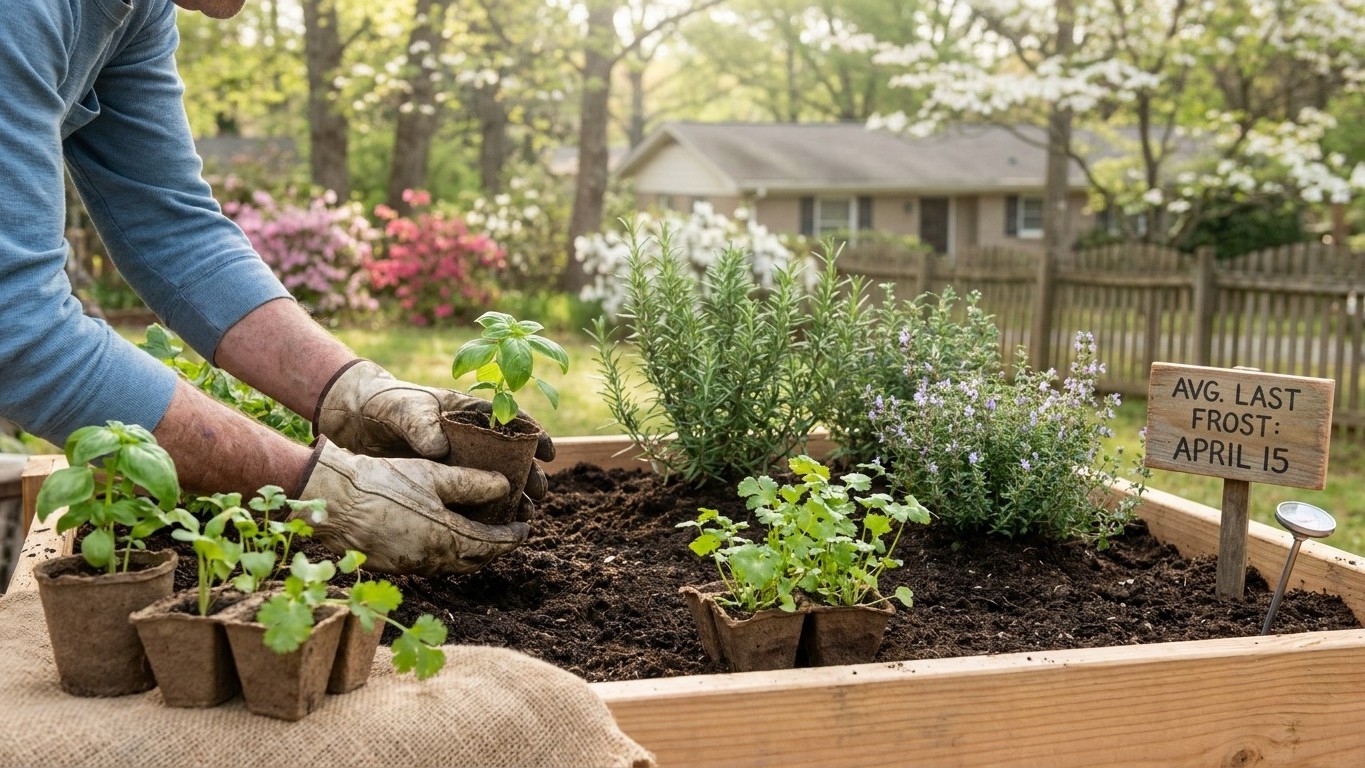

Manitoba gardeners get one workable window: sow hardy herbs outdoors starting around the last spring frost, but that date is a mean, not a guarantee, and the season closes fast enough that tender herbs need a head start indoors. The math behind that answer is worth walking through before you touch a seed packet.
The short answer for Manitoba
Environment and Climate Change Canada puts the average last spring frost at Winnipeg Richardson Int’l A at May 23, and the average first fall frost at September 22. That’s a growing season of roughly 122 days between two averages, which sounds like a plan until you read what “average” means here. These are mean dates from the 1981-2010 Canadian Climate Normals, not a probability band. In one year out of two, frost arrives later than May 23 in spring, or earlier than September 22 in fall. Treat both dates as the midpoint of a window, not a safe line to plant on.
For direct-sown hardy herbs, that midpoint is your starting cue: dill, cilantro, chives, and parsley tolerate a light frost and can go into the ground once soil has warmed near that late-May mark. Basil, on the other hand, is killed outright by any frost at all, so it has no business outdoors before early June in a typical year, and it needs the extra buffer precisely because half of all years run colder than average past May 23.
The tighter constraint is the other end of the season. With roughly 122 average frost-free days to work with, and given that the mean daily minimum of Manitoba’s coldest month sits at -6.6°F, there’s no coasting into a long fall harvest the way a warmer region might. Anything that needs 90-plus days to mature from seed, thyme grown from seed rather than division, for instance, is working with almost no margin if it’s started outdoors after the frost-free window opens rather than transplanted as a seedling.
That’s why the practical calendar for Manitoba splits herbs into two tracks. Track one: hardy, fast, direct-sown outdoors from roughly late May, dill, cilantro, chives. Track two: tender or slow-growing, started indoors four to six weeks before the mean last frost date and transplanted out only once the real risk of frost has passed locally, basil, parsley, and any perennial herb you’re establishing from seed rather than a nursery plant. Soil temperature data specific to Manitoba is not available, so lean on the frost dates and your own observation, covered further down, rather than a fixed calendar date.
What will not work here

A 122-day average window between mean frost dates defeats any herb that needs a long, leisurely season to bulk up. This is not a place to direct-sow slow perennial herbs from seed and expect a harvest the same year; a seed-grown rosemary or lavender needs more warm days than the gap between May 23 and September 22 reliably offers, especially in the roughly one year in two when frost arrives before that fall average.
Rosemary and bay laurel specifically fail here for a different reason, and it has nothing to do with the growing season length. Manitoba sits in Canadian hardiness zone 3b at the reference station, and the mean minimum of the coldest month runs to -6.6°F. Rosemary is hardy to roughly USDA zone 7 at best, and while the Canadian and USDA systems don’t convert directly, no reading of either scale puts a Mediterranean woody herb like rosemary or bay through a Manitoba winter outdoors. These are herbs to grow as annuals, or to pot up and bring indoors before the first fall frost risk sets in around late summer, not to plant in open ground and expect back next spring.
Watering habits that work in a milder, wetter climate also stumble here. Prairie summers swing hot and dry for stretches, and an herb bed watered once a week on a fixed schedule, rather than checked by hand, will show stressed, bolting cilantro and woody, bitter basil leaves before August is out. Shallow-rooted herbs in particular, basil and cilantro again, need more frequent, lighter watering through a Manitoba dry spell than a once-a-week routine provides.
Finally, cramming a full Mediterranean herb garden, rosemary, sage, thyme, oregano, into one bed and expecting uniform results ignores how differently these plants read a short season. Sage and thyme, both slower to establish, can be pushed by starting from purchased transplants rather than seed; oregano spreads fast enough that seed is fine. Treating them as interchangeable on one calendar is where a lot of Manitoba herb beds go wrong in year one.
What changes across Manitoba
The 3b hardiness rating cited above belongs to the reference city, generally Winnipeg’s climate station, not to the province as a whole. Manitoba is not one garden. It stretches from farmland along the US border to boreal forest and tundra near Hudson Bay, and hardiness zones across that range span from the mild end near 4a in sheltered southern pockets down through zone 2 and colder in the far north. There is no single zone number that describes Manitoba.
What that spread means in practice: a reader gardening near the Manitoba-North Dakota border is likely working with a longer effective season and a milder winter minimum than the -6.6°F figure cited here, which comes from a Winnipeg-area station. A reader farther north, or at higher elevation on the escarpment country west of the Red River Valley, should expect the last spring frost to land later than May 23 and the first fall frost to arrive earlier than September 22, which shortens that already tight 122-day window further still.
The shift that matters most for herb planting specifically is at the edges. Perennial herbs that might limp through a mild Manitoba winter in a protected, snow-covered spot near Winnipeg have essentially no chance farther north, where the coldest-month minimum runs colder than -6.6°F. Annual and tender herbs are less affected by the zone shift itself but are hit harder by a shorter frost-free season the farther north you go.
Rather than guess where you fall on that spread, check your own location against Natural Resources Canada’s Plant Hardiness Zone map, which is built from 1991-2020 normals and lets you look up hardiness by municipality rather than relying on a provincewide average.
Where to check this for your own county
Manitoba doesn’t use counties the way many US states do, but the equivalent step still applies: check with a local, not provincewide, source before finalizing a planting date. The provincial agriculture resource, Manitoba Agriculture, is the place to start, and it’s worth being specific about what to look for once you’re there rather than browsing generally.
Two things matter most. First, a local or regional planting calendar, if one exists for your municipality or rural municipality, will reflect frost data closer to your actual garden than the Winnipeg-area station. Second, look for any variety trial results or recommended cultivar lists specific to Manitoba growing conditions, since seed catalogs written for a national US or UK audience rarely account for a 122-day average frost-free window or a -6.6°F coldest-month minimum.
A regional or municipal recommendation beats a provincewide one every time, for the same reason a county extension calendar beats a statewide one in the US: the person compiling it is working with data closer to your actual soil and microclimate. The provincewide picture is built from a single reference station’s climate normals. It’s useful for understanding the shape of a Manitoba herb-growing season, the split between hardy and tender herbs, the reason woody Mediterranean perennials don’t overwinter outdoors, but it is not a substitute for whatever local guidance Manitoba Agriculture or a regional extension office can offer for your specific municipality.
If nothing municipality-specific is available, the provincial frost and hardiness data used here remains the most defensible starting point, adjusted by your own position on the north-south spread described above.
Checking this against your own garden
Every date here is an average pulled from decades of climate data at one station. Your own garden will tell you something more current and more local, and it outranks the calendar every time the two disagree.
Start with soil warmth by feel. Push a finger a couple of inches into the bed where you plan to direct-sow dill or cilantro. If it feels cold and damp rather than merely cool, the soil hasn’t caught up to the air temperature yet, regardless of what the calendar date says, and seed sown into it will sit and rot rather than germinate.
Watch for the first true leaves on anything you’ve started indoors or direct-sown. The rounded seedling leaves that appear first are stored energy from the seed itself; the second set, usually more textured and shaped like the mature plant, is the first growth the seedling has actually produced from its own roots and light. Their appearance tells you the plant has established, which matters more than counting days since sowing when you’re deciding whether it’s strong enough to transplant outdoors.
For herbs that flower, dill and cilantro both bolt to flower quickly under heat or stress, the first flush of flowers is useful information in the other direction: it’s an early warning that the plant is running its life cycle faster than you’d like, often because of a hot, dry stretch exactly like the ones that defeat weekly-schedule watering in a Manitoba summer. Catching that flush early lets you adjust watering or plan a second sowing before the whole bed bolts at once.
The Moon calendar is a separate, older custom: see when to plant herbs by the moon, written as tradition rather than fact.