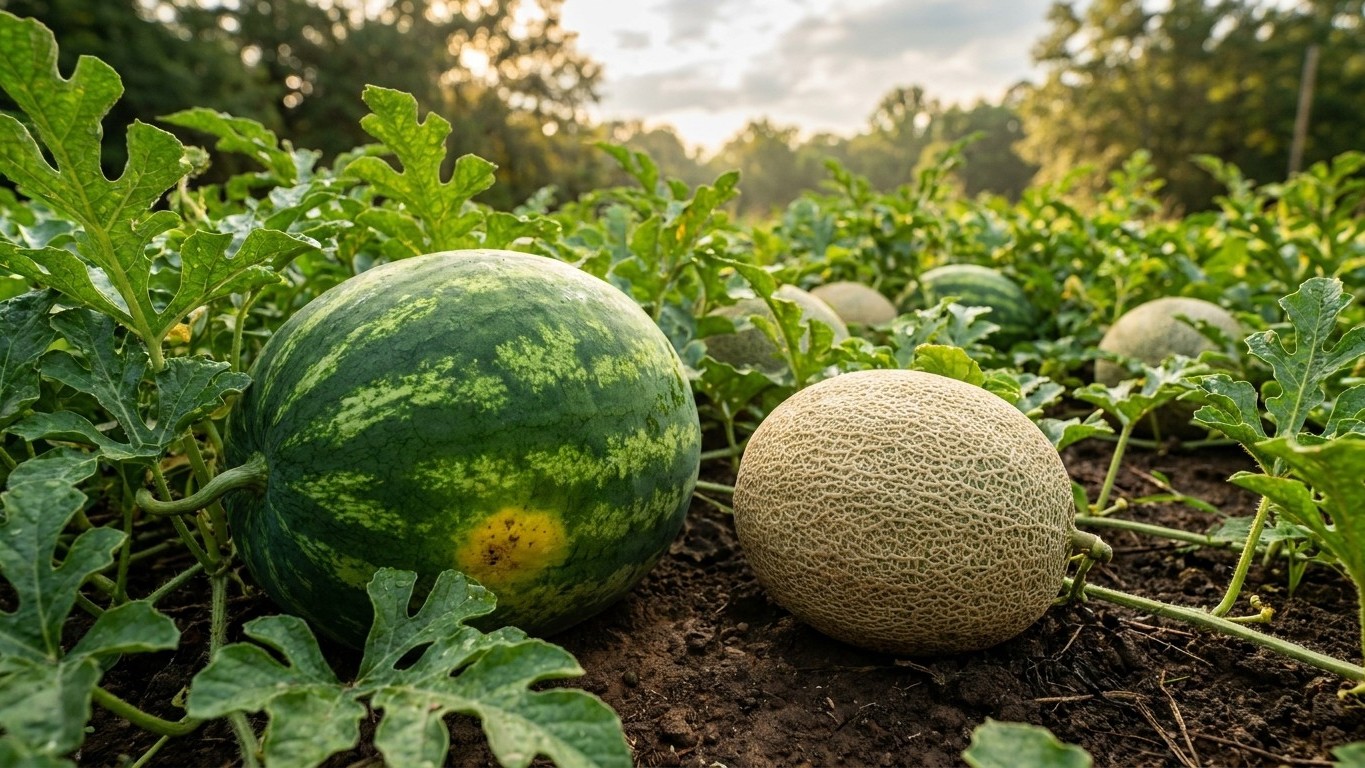

Short-season melons are the only realistic bet in Manitoba: cantaloupe and muskmelon types bred for 65 to 80 days, plus a handful of icebox watermelons under 80 days. Long-season honeydews, casabas and full-size watermelons are built for climates with real summer heat, and Manitoba’s mean frost window plus a heat record of zero days above 90F work against them.
The short answer for Manitoba
Start with the two numbers that actually decide this: the mean last spring frost at Winnipeg Richardson falls on May 23, and the mean first fall frost lands September 22. That’s a 122-day span between two averages, not a guarantee. Environment and Climate Change Canada is explicit that these are mean dates, which means in roughly half of all years the spring frost arrives later than May 23, and the fall frost can arrive earlier than September 22 too. Treat 122 days as the best-case midpoint, not a number you can bank a variety’s maturity date against.
That single fact rules out entire categories of melon before you even look at flavor. Anything listed at 90 days or more to maturity is asking for a season that, in a bad year, simply doesn’t show up. The safer play is to work backward from a shorter number, something in the 65 to 80 day range, and treat transplants (started indoors four to six weeks before the mean frost date) as the way to buy back the days that field-sown seed can’t afford to lose.
Matching melon type to Manitoba’s season
| Melon type | Typical days to maturity | Fit for this province |
|---|---|---|
| Cantaloupe / muskmelon, early types | 65–80 days | Best fit; the standard recommendation here |
| Icebox / short-season watermelon | 70–80 days | Workable, but no margin for a late spring |
| Honeydew | 80–90 days | High risk; only the earliest cultivars are worth trying |
| Full-size watermelon | 85–100+ days | Not a realistic choice |
| Casaba, canary, Charentais | 90–100+ days | Skip these entirely |
The pattern is simple: the shorter the number printed on the seed packet, the more room you leave for the year the frost doesn’t cooperate. In Manitoba, that margin is the whole game.
What will not work here

Days to maturity is only half the story, and it’s the half most gardeners fixate on. The other half is heat, and Manitoba’s record on heat is stark: the mean number of days per year reaching 90F is 0.0. Melons are warm-season fruit that need accumulated heat to convert starches into sugar, not just a calendar count of days. A cantaloupe rated “75 days” was very likely timed in a location that regularly hits the 90s in July and August. Grown here, with essentially no days that hot, that same plant runs functionally longer than 75 days, because the heat units it was counting on never arrive. This is the single biggest reason gardeners in this province end up with vines full of fruit that stall out small and mealy in early September.
Moisture works against the slow varieties too, in a different way. Summer rainfall here averages about 9.7 inches across June, July and August, with June the wettest month at 3.54 inches and August the driest at 3.03 inches. That’s not an extreme number on its own, but combined with the long, slow-ripening melons already stretched past their heat budget, it’s enough humidity to give powdery mildew and other fungal problems the extra week they need to take hold before the fruit is ready. Planting long-season melons at tight spacing, or letting vines sprawl into a shaded, poorly ventilated corner, compounds a problem that a short-season variety would have already escaped by ripening early.
Put the two together and the failure mode is predictable: a 90-day-plus watermelon, direct-seeded rather than transplanted, planted in a damp low spot, is fighting three separate limits at once (insufficient heat, a frost that may arrive before the fruit finishes, and disease pressure from lingering summer moisture). None of those are exotic risks specific to a bad year. They’re the ordinary conditions this province produces most summers, which is exactly why the long-season types keep disappointing gardeners who try them anyway.
What changes across Manitoba
The hardiness zone figure of 3b in the Canadian system describes the reference station at Winnipeg, not the province as a whole. That distinction matters more here than almost anywhere, because the Canadian zone system is built from seven climate variables rather than the single minimum-temperature reading the USDA system uses. Natural Resources Canada is blunt about this: there is no simple conversion between the two systems, and a single Canadian zone can span nine different USDA zones. So treat 3b as a description of Winnipeg’s conditions specifically, useful as a reference point, not as a number to apply to a garden two hundred miles away.
Manitoba is not one climate. A province running from the U.S. border north toward Hudson Bay covers a huge range of growing conditions, and a gardener near the southern farmland belt is working with a meaningfully longer, warmer season than one further north or on higher, more exposed ground. That gap shows up directly in when the last spring frost actually lifts and when the first fall frost actually lands, both of which shift earlier and later than the Winnipeg means as you move north. Rather than guess at a corrected zone number, check the interactive map Natural Resources Canada publishes, which lets you look up conditions closer to your own location rather than relying on the single reference city of Winnipeg.
The practical shift for anyone north of the Winnipeg reference point: assume less usable heat, not more, and lean toward the shortest-maturity end of the range already recommended above. Transplants become less of an option and more of a requirement, since direct-seeded melons lose ground fast once the effective season shrinks. No one should try to pin down their own zone from these numbers alone. That’s what the map is for.
Where to check this for your own county
Manitoba’s provincial picture rests on one reference station’s climate normals. That’s useful for setting expectations, but it is not a substitute for what your own region’s agricultural office publishes, and Manitoba Agriculture is the right place to look next.
Two things are worth searching for once you’re there. The first is a regional or local planting calendar, since Manitoba Agriculture and its regional offices track frost data and growing-degree-day accumulation by district, which will always be closer to your actual garden than the single Winnipeg station. The second is any variety trial information specific to melons, since provincial and regional trials sometimes name cultivars that have actually performed well in local field conditions, information a general province-wide page like this one can’t responsibly claim to have.
The reasoning here is straightforward rather than a formality: a recommendation built from your own municipality’s growing season will always outrank a provincial average, because a provincial average is, by definition, smoothing over exactly the north-south and elevation differences described in the previous section. The local one is the version that actually matches your soil, your frost pocket, and your particular stretch of summer.
Checking this against your own garden
Every date here is a mean drawn from three decades of records at one airport station. Your own garden will confirm or contradict it faster than any calendar can, and three simple observations tell you more than the numbers above ever will.
Soil warmth by feel is the first and most direct check: press a bare hand into the planting bed in the morning, and if it feels merely cool rather than cold, melon seed or transplants have a reasonable shot at establishing, regardless of what the calendar says the date is. Melons that go into soil still gripped by spring chill sit and sulk rather than grow, which costs more real days than waiting another week would have.
The first flush of male flowers is the second signal worth tracking, since male blooms typically open before the female flowers that actually set fruit, and their appearance is a rough read on how much accumulated warmth the plant has banked so far that season. A vine flowering weeks later than a neighbor’s, on the same soil, is telling you something about a shadier spot or a cooler microclimate that no provincial average could have predicted.
The first true leaves, the ones that emerge after the initial seed leaves and actually look like miniature melon foliage, mark the point where the plant has moved from surviving on stored seed energy to growing on what the garden itself provides. Slow, pale true leaves are an early warning that the bed isn’t warm or fertile enough yet, well before the plant shows any other sign of trouble, and they’re worth acting on rather than waiting out.