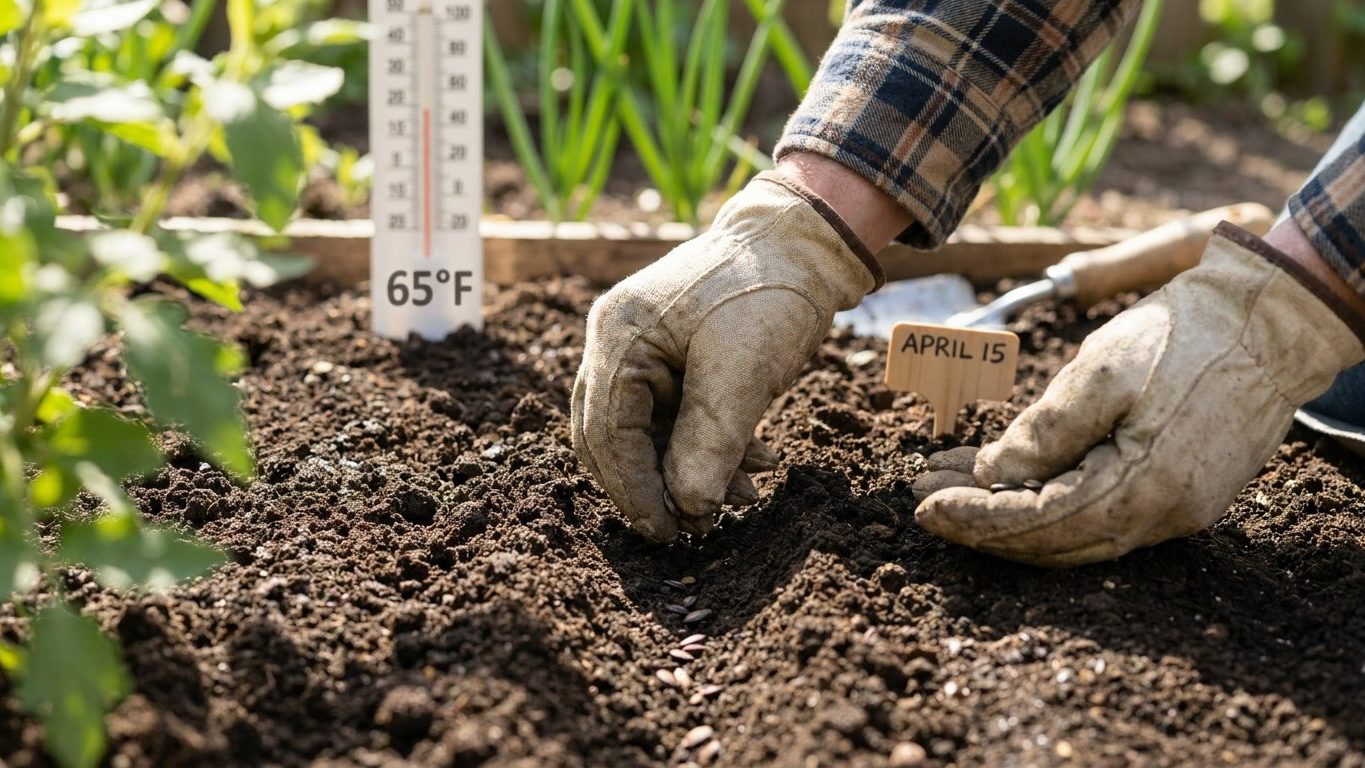

Manitoba’s frost dates put melon transplants in the ground close to May 23, the average last spring frost recorded at Winnipeg’s Richardson International Airport station. But that date is a coin flip, not a guarantee, and the growing season it opens closes fast: the average first fall frost lands September 22, leaving roughly 122 days to work with, and melons need every one of them.
The short answer for Manitoba
Start melon seed indoors, not outdoors. Manitoba’s frost-free window runs from a mean last spring frost of May 23 to a mean first fall frost of September 22, both figures from Environment and Climate Change Canada’s 1981-2010 normals at the Winnipeg Richardson station. That’s an average of 122 days between them, but the word “average” matters here more than usual.
Both dates are means, not safe thresholds. A mean frost date is the midpoint of a distribution: in roughly half of all years on record, frost arrived later than May 23, and in roughly half, the first fall frost came before September 22. Treat May 23 as the point where the odds tip in your favor, not the day you can safely set melons outside without a backup plan.
Given that, the practical calendar looks like this: sow melon seed indoors around late April, three to four weeks before you intend to move plants outside. Transplant into the garden after May 23, but build in a buffer of several days to a week, since the mean date still carries a real chance of frost. Keep a floating row cover or an old bedsheet within reach through the first week of June regardless of the calendar.
Melon type matters as much as the calendar here, because the 122-day window is a ceiling, not a target.
| Melon type | Typical days to maturity after transplant | Fit with Manitoba’s ~122-day window |
|---|---|---|
| Early, short-season cantaloupe | 65-75 days | Workable, with margin for a late spring or early fall frost |
| Standard muskmelon | 75-85 days | Tight; needs black plastic mulch and row cover to bank extra heat |
| Large watermelon | 85-100+ days | Rarely ripens outdoors without season-extension on every front |
Choose from the top of that table, and choose transplants started indoors, and the math has a chance of working.
What will not work here

Direct seeding melons into the ground is the first thing that fails in Manitoba, and it fails for a simple reason: melon seed needs warm soil to germinate, and cool spring soil combined with a 122-day ceiling leaves no room for the two or three weeks direct-seeded melons spend just getting out of the ground. Every day spent germinating outdoors is a day subtracted from an already short season.
Long-season melon varieties fail for the same math. A watermelon that needs 85 to 100 days from transplant to harvest, planted after the May 23 mean frost date and racing a September 22 mean first frost, is working with almost no slack. Add the fact that in half of recorded years the spring frost arrives later than May 23, and a 100-day variety can lose its transplant date entirely to a cold snap, then have no days left to make up the difference.
Heat-hungry varieties struggle even when the season length works out. Manitoba records an average of 0.0 days a year above 90°F at the reference station, meaning the sustained heat that pushes fruit from green to ripe in a warm-climate garden essentially doesn’t happen here. Varieties bred for high heat-unit accumulation, the kind that thrive in a long, scorching Prairie or southern-state summer, simply don’t get the degree-days they were bred for. This is the reason black plastic mulch and row covers show up so often in Manitoba melon advice: they aren’t optional extras, they’re substitutes for heat the climate isn’t providing.
Tight spacing carries its own risk, and it comes from the wetter side of the ledger. June is Manitoba’s wettest summer month at roughly 3.54 inches of rain, more than July’s 3.13 inches or August’s 3.03 inches. That early-season moisture, landing right when melon vines are filling in, raises humidity around the leaves. Crowd plants close together and that humidity lingers longer between leaves, which is exactly the condition powdery mildew and other fungal diseases need. Wider spacing than a seed packet from a drier region recommends, and airflow between plants, matter more here than the rainfall total alone suggests.
What changes across Manitoba
Canadian hardiness zone 3b is specific to the reference city behind Manitoba’s climate normals. It is not a province-wide number, and Manitoba is not one garden. A province that stretches from the U.S. border north into the Canadian Shield and beyond does not sit in a single hardiness zone.
What the 3b figure does tell you is the scale of the challenge at the reference point: a short, cool-summer classification under a system that weighs seven separate climate variables, not just winter minimum temperature. Move north from that reference point and the season shortens further, both dates in the frost window closing in from opposite ends. Move toward the Red River Valley or other lower-lying, more sheltered pockets in the south of the province, and local growers sometimes find a slightly longer effective season than the provincial averages suggest, though nothing here confirms that for any specific location.
There is no single Manitoba answer to “what zone am I in.” Canadian hardiness zones can shift by a full grade or more within a relatively short distance, especially where elevation, a large lake, or a river valley moderates the local climate. Rather than guess at a zone from a general description of where you garden, check the actual mapped zone for your location at Natural Resources Canada’s Plant Hardiness Site (planthardiness.gc.ca), which maps the country down to the municipality. That map is the source for your specific zone.
Where to check this for your own county
Everything above is a provincial-level picture, built from one reference station’s climate normals. It’s useful for understanding the shape of the season, but it is not a substitute for local trial data, and Manitoba is large enough that local data can diverge meaningfully from the provincial averages.
Manitoba Agriculture, the province’s extension service, publishes location-specific guidance. Two things are worth looking for there. First, any planting calendar or seeding-date guidance specific to your part of the province, since local agronomists adjust recommendations for known microclimates that a single Winnipeg-based frost normal can’t capture. Second, look for variety trial results or recommended cultivar lists for vegetable crops in your region. Melon varieties that have actually been grown and timed by extension trials in Manitoba conditions carry more weight than any general days-to-maturity figure printed on a seed packet from a supplier in a warmer climate.
A recommendation tied to your own district will beat a provincial one every time, for the same reason a tailored answer beats an average: it accounts for local soil, local frost pockets, and local growing-degree accumulation that a single reference station can’t. The provincial and station-level picture is the broad one, consistent across a large area. It’s the broad picture, not the local one, and Manitoba Agriculture is where the local picture lives.
Checking this against your own garden
Soil warmth is the first check, and you don’t need a thermometer to feel it: cold, damp soil that clings and feels raw to the touch is still too cold for melon roots to establish, even if the calendar says the mean frost date has passed. Soil that feels dry-crumbly and mild when you work your fingers a couple of inches down is a better sign that root growth will actually proceed rather than stall.
The first flush of male flowers on a melon vine is the second signal worth watching. Melons produce male flowers before female ones, sometimes well before, and a vine throwing plenty of male blooms with no female flowers yet is usually still building the vegetative growth it needs before it can commit energy to fruit. That gap between the first male flowers and the first female ones is a rough read on how much heat and time your specific plants have banked so far.
The first true leaves, the ones that emerge after the two rounded seed leaves, mark the point where a transplant has moved from surviving the shock of transplanting to actually growing. Slow true-leaf development after transplanting, compared to what the same variety did indoors under grow lights, is often the clearest sign that outdoor soil or air temperature is running behind what the calendar suggests it should be.
Some gardeners also time melons by the Moon: when to plant watermelon and cantaloupe by the moon, as almanac tradition rather than fact.