
Manitoba peppers ripen because the province racks up almost no days hot enough to stall fruit set, not because the season is long. The tradeoff is a short window bookended by a frost date that moves year to year and by cool nights this site can’t measure for you. Get the seed-starting math right and pick varieties that don’t need a heat wave to finish, and ripe peppers are realistic here.
The short answer

Start with the number that actually works in your favor: the Winnipeg reference station’s climate normal shows 0.0 days a year at or above 90°F. For peppers, that’s good news on one specific point. High heat above 90°F causes pollen to go sterile and blossoms to drop before they ever set fruit, and a Manitoba pepper patch essentially never faces that problem. You’re not going to lose a crop to a July heat dome the way a grower further south might.
But pepper fruit set fails at both ends, and the cool end is the one Manitoba growers actually need to watch. Nights below 55°F stop pollen from developing properly just as surely as extreme heat does, and a short prairie summer means those cool nights show up more than once, especially in early June right after the frost-free window opens and again as August winds down. This site tracks daytime heat loads across territories, but it does not carry summer night minimum temperatures. That’s not a gap you can fill by guessing based on latitude or by looking at how cold the coldest month gets. Overnight lows in a given yard depend on drainage, tree cover, distance from a lake or river, and elevation, none of which a regional average captures. If cool nights matter to your fruit set, and in Manitoba they usually do, put a min-max thermometer in the garden and read it yourself.
There’s a second number worth knowing once flowers actually appear. According to Utah State University Extension, pepper fruit takes roughly 35 to 45 days to develop and ripen counting from the flower, not from the day you sowed seed or set out transplants. That distinction matters in a short season: a plant that flowers late in a cool June has to squeeze that 35-to-45-day window into whatever warm weeks remain before the next round of cool nights arrives. Utah State’s guidance names six pepper varieties suited to home gardens but doesn’t attach a heat rating, a days-to-maturity figure, or a mature size to any of them. That means the safest strategy isn’t hunting for one named type promising a super-fast finish. It’s starting early enough, indoors, that whatever variety you plant already has flowers open by the time the warm stretch of summer begins.
When to start seed here
- Anchor to the mean last spring frost date. For the Winnipeg area, Environment and Climate Change Canada’s 1981-2010 climate normals put the average last spring frost at May 23, based on the Winnipeg Richardson Int’l A station. That figure is a mean, not a safe planting date. In roughly half the years on record, frost arrived after May 23, so treat it as the midpoint of a window rather than a green light.
- Account for where you actually garden. A province this size is not one climate. Northern districts and higher, more exposed ground can run weeks behind the Winnipeg station’s average, so growers outside that immediate area should push their working frost date later, not earlier, until they’ve tracked their own site for a season or two.
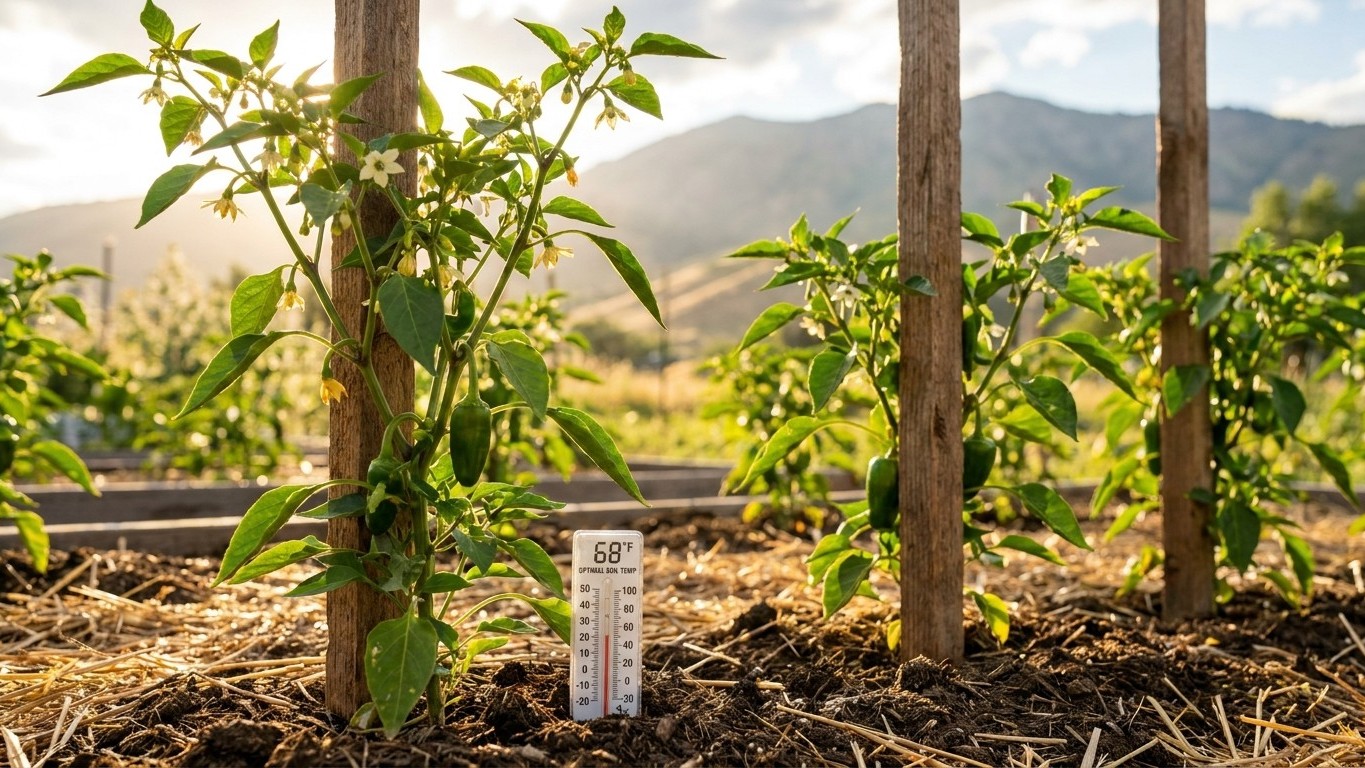
- Wait for soil, not just air, to warm. Utah State University Extension recommends transplanting peppers only after the danger of frost has passed and once the soil itself reaches 60°F. Soil temperature typically lags behind air temperature by a week or two after the last frost, particularly in a raised bed that hasn’t been mulched yet or heavy clay ground that holds cold.
- Set your transplant date first, then count backward. Once you have a realistic transplant date built from the frost mean plus your own buffer plus the soil-warming lag, that date becomes the anchor for everything else.
- Subtract 8 to 10 weeks for indoor seed starting. That’s the range Utah State University Extension gives for how long pepper transplants need indoors before they’re ready to go in the ground. If your working transplant date lands in early-to-mid June, counting back 8 to 10 weeks puts your indoor seed-starting date somewhere in early-to-mid April.
- Redo the arithmetic for your own county. This isn’t a fixed calendar date. It’s a chain: your local frost pattern sets the transplant date, and the transplant date sets the seed-starting date. Move one and the other moves with it.
What goes wrong here
- Blossom drop from a cool night, not a hot spell. Because Manitoba almost never sees days at or above 90°F, the heat-driven version of blossom drop is rare here. The cooler version is the real risk: nights below 55°F, which this site doesn’t track for you, can cause flowers to fall before they set fruit. Watch your own overnight temperatures during the first few weeks after transplant and again late in the season, and consider a floating row cover on nights that look marginal.
- Sunscald on exposed fruit. Peppers that lose their leaf cover, whether from disease, wind damage, or aggressive pruning, can develop pale, papery patches on fruit facing direct sun. This isn’t strictly a heat problem; it happens from raw sun exposure on unprotected fruit. Leave foliage in place rather than trimming for looks, and stake plants that tend to sprawl and expose their fruit.
- Blossom-end rot from uneven watering. Prairie wind and sandy or fast-draining soil can dry out containers and raised beds quickly between waterings, interrupting the calcium uptake peppers need and producing sunken, leathery spots on the fruit’s blossom end. A consistent watering schedule and a layer of mulch to slow evaporation address this more reliably than any fertilizer aimed specifically at calcium.
Common questions
Can I skip starting seed indoors and direct-sow peppers in Manitoba?
Given the 8-to-10-week indoor requirement and a frost-free season that only really opens after the May 23 mean last frost date, direct-sowing peppers outdoors in Manitoba doesn’t leave enough time for flowering, let alone the 35 to 45 days from flower to ripe fruit. Indoor starting isn’t optional here; it’s what makes the season long enough.
Does Manitoba’s cool summer mean I should pick the fastest-maturing pepper I can find?
Speed helps, but the source data behind this guidance, Utah State University Extension, doesn’t attach specific days-to-maturity figures to any named variety. Rather than shopping for a single promised number, focus on getting transplants into the ground as early as soil temperature and frost risk allow, since an early flower date does more for a short season than a marginal difference in variety speed.
How do I know if my nights are too cool for fruit set?
Put a simple min-max thermometer in the bed where the peppers grow. If readings regularly fall below 55°F overnight, especially in early June or late August, expect blossom drop during those stretches regardless of how warm the days get. This is a site-specific measurement; regional averages and this site’s data don’t cover it.
If my county’s frost date runs later than Winnipeg’s, how much later should I plant?
This site doesn’t publish a specific offset for districts north of the Winnipeg Richardson Int’l A reference station. The honest answer is that no fixed number is published here for that gap. The practical approach is to track your own last frost date for a season or two and build your transplant and seed-starting schedule from that local record rather than assuming the Winnipeg mean applies directly.