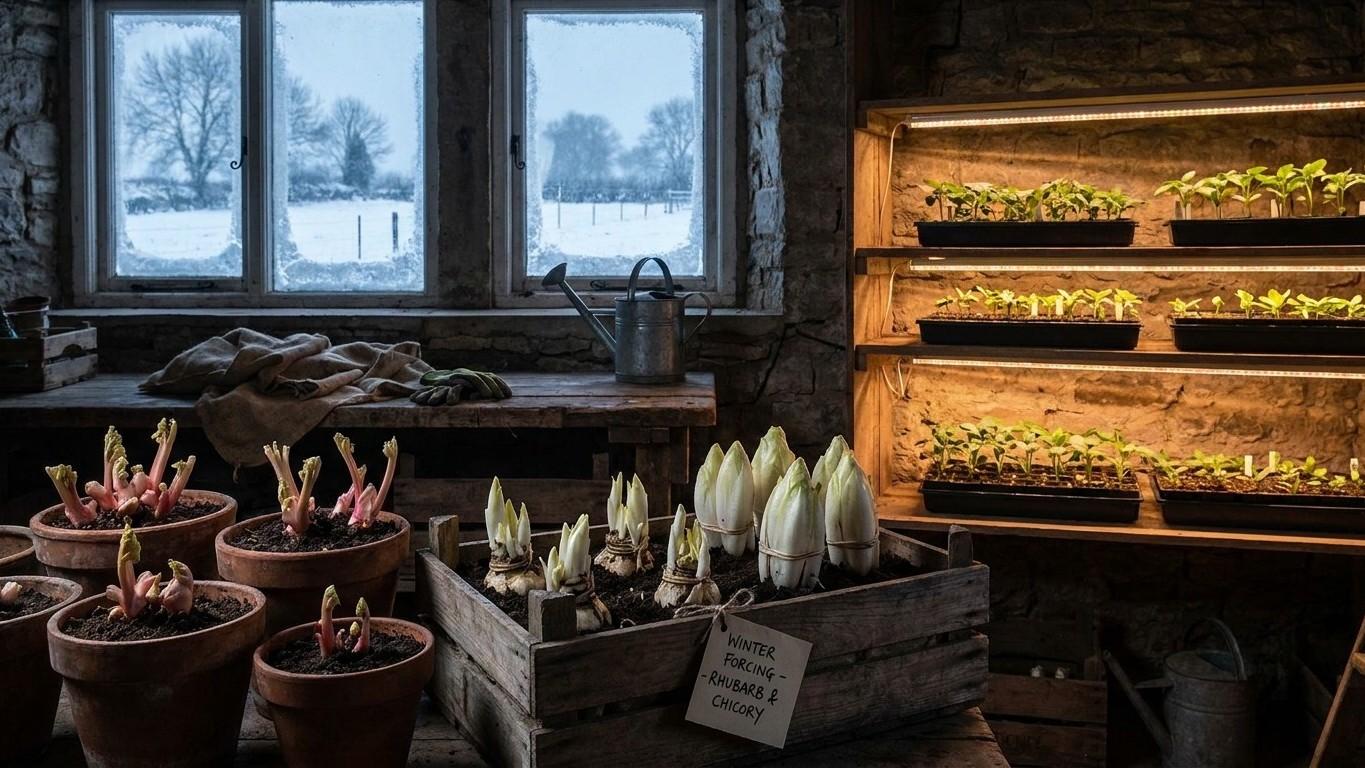

Manitoba’s ground is frozen solid and buried under snow from one end of the province to the other, so the direct answer is that nothing goes into the open garden this month. The only planting happening is indoors: forcing rhubarb crowns and witloof chicory in the dark, starting the slowest seeds under lights, and checking on any cold frame left over from fall. Zone 3b, on the Canadian hardiness scale, doesn’t ease up until well into spring.
What goes in the ground in January

The reason nothing gets planted outdoors isn’t the calendar, it’s the soil. Soil temperature drives germination and root establishment, and in Manitoba the frost line runs feet deep by midwinter. A mild afternoon with sun on the snow means nothing to a seed sitting in ground that hasn’t thawed since fall. The province sits at Canadian hardiness zone 3b, based on the reference station in Winnipeg, and that number reflects a climate built on seven variables, not one, so it doesn’t translate to a USDA zone on any simple chart. Whatever the number, the practical result is the same: frozen dirt does not accept seeds or transplants.
So say it plainly: there is no direct-sowing and no outdoor transplanting to be done this month, anywhere in the province. What’s left is a short, real list of things that still count as planting, just not in open soil.
- Forcing rhubarb crowns in pots or crates in a warm, dark spot, a way to get an early harvest weeks before the garden wakes up.
- Forcing witloof chicory roots in a dark basement or under a box, the classic way to produce pale, tender chicons through the winter.
- Maintaining a cold frame or low tunnel set up the previous fall over hardy greens, without expecting new growth, just protection and occasional harvest.
- Bare-root plantings stay on hold. Dormant trees and canes wait for thawed, workable ground, which this month does not offer.
None of this replaces a spring garden. It’s simply the honest inventory of what a frozen province allows.
What to start under cover
Indoor seed-starting is where the month earns its keep, and the arithmetic runs backward from the frost window rather than forward from a date on a calendar. The mean last spring frost for the Winnipeg area lands around May 23, but that figure is a midpoint, not a guarantee. In one year out of two, frost arrives later than that mean date, which means treating it as a safe deadline is a mistake before the season even starts.
Working backward from that midpoint, the crops that need the longest head start go in first. Onions and leeks are the classic case: they grow slowly from seed and typically need something in the range of ten to twelve weeks indoors before they’re sturdy enough to harden off, which puts their start squarely in this month for anyone aiming at a mid-to-late-spring transplant. Anything with a shorter runway, like most brassicas or tomatoes, can wait.
The two ways this goes wrong are mirror images of each other. Start too early, without enough light or room, and the seedlings turn leggy and rootbound in their trays long before the ground is fit to receive them, stalling out and sulking after transplant. Start too late, and short-season Manitoba summers don’t leave enough growing time to make up the difference. Counting backward from a frost window that moves is safer than counting forward from a fixed date that doesn’t reflect the actual risk.
What is ready to pick
Outdoors, the honest answer is little to nothing. Snow cover and frozen ground rule out fresh harvest from open beds, and even greens tucked under a cold frame mostly hold rather than grow this deep into winter, given how low the sun sits in the Manitoba sky. Anyone hoping to find kale or leeks still standing under snow in January is usually disappointed; that trick works better in milder climates than it does at zone 3b.
What still feeds a household comes from two places: storage and the indoor counter. Root cellars, cold rooms, and garages holding squash, potatoes, carrots, and onions from fall’s harvest are doing quiet work right now, and they need regular checking, not just a set-and-forget approach.
- Squash: press gently near the stem end; softness or a sweet smell means it’s turning and should be used first.
- Potatoes: pull any that have gone green, sprouted heavily, or gone soft, since one bad tuber spreads rot to its neighbors.
- Onions: check for sprouting necks or mushy layers near the root plate.
Beyond storage, sprouts and microgreens grown indoors on a windowsill or under a light are the closest thing to a fresh harvest this month offers, ready in days rather than weeks.
The jobs that matter this month
Pruning and ordering
Dormant fruit trees and cane fruit are best pruned while they’re fully asleep, and this month usually qualifies, provided the weather isn’t in the middle of a deep cold snap. Wood cut during extreme cold turns brittle and splinters instead of shearing clean, so picking a milder stretch within the month matters more than picking a specific date. On the paperwork side, seed catalogs move fast: the varieties that performed well last season, especially short-season types bred for northern gardens, tend to sell out first. Ordering now beats settling for a second choice in March.
Soil, tools, and storage
Soil testing can happen even now, since samples can be sent off and results come back well before spring planting starts, giving time to amend based on what the test actually shows rather than guesswork. A compost pile won’t turn easily if it’s frozen through, but it still benefits from a check on moisture and a light insulating layer of leaves or straw. Tools sitting idle all month are exactly the tools that should get cleaned, sharpened, and oiled before the rush of spring makes that task feel like an interruption. Beds, fencing, and cold frame frames damaged by fall winds or snow load are easier to repair now, while there’s no growing crop to work around, than later when every hour outdoors competes with planting. And storage crops, as noted above, need a weekly look, not a January-and-forget approach.
What not to do in January
The most common mistake this month is treating a mild afternoon as a green light. A stretch of sun on the snow can feel like spring, but the soil underneath hasn’t moved, and pulling back mulch or opening a cold frame too early exposes whatever’s underneath to the next cold snap that inevitably follows. Put covers back and wait for the ground itself, not the air temperature, to signal a real change.
Pruning during the coldest days of a deep freeze is another one. Wood that’s frozen hard splits instead of cutting cleanly, leaving ragged wounds that heal poorly and invite disease once the tree wakes up. Wait for a calmer stretch within the month rather than forcing the job on the coldest day available.
Starting warm-season seeds like tomatoes and peppers too early, out of eagerness for spring, backfires by May: the seedlings outgrow their trays, become rootbound, and stall out after transplant instead of taking off. And feeding nitrogen to anything dormant, whether it’s a lawn under snow or a fruit tree still fully asleep, does nothing useful this month; the plant isn’t taking it up, and the excess is more likely to wash away than help anything grow.
Checking this against your own county
A province-wide month is a starting point, not an instruction. Manitoba stretches from the Red River Valley in the south to Thompson and beyond in the north, and elevation, latitude, and local lake effect shift real planting windows by weeks in either direction from the Winnipeg-based figures cited here. A garden near the US border thaws out differently than one hundreds of miles north. For local specifics, the province’s own agriculture resources are the better reference point: check Manitoba Agriculture for planting guidance tuned to specific regions rather than a single station’s averages.
Common questions
Can you plant garlic in Manitoba in January?
No. Garlic goes into the ground in fall, before freeze-up, so it can establish roots ahead of winter. By January the window has long closed; the next chance comes at fall planting, not midwinter.
What hardiness zone is Manitoba for gardening?
The reference city, Winnipeg, sits at zone 3b on the Canadian hardiness scale, which is built on seven climate variables rather than the single minimum-temperature measure the USDA system uses. The two scales don’t convert directly, and zones shift across the province depending on latitude and local conditions.
When is the last frost date in Manitoba?
The mean last spring frost for the Winnipeg area is May 23, based on 1981-2010 climate normals. That’s a midpoint, not a safe date: in one year out of two, frost arrives later than that average.
What can you harvest in Manitoba in January?
Almost nothing directly from the garden. The real harvest this month comes from storage, squash, potatoes, onions, and carrots kept from fall, plus whatever sprouts or microgreens are grown indoors on a counter or under a light.