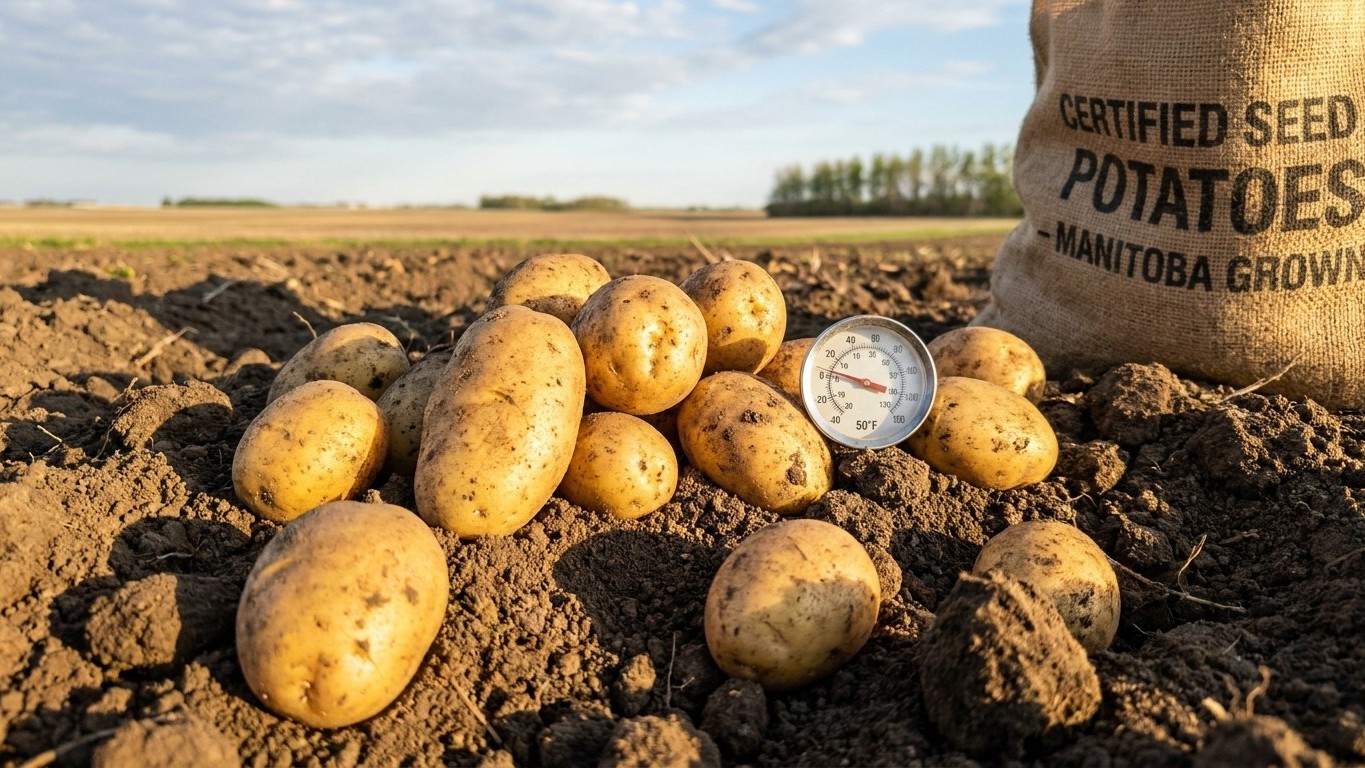

Manitoba’s short frost-free stretch and its run of soil days above 90°F point straight to early and mid-season potatoes, planted from certified seed as soon as the ground hits 50°F. Winnipeg’s average last spring frost lands May 23, per Environment and Climate Change Canada’s Canadian Climate Normals for Winnipeg Richardson International Airport, a midpoint, not a promise. Season class, not the variety name on the seed bag, is what actually decides whether a Manitoba potato patch fills out or stalls.
The short answer
May 23 is the number to anchor a Manitoba planting plan around, and it comes from Environment and Climate Change Canada’s Canadian Climate Normals (1981-2010) for the Winnipeg Richardson International Airport station. That date is an average, which means in roughly one year out of every two, the last frost actually arrives later than May 23. Treat it as the center of a window, not a green light.
Because Manitoba’s frost-free season is compressed and because soil above 90°F stops tuber set and fill cold, the potatoes that suit this province are the ones classified as early or mid-season by extension sources. Utah State University Extension and the University of Maine Cooperative Extension both publish season class (early, mid-season, late) rather than a days-to-maturity count, and that classification is the tool a Manitoba gardener actually has. Neither source publishes a specific maturity-day figure for any variety, so nobody should be planning around one.
Late-season types are not off the table everywhere in the province, but they carry more risk the closer a garden sits to Manitoba’s shorter-season districts, where the frost-free window runs tighter than it does around Winnipeg. A garden in the Interlake or in the Parkland region is not on the same clock as one just outside the city, even though both sit in the same province. That’s the reason a single provincial recommendation always needs a reference point, and Winnipeg Richardson International Airport is the reference point this page is built on.
Certified seed matters as much as season class. Seed that has not been certified can carry viruses invisibly, and a virus-carrying seed piece will not recover once it’s in the ground, no matter how well the season class was chosen. Buying certified seed potatoes is the one step in this whole process that has no workaround.
Put together, the short answer is: early or mid-season class, certified seed, planted by soil temperature rather than by calendar guesswork, with the Winnipeg-area May 23 average frost date used only as the midpoint it actually is.
What actually decides it
Two separate mechanisms govern whether a potato crop succeeds in Manitoba, and they pull in different directions. One sets how early a gardener can safely get seed potatoes into the ground. The other sets how much time that crop has before heat shuts tuber growth down. A reader facing a garden this page never mentions can still work out the answer by tracing both mechanisms through.
Soil temperature at planting
Potatoes go into the ground once soil temperature reaches 50°F, according to Utah State University Extension and the University of Maine Cooperative Extension. That threshold typically arrives 14 to 21 days before the last frost date, because soil warms ahead of the air reliably clearing of frost risk. In a Winnipeg-area garden using the May 23 average, that puts the soil-temperature window in early-to-mid May in a typical year, but only in a typical year. A garden that sits colder than the Winnipeg Richardson station, whether from elevation, exposure, or simply being farther north or west in the province, will hit 50°F soil later, and the whole schedule shifts with it. The mechanism doesn’t change; the date it produces does.
The heat ceiling on tuber set and fill
Soil temperatures above 90°F inhibit tuber set and fill, per the same two extension sources. Watering doesn’t reverse that effect once soil has crossed the threshold; the tubers simply stop sizing for as long as the soil stays hot. This is the mechanism that makes season class matter more than variety name. A late-season potato needs a longer stretch of soil below that 90°F ceiling to finish sizing, while an early or mid-season type needs less of that window, which is exactly why the two classes carry different risk in a province where the growing season is already short at the front end.
How the two mechanisms interact
A gardener anywhere can reason through this without a Manitoba-specific chart: count the days between when soil first hits 50°F and when local soil temperatures start regularly crossing 90°F. Whatever season class fits inside that count is safe to plant; whatever doesn’t fit is a gamble that depends on an unusually cool summer to pay off.
| Season class | Time needed below the 90°F soil ceiling | Fit for a short, cool-start season like Manitoba’s |
|---|---|---|
| Early | Shortest | Best fit; finishes well inside a compressed window |
| Mid-season | Moderate | Good fit in most years; watch garden-specific frost timing |
| Late | Longest | Highest risk; needs a longer heat-free stretch than a short season reliably offers |
How to do it
- Buy certified seed potatoes rather than saved or grocery-store tubers, since uncertified seed can carry virus that no amount of good soil or timing will fix.
- Choose an early or mid-season class variety based on the extension classification published by Utah State University Extension or the University of Maine Cooperative Extension, rather than a days-to-maturity number, since neither source publishes one.
- Track soil temperature directly in the planting bed rather than relying on the calendar alone.
- Plant once soil temperature reaches 50°F, which typically falls 14 to 21 days ahead of the last frost date for the area.
- Use the Winnipeg-area average last frost date of May 23 as a midpoint reference only, remembering that frost arrives later than that average in roughly half of all years.
- Adjust the planting window earlier or later depending on how the specific garden site compares to the Winnipeg Richardson International Airport reference station, since elevation, exposure, and distance from that station all shift local soil warming.
- Monitor soil temperature again through the growing season, watching for stretches above 90°F, since that threshold is what actually stops tuber set and fill.
- Harvest according to how the chosen season class has performed once foliage begins dying back, rather than by a fixed date on the calendar.
What goes wrong
- Planting by calendar date instead of soil temperature. A gardener who plants on a fixed date regardless of soil conditions can end up either too early, with seed sitting in cold, slow soil, or too late, losing days off an already short season. The fix is to check soil temperature directly and plant at 50°F, not at a date copied from a neighboring province.
- Treating the May 23 average as a safe date. Because that figure is a mean from Environment and Climate Change Canada’s Canadian Climate Normals, frost arrives after it in close to half of all years at the Winnipeg Richardson station. Planting tender growth right at the average invites frost damage in any year that runs even slightly behind normal. The fix is to treat the average as the center of a window and build in a margin on either side.
- Choosing a late-season variety for a short, cool-start garden. Late-season potatoes need more time below the 90°F soil ceiling than Manitoba’s compressed season reliably offers, especially outside the Winnipeg area. The fix is to match season class to the actual count of frost-free, sub-90°F days available at the specific garden site, not to the variety that looked best on a seed rack.
- Planting uncertified seed to save money. Seed that has not been certified can carry virus invisibly, and an infected seed piece produces a weakened plant no matter how well the timing and season class were chosen. The fix is straightforward: buy certified seed potatoes every time.
- Assuming one provincial frost date applies everywhere in Manitoba. A province is not one climate, and gardens north or west of Winnipeg, or at different elevations, run behind the Winnipeg Richardson station’s normals. The fix is to treat the published average as a reference point tied to that specific station, then adjust for how the local garden compares to it.
Common questions
What is the average last spring frost date for the Winnipeg area?
May 23, based on Environment and Climate Change Canada’s Canadian Climate Normals (1981-2010) for the Winnipeg Richardson International Airport station. It is a mean date, so actual frost arrives later than May 23 in roughly half of all years.
Why does soil temperature above 90°F matter for potatoes?
Utah State University Extension and the University of Maine Cooperative Extension both report that soil above 90°F inhibits tuber set and fill. Once soil crosses that threshold, tubers stop sizing, and irrigation does not reverse the effect while the soil stays hot.
Should I look for a specific days-to-maturity number when picking a variety?
No published figure exists for this. Neither Utah State University Extension nor the University of Maine Cooperative Extension publishes a days-to-maturity number for potato varieties; both publish season class instead, meaning early, mid-season, or late.
Does certified seed really make a measurable difference?
Uncertified seed potatoes can carry virus that isn’t visible at planting time, and a virus-infected seed piece will not produce a healthy crop regardless of how well the season class or planting date was chosen. Certified seed removes that risk at the source.