
Winnipeg gardeners hear the same answer more than any other: the first week or two of May. That figure isn’t a guess pulled from a farmer’s saying. It comes from working backward from the region’s average last frost and forward from the soil temperature a potato tuber actually needs before it will sprout. The calendar matters less than what’s happening six inches down, and that’s where the real counting starts.
The short answer
Environment and Climate Change Canada’s Canadian Climate Normals, drawn from the 1981-2010 period at the Winnipeg Richardson Int’l A station, put the average last spring frost at May 23. That’s the reference point most Manitoba planting schedules use, because it’s the closest long-running station with published normals.
Utah State University Extension and the University of Maine Cooperative Extension both describe potatoes as a crop planted as soon as the soil reaches 50 F, which typically falls 14 to 21 days before a location’s last frost date. Counting back from Winnipeg’s May 23 average puts that soil-ready window at roughly May 2 to May 9. That’s the short answer for a Winnipeg-area garden: don’t wait for frost risk to disappear, plant into the window that opens two to three weeks earlier, once the ground itself says it’s ready.
There’s a catch worth sitting with before you circle a date. May 23 is a mean, not a promise. Half the years on record, Winnipeg’s last frost lands after that date, sometimes well after. Treat May 23 as the midpoint of a spread, not a line you can plant right up against. And Winnipeg is one station. A garden in a northern district or on higher ground can run weeks behind what the Richardson Int’l A record shows, because a province this size is never one climate.
One more thing belongs in the short answer, not buried later: buy certified seed potatoes. Saved tubers or grocery-store potatoes carry a real risk of virus that a certification program is built to screen out, and that risk follows the crop all season regardless of how well you time the planting.
What actually decides it
Soil temperature, not the calendar
The date on a seed packet or a frost chart is a proxy. What actually triggers safe planting, according to both Utah State and Maine’s extension services, is the soil holding near 50 F at planting depth. A cold, wet spring can push that threshold well past the calendar date that worked the year before; a dry, sunny stretch can pull it earlier. Counting back 14 to 21 days from the average last frost gives you a target window, but the soil thermometer is what confirms whether that window has actually opened where you’re standing.
The heat ceiling that caps the season
The other end of the mechanism is less talked about but just as decisive. Both extension sources note that soils above 90 F inhibit tuber set and fill, and no amount of watering reverses that once it happens. This is why the advice leans toward planting early rather than late: a crop that gets its tuber-forming stage finished before the hottest weeks of summer arrive sizes up properly, while one still setting tubers during a heat spell stalls out. In a district with a long run of days above that 90 F soil threshold, the practical answer isn’t to baby a summer crop through the heat, it’s to get an early or mid-season class into the ground as soon as the 50 F floor is met and let it finish before the heat peaks.
Why the frost date itself moves
A normals-based average is built from decades of records at one station, so it smooths over the year-to-year swings that any single gardener actually experiences. It also only describes that station’s microclimate. A slope that drains cold air, a low spot that pools frost, or a location well north of Winnipeg’s latitude will all shift the real last-frost date away from the published normal, sometimes by weeks. None of that changes the underlying mechanism, soil temperature governs planting, heat governs tuber fill, but it does mean the same 14-to-21-day count produces a different calendar date depending on where you actually garden.
How to do it
- Pull your local last-frost record and treat the average as the middle of a range that varies year to year, not a date you can plant right up against.
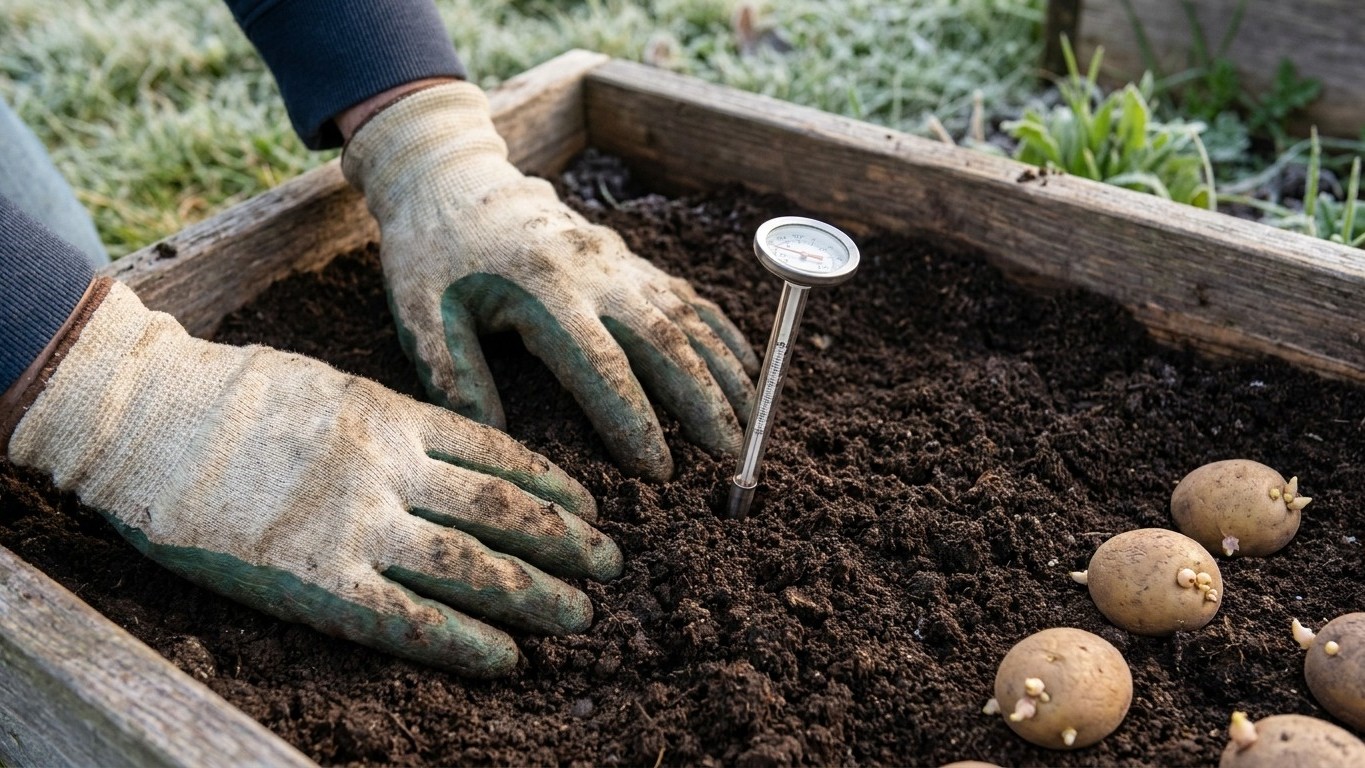
- Push a soil thermometer to planting depth in the bed you intend to use, and check it every few days rather than relying on air temperature.
- Wait until the soil reading holds near 50 F, then count backward 14 to 21 days from your local last-frost average to see whether that reading lines up with the expected window.
- Order certified seed potatoes ahead of that window rather than planting saved tubers or store-bought potatoes, since uncertified stock carries a materially higher risk of virus.
- Plant into the soil-ready window even though frost risk hasn’t fully passed. The seed piece and developing tuber are insulated underground; it’s the emerging foliage that’s exposed, and it emerges after the soil has already warmed further.
- Keep tracking soil temperature as the season moves toward summer, so you have advance notice if a stretch of heat threatens to push the soil past the 90 F ceiling during tuber set.
What goes wrong
- Planting strictly by the calendar date. A date that worked one season can land on cold, wet soil the next. Check a soil thermometer at planting depth instead of trusting the date alone.
- Waiting for frost risk to fully disappear before planting. That means giving up the entire 14-to-21-day head start the extension sources describe. Count backward from the last-frost average and plant into that earlier window once the soil hits 50 F.
- Treating May 23 as a guaranteed safe date. It’s an average from Environment and Climate Change Canada’s 1981-2010 normals, and frost lands after it in roughly half the years on record. Build in a buffer and watch short-range forecasts as the date approaches.
- Using saved or store-bought potatoes as seed. They carry a much higher chance of virus than certified seed, and that problem shows up in reduced yield later, when it’s too late to fix. Order certified seed potatoes instead.
- Ignoring the heat ceiling in a hot summer. Soil above 90 F stalls tuber set and fill, and watering doesn’t reverse it. Plant early enough that bulking finishes before the hottest stretch, and lean toward an early or mid-season class where summers run hot.
- Applying one province-wide date to every garden. The May 23 figure comes from a single Winnipeg-area station. Gardens further north or at higher elevation should expect their own last frost to run later and should count backward from their own local record where one exists.
Common questions
Is May 23 a safe date to plant potatoes in Manitoba?
It’s an average, not a safe date. Environment and Climate Change Canada’s 1981-2010 normals for the Winnipeg Richardson Int’l A station put the last spring frost at May 23, but frost falls later than that in roughly half the years on record. Use it as a midpoint for counting backward, not a guarantee.
How early can I actually plant potatoes in Manitoba?
Utah State University Extension and the University of Maine Cooperative Extension both describe planting as soon as soil reaches 50 F, generally 14 to 21 days before the last frost date. Counting back from Winnipeg’s May 23 average puts that window around May 2 to May 9, provided the soil itself confirms it.
Does the season class of a variety change when I should plant?
The planting window is set by soil temperature, not by whether a variety is early, mid-season, or late. What the season class affects is how much of the growing period the crop needs to finish tuber fill before hot weather arrives, which is exactly why an early or mid-season class is the safer pick in a district with many days above the 90 F soil threshold.
What if my garden isn’t near Winnipeg?
The May 23 figure is specific to the Winnipeg Richardson Int’l A station. A garden further north, at higher elevation, or in a frost-prone low spot should expect its own last frost to run later, sometimes by weeks, and should count backward 14 to 21 days from its own local record rather than borrowing Winnipeg’s date directly.