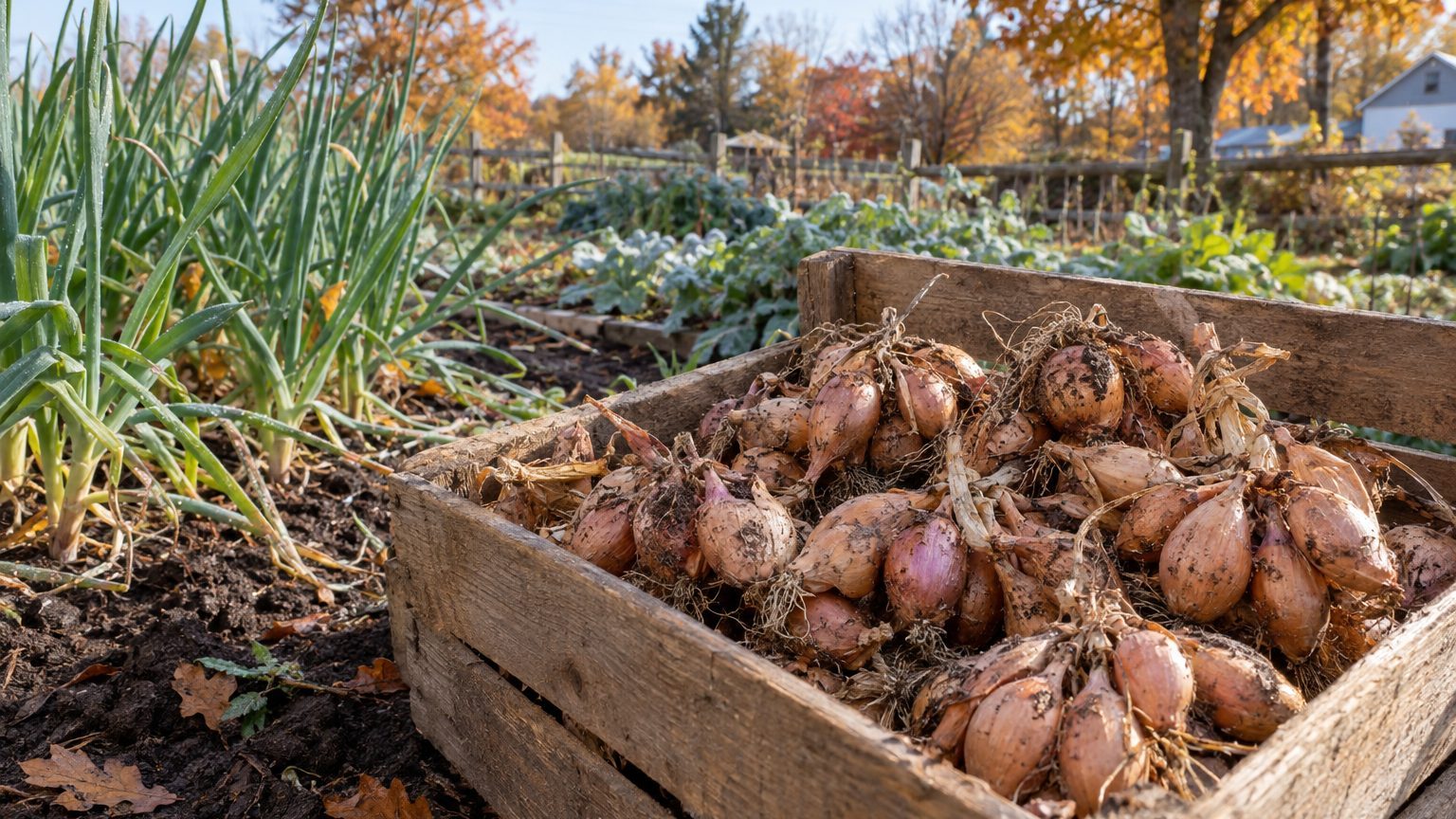

In Manitoba, pick shallots that mature quickly and take cold in stride. Spring-planted multiplier types grown from sets are the dependable choice, and seed-grown types started indoors are a close second. Skip slow, long-season types bred for milder places. The frost dates behind that advice come from Winnipeg, where the average last spring frost is May 23 and the average first fall frost is September 22.
The short answer for Manitoba
The best shallots here are early-maturing, cold-tolerant types, and the real decision is how you start them. Sets (small bulbs) planted in spring are the safest route. Seed started indoors is the second route. Fall planting is a gamble that depends on your winter.
The numbers explain why. At the Winnipeg Richardson International Airport station, Environment and Climate Change Canada’s 1981-2010 normals put the average last spring frost on May 23 and the average first fall frost on September 22. That leaves a little over four months between the two means. These are averages, not guarantees. In about one year out of two the last spring frost falls later than May 23, and the fall frost lands on either side of September 22 about equally often. Treat each date as the midpoint of a window.
Shallots are hardy enough that the spring date matters less than you’d think. Their limit is the back end of the season, when tops must fall, bulbs must size up, and the crop must dry down before weather turns. A type that needs a long run of warm days will be rushed in a prairie year. For the timing itself, When to Plant Shallots in Manitoba goes through the window, and Growing Shallots in Manitoba covers the full crop cycle.
The decision by type
| Type | How it is started | Fit for Manitoba |
|---|---|---|
| Multiplier shallots from sets | Planted in spring as soon as the soil can be worked | Best default; the most forgiving of a short season |
| Seed-grown shallots | Sown indoors in late winter, transplanted in spring | Good if you have bright window space; no bulb stock to buy |
| Fall-planted sets | Planted in autumn under heavy mulch | Risky; depends on snow cover and a mild winter |
| Slow, long-storing types from milder regions | Either | Only if the days to maturity fit the window |
This page does not have Manitoba variety trial results, so it recommends by type rather than by named cultivar. When you shop, compare the days to maturity on the label against your own frost window and favor the shorter number.
What will not work here
Winter is the first problem. The mean daily minimum of the coldest month at the Winnipeg reference station is -21.4 °C (-6.6 °F). That is the figure that decides what survives, and it explains why fall-planted shallots are a coin flip. A bulb in the ground with reliable snow cover over it can come through. The same bulb in a bare, windy bed that freezes, thaws and freezes again can heave out of the soil or rot. The cold alone is survivable. Exposure is what kills the crop.
The second failure is the slowest shallots. With a little over four months between the mean frost dates, a type that wants a long, steady growing season has no slack. In a cool June or a wet July, the bulbs stay small and the tops stay green when the weather turns. Plenty of southern catalogs sell excellent shallots that were never meant for a short season, and a good flavor reputation tells you nothing about days to maturity.
Third, waiting for a “safe” date wastes the weeks you can least spare. Some gardeners hear “last frost May 23” and hold off until the end of May. Because that is only a midpoint, half of years bring a frost after it anyway, and shallots shrug off light frost. Sets can go in as soon as the soil is workable, and every week you wait comes straight off the end of a short season. The date to fear is the fall one, not the spring one.
Fourth, heavy, cold soil. Much of southern Manitoba, the Red River Valley especially, has clay soil that stays cold and soggy after snowmelt. Sets planted into a waterlogged bed rot before they root. Raised rows or beds, or simply waiting a few days for the surface to drain, solve this far better than any variety choice.
Finally, direct-seeding outdoors does not suit the province’s season. Seed sown in the garden in late May has too little time to make a full bulb before fall, which is why the seed-grown route here starts indoors.
What changes across Manitoba
The reference city for this page, Winnipeg, sits in Canadian hardiness zone 3b, according to Natural Resources Canada’s 1991-2020 plant hardiness data. That is the Canadian system, not a USDA zone. Natural Resources Canada says plainly that there is no simple conversion between the two, because the Canadian system is built on seven climate variables and the USDA’s on one. So do not read 3b as a USDA number, and do not line it up against US maps.
It is also the zone of one city, not a province. Manitoba stretches from the southern prairie through parkland and Interlake country into boreal forest and the far north. There is no single answer for the province, and this page only has the Winnipeg figure, so it will not guess at the spread. The frost dates carry the same warning: northern and upland districts run weeks behind the Winnipeg station. Note too that the frost normals cover 1981-2010 while the zone data cover 1991-2020, so the two are not from the same period.
What should a reader farther north or on higher ground shift? Four things:
- Choose the earliest-maturing types you can find, and reject borderline ones.
- Start seed-grown shallots indoors and transplant them rather than planting sets late.
- Skip fall planting unless you have dependable, deep snow cover.
- Use raised beds, which warm sooner than flat ground.
To find your own zone, check Canada’s Plant Hardiness Site and look up your municipality there. This page cannot tell you which zone your garden falls in.
Where to check this for your own county
Start with Manitoba Agriculture, the provincial agriculture department and the closest thing Manitoba has to a state extension service. Look for two things: a local planting calendar for your region, and any varieties trialled near you. The first tells you when gardeners in your district actually get sets into the ground. The second tells you what has been grown to maturity in conditions like yours, which is more useful than any national catalog description.
A note on terms: Manitoba is organized into rural municipalities rather than counties, so look for regional or district information rather than a county page. If the department’s pages do not list shallot trials, ask regional staff whether growers nearby have results for onions or garlic. Those are close relatives and often tell you the same story about season length and winter survival.
Be clear about what this page is. It is a provincial summary built on one Winnipeg station, one hardiness zone and averaged frost dates. A local recommendation from your own district beats it every time, whether it comes from a regional calendar, a trial report or a neighbor who has grown shallots for twenty years on the same ground. Use this page to narrow the field, then let the local source settle the details.
Checking this against your own garden
Your own observations outrank every date above. Three things are worth watching, and none needs equipment.
Soil warmth by feel. Push your hand a few inches into the bed. If the soil crumbles, drains and no longer feels icy, sets can go in. A bed that reaches that point days before the neighboring one is telling you about its drainage and sun exposure, so plant there first.
The male flowers on local trees. Willow and aspen catkins are male flowers, and they open on a local schedule. Note the week they appear this year and the next. Over a few seasons you will build a personal marker that tracks your own spring better than a 1981-2010 average does.
The first leaves. Watch how fast green shoots show on sets, or when true leaves appear beyond the seed leaf on indoor seedlings. Slow, pale growth means cold soil or low light. Compare beds, and you will see which corner of your yard runs warm and which one lags.
Common questions
Can I plant shallots in the fall in Manitoba?
Sometimes, but it is a gamble. A coldest-month mean minimum of -21.4 °C (-6.6 °F) is hard on bulbs without protection, and snow cover decides the outcome. Spring planting is the safer default.
Are seed-grown shallots worth trying?
They suit gardeners with bright window space and a late-winter start. Sown indoors and transplanted, they get a head start on a short season. Direct-seeding in late May leaves too little time.
Is zone 3b a USDA zone?
No. It is Natural Resources Canada’s zone for Winnipeg, built on seven climate variables, and it does not convert to a USDA zone.
Do I have to wait until May 23 to plant?
No. May 23 is an average last frost, not a safe date, and shallots tolerate light frost. Plant sets once the soil is workable and not waterlogged. One more caution if you compare notes with gardeners just across the border in the United States: their frost figures cover 1991-2020, while the Winnipeg normals used here cover 1981-2010, so the two sets of dates are not strictly comparable.