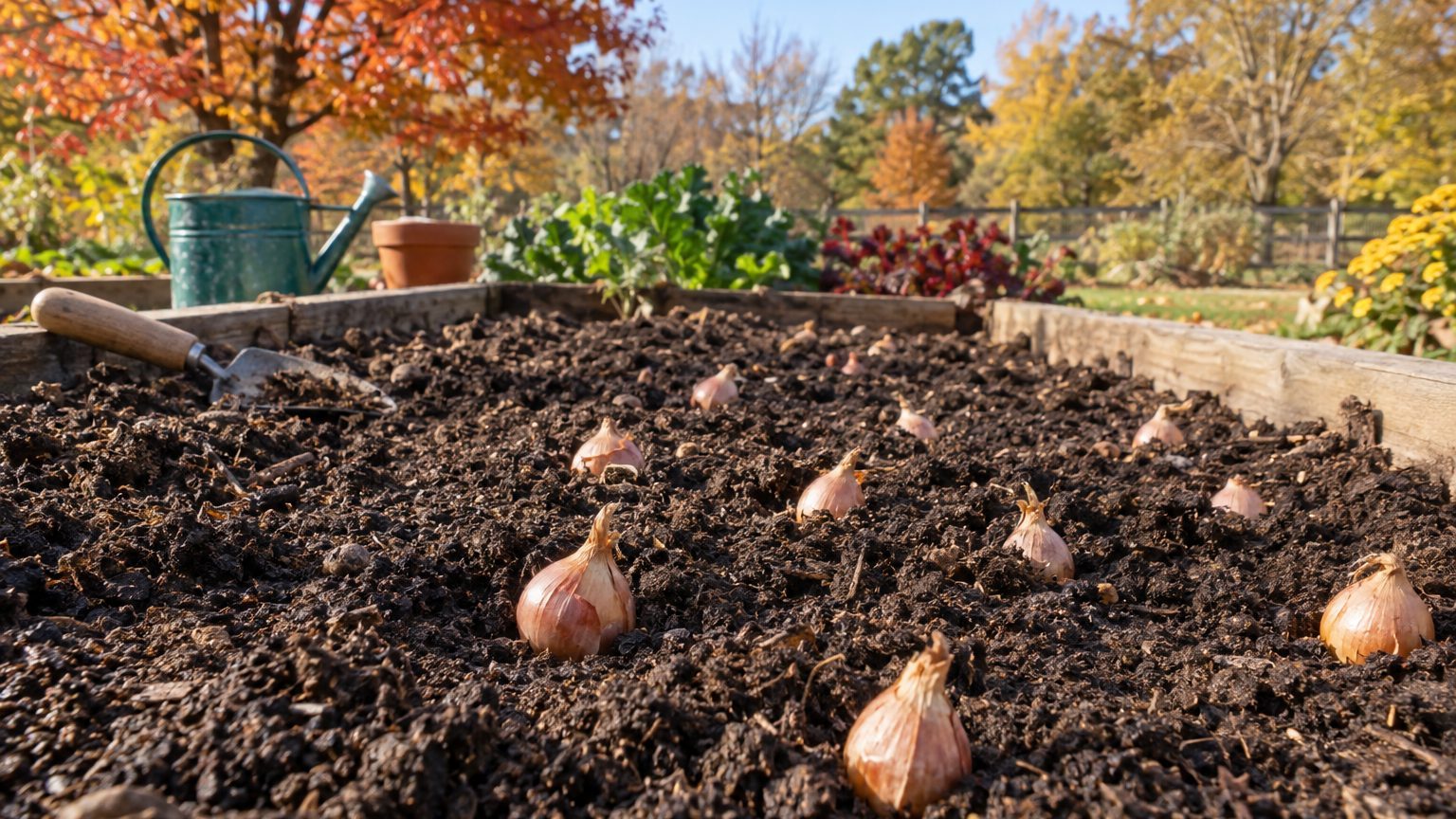

Plant shallots in Minnesota in early spring, as soon as the soil can be worked. Fall planting is the second option, but only if you mulch and accept some risk. Both windows hang on frost dates measured at Minneapolis, so a gardener north of the Twin Cities needs to shift them. The reasoning behind each choice is below.
The short answer for Minnesota
The spring window opens when the ground thaws and dries enough to dig, which usually falls near the last spring frost: April 17 to April 30 in the Twin Cities. The fall window opens after the first fall frost, October 11 to October 23. Both ranges come from the NOAA NCEI 1991-2020 Climate Normals for Minneapolis.
These are not guaranteed dates. Each range is the band where the chance of a 32°F freeze runs between 30 and 70 percent. Inside it, a freeze is plausible but not certain, and in any given year a hard frost can land on either side. Shallots tolerate light frost well, which is why the spring window can start before you feel safe planting tomatoes.
| Marker (Twin Cities reference) | Date range |
|---|---|
| Last spring 32°F freeze (30-70% band) | April 17 to April 30 |
| First fall 32°F freeze (30-70% band) | October 11 to October 23 |
| Northern Minnesota | Two to three weeks tighter at both ends |
Why spring comes first
Shallots are cool-weather starters. They put out roots in cold soil, and they would rather establish before summer heat arrives. A bulb set into thawed ground in the April window has the longest runway before the season closes in October. If you want the full growing picture beyond timing, Growing Shallots in Minnesota covers it.
Where fall planting fits
Fall planting aims for roots without top growth. You plant after the first fall frost window, when the soil is cooling but not frozen, then cover the bed with mulch. The reward is an earlier start the next spring. The cost is exposure to a Minnesota winter, and the section below explains where that goes wrong.
One limit on this page: the sources behind it give frost dates and hardiness figures, not a Minnesota shallot calendar from the extension service. The dates above are a frost-based starting point, not a tested planting schedule.
What will not work here
Late planting fails first. The season ends with a freeze somewhere between October 11 and October 23 even in the mild south, and sooner in the north. A shallot set in the ground in late May or June has less time to size up before that door shuts. Expect small bulbs, or bulbs that never finish curing.
Slow varieties and seed-grown shallots
The slowest, longest-season shallots are a poor match for a window this short. Growing from true seed makes it worse, because the plant has to build a bulb from nothing before fall. If you start from seed at all, start indoors early. For most gardeners, bulbs or sets are the safer path, and the variety discussion in The Best Shallots to Grow in Minnesota is the place to match type to season.
Unprotected fall planting
The coldest month here has a mean daily minimum of 8.8°F at the Minneapolis reference station. That is an average of the nightly lows, not the record, so real nights run colder and the north runs colder still. A bare fall bed faces that with nothing between the bulbs and the air. The danger is not only the cold itself. Alternating thaws and freezes can heave shallow bulbs up out of the soil. A warm spell in late October can also push green shoots that a January freeze then kills. Mulch (straw or shredded leaves, laid after the ground starts to cool) reduces both risks but does not remove them.
Planting too early and too close
Eagerness has its own failure. Soil that is still sodden in April rots bulbs in the ground. Squeeze a handful; if it holds as a wet ball, wait. Minnesota summers are also humid, and crowded rows hold moisture in the foliage, which invites fungal disease. Give each bulb room for air to move.
The honest summary: a short, cold, humid-summer climate rewards early planting, moderate spacing, and varieties that finish on time. It punishes anything slow or late.
What changes across Minnesota
Minnesota is not one garden. The USDA Plant Hardiness Zone Map (2023, built on 1991-2020 normals) places the state in zones 3a to 5a. That system rests on a single variable, the average annual extreme minimum temperature, so it says how cold winters get and nothing about how long summer lasts. A spread of three zones means there is no single planting answer for the state.
The frost dates above describe the Twin Cities, which are the mild south of Minnesota. Northern Minnesota runs two to three weeks tighter at both ends: spring comes later and fall arrives earlier. For a northern gardener, that shrinks the growing window from both sides and pushes decisions toward spring planting, faster-finishing types, and thicker mulch if fall planting is attempted at all.
In the south and in the warmer pockets near the Twin Cities, fall planting becomes more reasonable, and spring planting can start at the early end of the April window. Sites also vary within a single county. Low ground collects cold air and stays frosty longer, while a south-facing slope thaws sooner. Wind-exposed rural plots lose snow cover, and snow is the best insulation a fall bed can get.
I will not tell you which zone you are in, because the answer depends on your address. The USDA Plant Hardiness Zone Map lets you look up your own ZIP code. Once you have your zone, treat the Twin Cities dates as the best case and subtract time from both ends as you move north.
Where to check this for your own county
Your state extension service is the next stop. University of Minnesota Extension is the land-grant university’s public arm, and its horticulture staff work with growers in every region of the state.
Look for two things there. The first is a local planting calendar for your area, ideally one for alliums or for onions, since shallot-specific guidance may be sparse. The second is information on varieties that have been trialled in your county or nearby, because a variety that finishes in time in the south can come up short in the north.
Be clear about the hierarchy. A county recommendation beats a state one, and this page is the state one. It uses a single reference station, Minneapolis, to stand in for a state that stretches across three hardiness zones. Extension staff know your county’s soils, typical spring wetness, and local frost pockets, which no statewide page can capture.
If a local calendar exists, use it and treat this page as background reasoning. If it does not, call or message your county office and ask what has worked for onions and garlic locally. Those answers transfer reasonably well to shallots.
Checking this against your own garden
Dates on a page are averages. Your garden’s own signals outrank them, and three are worth watching.
- Soil by feel. Dig a handful a few inches down. If it crumbles when squeezed rather than forming a sticky ball, it is workable. If it is still cold enough to numb your fingers quickly, roots will be slow. This tells you how fast your particular bed warms and drains.
- The order of snowmelt. Note which parts of your yard go bare first and which hold snow. The early-bare spots are your warmest microclimate, and the slow ones will stay cold and wet well into April.
- The first true leaves. Once the shallots are in, watch for green shoots to push up. Leaves that appear on schedule suggest the bed suits them. Late or ragged leaves point to cold, wet, or crowded conditions, and that is your cue to adjust next year.
Neighbors’ plants also work as a calendar. If the lilacs nearby are just leafing out, the soil is generally past the dead-of-winter stage. Keep a few notes each year, since your own record of what worked will soon outrank any statewide average.
Common questions
Can I plant shallots in the fall in Minnesota?
Yes, but with more risk than spring planting. Plant after the first fall frost window (October 11 to October 23 in the Twin Cities), then mulch. In the north, where fall comes two to three weeks sooner, spring planting is the safer choice.
Is it too late to plant shallots in May?
It is not too late to get a crop, but you give up growing time. Later plantings tend to produce smaller bulbs because the season ends in mid-October at the earliest and sooner in the north.
Will a late spring frost kill shallots?
Light frost usually does not. Shallots tolerate cold better than most garden crops, which is why they can go in during the April 17 to April 30 band. A hard freeze after strong growth is the real concern, so cover young tops if one is forecast.
Should I grow shallots from seed in Minnesota?
It is harder here. A seed-grown plant must build a bulb within a short season, so it needs an early indoor start. Bulbs or sets give most gardeners a more reliable harvest.