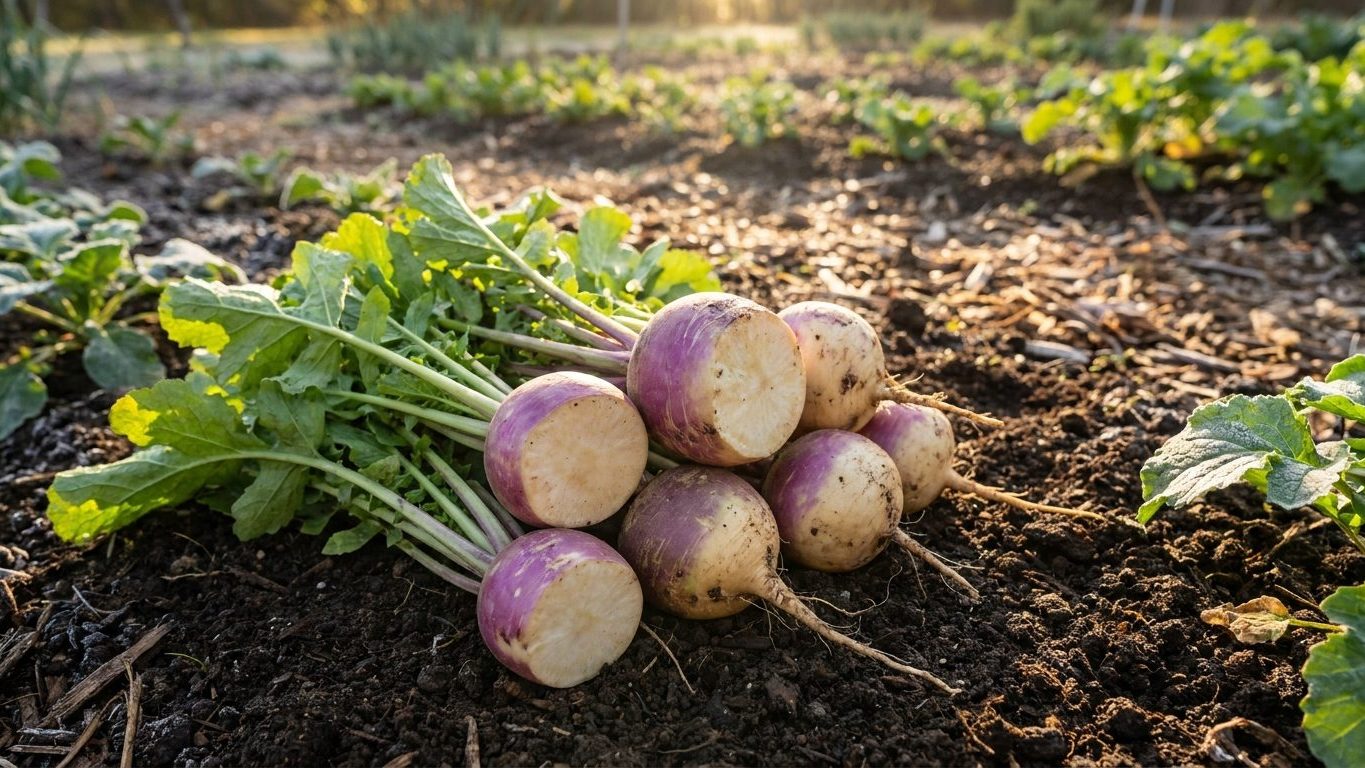

Growing turnips in Manitoba works best as an autumn project. Winnipeg’s average last spring frost is May 23 and its average first fall frost is September 22, which leaves enough room for a spring sowing, a late-summer sowing, or both. Rutabaga fits as a single main crop. The real limits come from soil temperature and from the deep cold of the coldest month, not from summer heat.
When the soil is warm enough in Manitoba
The date most Manitoba gardeners ask about is May 23. That is the average last spring frost at the Winnipeg Richardson International Airport station, according to Environment and Climate Change Canada’s 1981-2010 Canadian Climate Normals (station climate ID 5023222). Treat it as a midpoint, not a green light. In one year out of two, the last frost lands later than May 23.
Frost is a stand-in, soil is the real gate
A frost date is only a proxy. Turnips and rutabaga do not care what the calendar says; they respond to the temperature of the soil around the seed. Soil lags behind the air, so it warms after the frost risk ends, not at the same moment. A bed that looks ready on May 24 can still be cold and wet a hand’s depth down, and seed sown into it sits, swells slowly and invites rot.
A cheap soil thermometer settles the argument better than any date. Push it a couple of inches into the bed in the morning, when the reading is at its lowest, and match it against the germination guidance on your seed packet. Watch the forecast, too. A cold snap after sowing is less dangerous to these hardy roots than to tomatoes, but a stalled seedling is an easy target for flea beetles, which attack brassicas and thrive on slow growth.
Read the number with its limits in mind
Three caveats come attached to that May 23 figure. First, it comes from one station in Winnipeg, and Manitoba is not one climate. Northern and upland districts, such as the Parkland and the areas toward the Interlake and beyond, run weeks behind the city. Second, the Canadian normals cover 1981-2010, while the US figures elsewhere on this site cover 1991-2020, so a side-by-side comparison with a Dakota or Minnesota page is approximate. Third, a gardener who keeps a local record of the last frost in their own yard will beat any regional average.
Natural Resources Canada places Winnipeg in Canadian hardiness zone 3b (Canada’s Plant Hardiness Site, 1991-2020 normals). That is the Canadian system, built on seven climate variables, and it does not convert to a USDA zone. It tells you the winters are serious, which matters more for this crop than the spring date.
Whatever you grow, remember the family. Turnips and rutabaga are brassicas, and they share their pests and diseases with cabbage, kale and mustard. Planting them where those crops grew last year is not rotation at all; the soil-borne trouble is waiting for them. The general guide to growing turnips and rutabaga covers the method that applies everywhere. This page deals with what is specific to Manitoba.
How long the season lasts here
Count the days between the two dates. From the average last spring frost on May 23 to the average first fall frost on September 22, the Winnipeg station gives a window of 122 days. Both are mean dates from the same 1981-2010 normals, so the window is a midpoint too. In roughly half of years it will be shorter at one end or the other.
| Marker | Average date at Winnipeg Richardson Int’l A | What it means for the crop |
|---|---|---|
| Last spring frost | May 23 | Start of the window, not a safe date |
| First fall frost | September 22 | Light frost tolerated; the start of sweetening, not the end of the crop |
| Length of the window | 122 days | Room for a spring sowing and a later one |
What does 122 days allow? More than a short-season territory would, less than a mild one. It is long enough to sow turnips in spring for an early pull and sow again later for the autumn harvest. That second sowing is the one that matters, because roots that mature in cooling weather turn out sweeter than roots that bulk up in July heat. Rutabaga asks for more patience. It is generally the slower root, and in this window it makes sense as one main sowing rather than a repeated one.
To plan a sowing, work backward. Take the days to maturity printed on the packet for the type you chose, count back from September 22, and add a margin, since growth slows as nights cool and the average frost date is only a midpoint. Hardy roots shrug off a light frost, so the frost date is a planning marker rather than a deadline. Gardeners who want to stagger harvests will find the logic of succession sowing laid out in this series; the principle is to repeat small sowings rather than one big one.
Transplanting is rarely worth the trouble here. Turnip and rutabaga roots resent disturbance, and a transplant with a damaged or bent taproot gives you a forked, misshapen root. With 122 days on the table, direct sowing leaves nothing on the table. If a cold spring eats into the window, sow thinner, thin early and put your effort into protecting the seedlings, not into starting them indoors.
Heat and water in Manitoba
This page does not carry a verified count of days above 90°F (32°C) or a summer rainfall total, and I will not quote a figure I cannot source. What the verified record does show is a cold climate. Treat the heat question as a minor one for this crop. These are cool-weather roots, and in a territory with a hardiness zone of 3b in the Canadian system, summer scorch is rarely what ends a turnip bed. The best source for station-level heat and rainfall is the Climate Normals data from Environment and Climate Change Canada for the station nearest you.
A cool, damp summer causes the opposite set of problems. Leaves stay wet, powdery and downy mildew move in, roots size up slowly, and the brassica diseases that come with wet soil get their foothold. Give the plants airflow by thinning to the spacing on the packet, water in the morning so the foliage dries by evening, and avoid heavy overhead watering late in the day. A hot, dry spell calls for the reverse: steady moisture, because uneven watering splits roots and turns them woody.
The facts that really govern an autumn crop here are both cold ones. The first is the mean daily minimum of the coldest month, which is -21.4°C (-6.6°F) at the Winnipeg reference station, from the 1981-2010 normals. It is an average of nightly lows, so many nights run colder. At that level the soil freezes deep, and a mulched row of roots is a gamble rather than a storage plan. The safer course is to lift the crop before the ground freezes hard, and to treat in-ground storage, even under thick straw, as an experiment you can lose.
The second is how much frost sweetening the roots actually receive. Cold nights push the plant to convert starch to sugar, which is why a turnip pulled after a few frosts tastes better than one pulled in August. The window for that is the stretch between the first fall frost (September 22 on average) and the day the ground freezes solid. This page has no verified freeze-up date, so watch the ground itself: if a fork bounces off it, the sweetening is over and the lifting is overdue.
Storage is a food-safety matter. Before putting any root away, inspect it. Trim the tops, check the crown, and press along the shoulder. A soft patch, a weeping spot or a moldy crown ends the question for that root; do not cut the bad part off and keep the rest. Look at them again while they are stored, and never assume a root is sound because it looks fine on the outside.
Which turnips and rutabaga suit Manitoba
This page names no varieties, and that is deliberate. A variety recommendation means something only if it comes from a trial in the region where you garden, and this page does not have those results. A name pulled from a seed catalogue would be a guess dressed up as advice, and Manitoba gardeners would spot it quickly. Manitoba Agriculture is the right place to ask about the types that have been trialled in the province, and a local seed supplier can tell you what its customers actually grow.
What can be said is how the territory’s facts steer the choice by type. A 122-day average window means a quick-maturing turnip suits the spring sowing, while a main-season turnip fits the second sowing for fall. Rutabaga, as the longer-season root, belongs in the earliest part of its own planting window. If your garden sits north or at elevation, remember the Winnipeg dates run earlier than yours and move toward the faster types.
In damp years, disease resistance becomes the first thing to read on a seed packet. Choose types sold with resistance noted, and give them space. A dense, crowded planting stays wet and shows its troubles first. Keep the root crops away from last year’s cabbage, kale, mustard or broccoli beds, since the brassica family shares pests and diseases, and plan your rotation across the whole family, not just across turnips.
Gardeners in neighbouring territories face different trade-offs. The South Dakota guide to growing turnips and rutabaga deals with a hotter, drier summer, and the British Columbia guide works with a very different climate. Comparing them shows how much of a Manitoba decision rests on cold.
Common questions
Is May 23 a safe date to sow turnips in Manitoba?
No. It is the average last spring frost at the Winnipeg Richardson station, which means that in about half of years the last frost comes later. Use it as the middle of a window and let the soil temperature decide.
Can turnips and rutabaga stay in the ground over winter in Manitoba?
Do not count on it. The mean daily minimum of the coldest month at the Winnipeg reference station is -21.4°C (-6.6°F), and the ground freezes deep. Lift the roots before it freezes hard, and inspect each one before storing it.
Do the Winnipeg frost dates apply to my garden?
Only roughly. The dates come from one station, and northern and upland districts run weeks behind it. Your own record of local frosts is a better guide, and Manitoba Agriculture can point you to regional information.
Can I plant turnips where cabbage grew last year?
Avoid it. Turnips and rutabaga are brassicas, so they share their pests and diseases with cabbage, kale and mustard. A rotation that moves them into a cabbage-family bed has not rotated anything.
One last nuance: the dates on this page come from normals ending in 2010, and a recent warm run of autumns may stretch your own window. Keep a note of your first fall frost each year. After five seasons you will have a better planting calendar than any regional table.