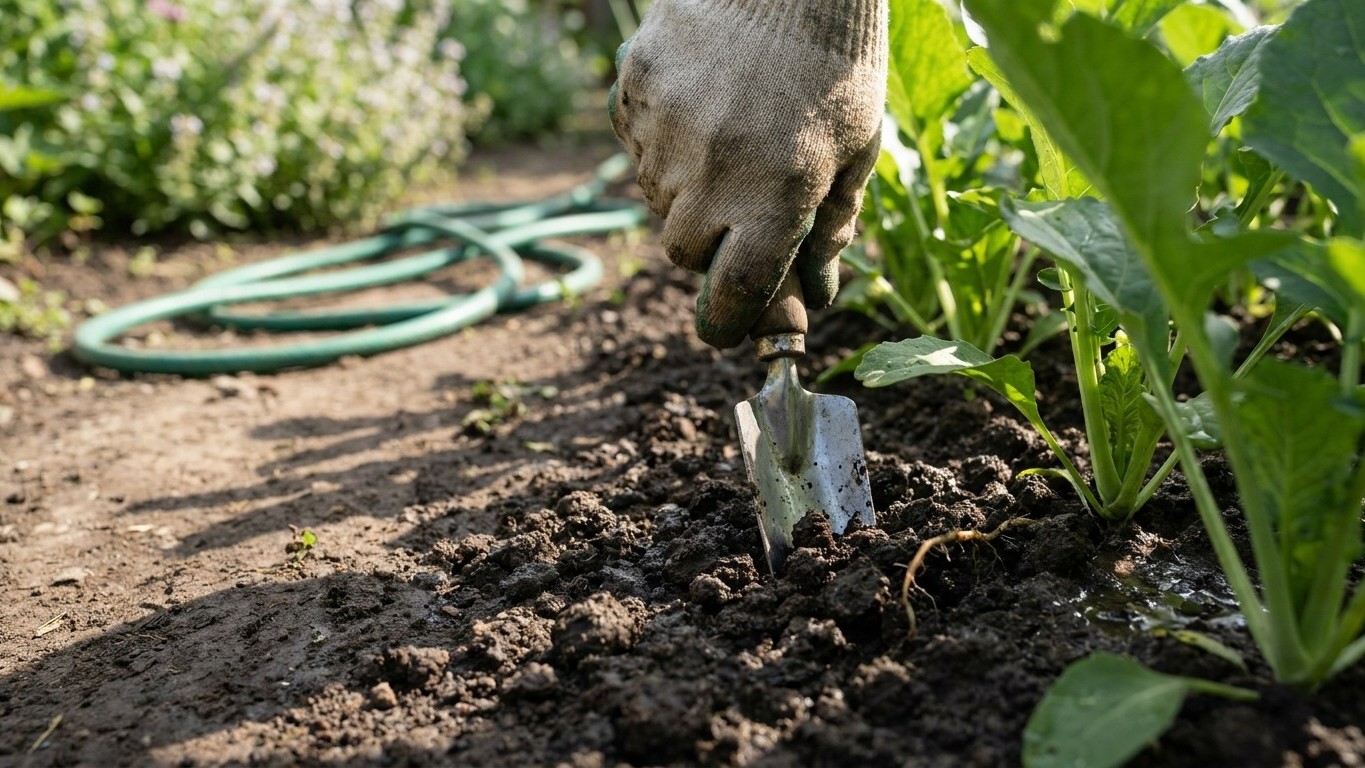

Manitoba gardens need deep, infrequent watering rather than daily sprinkles — roughly one to two inches a week during the growing season, delivered at the soil rather than the leaves, and cut back or eliminated when rain shows up. The right amount depends on your soil, the plant, and the week, but the rules below apply almost everywhere in the province.
How much, how often

The single biggest mistake in a Prairie garden is watering a little bit, every single day. Shallow watering trains roots to stay near the surface, where they dry out and bake the moment a hot afternoon rolls through. Deep, less frequent watering pushes roots down into cooler, moister soil, which is exactly where you want them when Manitoba throws a dry stretch. And dry stretches happen: Winnipeg’s official climate normal shows an average of 0.0 days a year above 90°F (ECCC Canadian Climate Normals 1981-2010), so scorching heat isn’t the usual threat here. Wind and long summer daylight hours, drying out topsoil fast even on mild days, are the real culprits.
The test for whether your garden actually needs water isn’t the calendar, it’s the soil. Push a finger, or better, a trowel, about two inches down near the root zone. If it comes out dry and crumbly at that depth, water — this is especially critical for Watering Through a Dry Spell in Manitoba, when soil can dry out fast under wind and sun. If it’s still cool and slightly damp, wait another day or two, no matter what the sprinkler timer says.
Soil texture changes the math. Sandy soil, common in parts of southern Manitoba, drains fast and holds little reserve, so it needs shorter, more frequent soakings than the “deep and infrequent” rule would suggest on its own. Heavy clay, which dominates much of the Red River Valley, behaves the opposite way: it can hold a week’s worth of water, but soaking or working clay while it’s still wet compacts it and can drown roots outright. Wait until clay has actually dried at depth before you touch it with a hose or a shovel. The same logic applies, often more intensely, to Watering Pots and Containers in Manitoba, since potting mix drains even faster than sandy garden soil and dries out within hours on a hot, windy day.
The watering season itself has real boundaries. Environment and Climate Change Canada’s normals put the average last spring frost in Winnipeg at May 23 and the average first fall frost at September 22, and both are mean dates, not safe dates, meaning frost arrives later than that roughly half the time. Treat those dates as the rough midpoint of your garden’s growing window, not a guarantee, especially if you’re gardening north of Winnipeg or at higher elevation, where frost can linger weeks longer.
A simple watering routine
- Check soil moisture two inches down before you turn on the hose, not on a fixed schedule.
- Water early morning, ideally before 9 a.m., so moisture soaks in before the sun and wind pull it back out.
- Aim the water at the base of the plant, never at the foliage, to cut down on fungal disease.
- Apply about one to one and a half inches per week for most vegetable and flower beds, adjusted down for clay and up for sandy soil.
- Skip the watering entirely after a soaking rain of half an inch or more, and recheck soil moisture before resuming.
Restrictions and rules
Watering restrictions aren’t universal in Manitoba, but they aren’t rare either, and they change from one summer to the next depending on reservoir levels and municipal water demand. Some municipalities set specific days or hours for outdoor watering during dry summers; others only step in with restrictions when conditions get severe. None of that is fixed enough to print as a blanket rule for the whole province, and a rule that applied last July may not apply this one.
Prairie summers can swing from a wet June to a bone-dry August with little warning, and when a dry stretch settles in, that’s exactly when municipalities are most likely to introduce or tighten watering restrictions. If you’re setting up an irrigation timer for the season, it’s worth checking before you commit to a fixed schedule rather than after a bylaw officer knocks on the door.
The most reliable move is to check directly with your local water utility or municipal office for the rules in effect where you live, since restrictions are set locally rather than province-wide. Manitoba Agriculture also publishes seasonal guidance for home gardeners and can point you toward current best practices for your region; their resources are available at gov.mb.ca/agriculture. Bookmark that page or your municipality’s water services site rather than relying on last year’s rule, especially if you’re new to a property or a rural municipality where the bylaw isn’t well advertised online.
Using less
Cutting water use in a Manitoba garden doesn’t mean stressing your plants, it means being smarter about where the water goes. A few changes do most of the work, and they’re worth tackling one at a time rather than all at once.
- Mulch: A two- to three-inch layer of shredded bark, straw, or leaf litter over the root zone slows evaporation dramatically and keeps soil temperature more even, which means less frequent watering even during a dry week.
- Drip irrigation or soaker hoses: Delivering water directly to the soil surface near the roots, rather than spraying it into the air where wind and evaporation take a share, can cut outdoor water use by a large margin compared with an overhead sprinkler.
- Grouping plants by water need: Putting thirsty vegetables and annuals in one bed and drought-tolerant perennials or native prairie plants in another means you’re not overwatering the tough plants just to keep the thirsty ones alive.
- Organic matter in the soil: Working compost into sandy soil boosts its ability to hold water between waterings; working it into clay improves drainage so water doesn’t just sit and drown roots.
- Rain barrels, where local rules allow them: An inch of rain falling on a thousand square feet of roof adds up to roughly 600 gallons of runoff. Manitoba’s summer rain tends to arrive in bursts rather than steady drizzle, so a barrel can fill fast after one good storm, and then sit nearly empty through the following dry stretch. That makes a barrel most useful as a supplement for container plants and small beds, not as your only water source through August.
None of these changes require ripping out an existing garden. Mulching and grouping plants by water need can be done in an afternoon, and even a partial switch to drip lines on your most water-hungry beds tends to show up in a lower water bill by the end of the season.
Common questions
How often should I water a Manitoba vegetable garden in summer?
Most vegetable beds do best with a deep watering once or twice a week rather than daily sprinkling, adjusted based on the two-inch soil check rather than a fixed calendar. Sandy soil may need a bit more frequency; clay-heavy beds usually need less.
Is it legal to use a rain barrel in Manitoba?
Rules on rain barrels are set locally rather than provincially, so it’s worth confirming with your municipality before installing one, particularly in towns with specific stormwater bylaws. Where they’re allowed, they work best as a supplement rather than a primary irrigation source given how unevenly summer rain falls.
When does the Manitoba growing season typically start and end?
Based on Environment and Climate Change Canada’s 1981-2010 normals for the Winnipeg Richardson International Airport station, the average last spring frost falls around May 23 and the average first fall frost around September 22. Those are mean dates, so frost can and does arrive later than that in roughly half of all years, and northern or higher-elevation parts of the province typically see a shorter window.
Where can I find current watering restrictions for my area?
Check with your municipal water utility or town office directly, since restrictions vary by community and by year depending on water supply conditions. Manitoba Agriculture’s website, at gov.mb.ca/agriculture, is also a useful starting point for general seasonal gardening guidance.