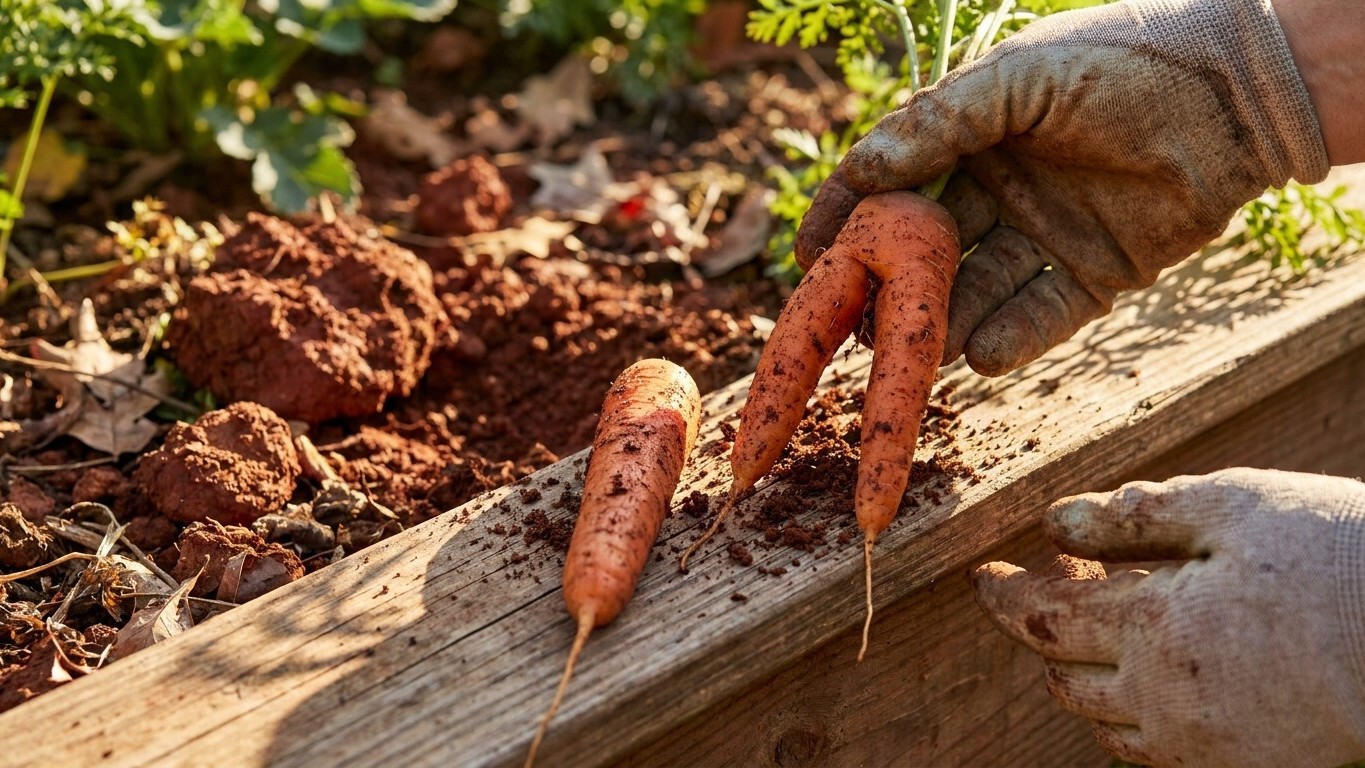

Maryland’s benchmark soil, the Sassafras series, runs sandy and well drained, so carrots grown in ground that matches it typically come out straight, not forked. But most Maryland gardens sit on soil that’s been graded, filled, or compacted during construction, and that ground behaves nothing like the state’s representative series. The real answer depends on what’s actually under your feet, not on a statewide average.
The short answer
The soil USDA lists as representative of Maryland is the Sassafras series, an Ultisol, which is soil scientist shorthand for old, heavily weathered ground that’s been leached of nutrients over a very long stretch of time. The surface horizon runs 67 percent sand, 10 percent clay, and 23 percent silt, with organic matter around 1.6 percent and a surface pH near 5.3, which counts as strongly acid. It drains well. USDA NRCS pulled these numbers from 290 sampled components of the series through its Soil Data Access system.
Translate that into carrot terms and the news is mostly good. Carrots want deep, sandy, well-drained ground rich in organic matter, according to Utah State University Extension’s guidance on growing carrots in the garden. Sassafras soil checks two of those three boxes on its own: it’s sandy, and it drains. What it’s missing is the organic matter, sitting at just 1.6 percent when a productive vegetable bed usually wants more than that to hold moisture evenly and feed the crop. Skip that step and you’re not looking at forking so much as small, woody roots and slow growth.
Forking itself, where the taproot splits into two or three legs instead of growing as one straight carrot, is what happens when a root meets resistance and detours around it. Utah State’s extension office is blunt about the cause: heavy or rocky soil makes the root fork. Sassafras soil, being sandy with only 10 percent clay, isn’t the heavy, compacted kind of ground that typically causes this. If your garden sits on soil close to that profile, straight carrots are a reasonable expectation, provided you dig in compost to make up for the low organic matter.
The soil most gardeners actually work with is a different story. Clay content above what Sassafras carries, rock fragments left behind by a foundation dig, or a hardpan a few inches down from years of foot traffic will all cause the same forking problem, no matter what the county’s benchmark soil says. Utah State’s fix for that heavier ground is straightforward: work in plenty of compost and double dig the bed, breaking up the soil to a full spade’s depth or more so there’s nothing solid in the taproot’s path. Where the ground refuses to cooperate even after that, a raised bed filled with a sandy, compost-rich mix sidesteps the problem instead of fighting it.
None of this replaces knowing your own dirt. Maryland spans hundreds of mapped soil series, and the Sassafras profile describes what USDA considers characteristic of the region, not a reading on any one backyard. A lot bordering a stream carries totally different soil than a subdivision built on scraped and re-graded fill half a mile away. Treat the numbers above as a starting point for what the region’s ground tends to do, then confirm what’s actually in your bed before you decide whether you need a shovel, a bag of compost, or a raised frame.
The test that settles it in your own garden
Skip the guesswork and check the bed itself. None of this requires lab equipment, just a shovel, a bit of water, and twenty minutes.
- Dig a hole at least a foot deep where you plan to sow carrots. Note how far down you get before hitting something solid, whether that’s a rock layer, hardpan, or old construction debris. Carrots need open ground down to their expected root length, so any obstruction in that top foot is a red flag for forking.
- Look closely at what comes out of the hole. Count how many rocks or hard clumps you’re pulling out, and notice whether the soil holds together in a solid slab or breaks apart loosely. A wall of stones or a dense, undisturbed clay layer is exactly the kind of resistance that splits a taproot in two.
- Grab a handful of moist soil and rub it between your fingers. Sandy soil feels grainy and falls apart almost immediately. Clay-heavy soil feels sticky, smears when you rub it, and can be rolled into a ribbon without cracking. The stickier and more ribbon-like it behaves, the more compost and loosening it’s going to need before carrots go in.
- Fill the hole with water and time how long it takes to drain. Water that lingers for hours, or sits on the surface without soaking in at all, points to poor drainage, which invites rot and uneven root shape as much as forking does. Ground that drains at a steady pace within a reasonable stretch is the kind carrots tend to reward.
- Repeat the dig in two or three other spots in the same bed. Soil can change character over just a few feet, especially in yards that were graded unevenly or patched with fill dirt at different times, so one hole rarely tells the whole story.
What you’re really building with this walk-through is a mental map of your bed: how deep the open ground actually runs, how many obstacles sit in that zone, and how the texture and drainage compare to sandy, well-drained ground. That map, not a statewide average, tells you whether you’re amending in place or building up instead.
What goes wrong here
The combination of leftover construction soil, seasonal heat, and Maryland’s mix of downpours and dry spells creates a specific set of carrot problems. Each one has a fix that starts in the bed, not in the seed packet.
- Forking in heavy, compacted ground. Wherever a yard’s topsoil was stripped or fill was brought in, the taproot hits resistance and splits. Utah State University Extension’s answer is to work in generous compost and double dig the bed to loosen the soil well past the depth carrots will grow, removing rocks and clumps as you go rather than leaving them for the root to navigate around.
- Poor germination during a hot stretch. Carrot seed is small and sits close to the surface, so a run of hot, dry days can crust the soil and stop seedlings from pushing through before they even sprout. Keeping the top inch of soil consistently damp until seedlings emerge, since carrots are sown directly where they’ll grow and never transplanted, matters more than any other single step in that first stretch after seeding.
- Splitting from uneven watering. A dry spell followed by a heavy rain or a big catch-up watering session swells the root faster than the skin can stretch, and it splits down the side. Watering on a steady schedule instead of letting the bed dry out completely between soakings keeps the root growing at a consistent pace.
- Low organic matter slowing growth. Sandy ground with organic matter near the 1.6 percent mark typical of the region’s representative soil drains well but doesn’t hold nutrients or moisture for long. Digging in compost before sowing gives the crop something to draw on through the full 70 to 100 days it takes carrots to mature from seed.
Common questions
Do I need to test my soil’s pH before planting carrots in Maryland?
The state’s representative soil runs strongly acid at a surface pH near 5.3, but that figure describes the Sassafras series specifically, not every yard in the state. A home soil test is the only way to know where your own bed actually sits.
How long do carrots take to mature after seeding in Maryland?
Carrots are sown directly in the bed where they’ll grow, with no transplanting step, and Utah State University Extension counts the growing period from that seeding date, running roughly 70 to 100 days depending on conditions.
Is a raised bed necessary for growing straight carrots?
Not always. If your soil turns out sandy and loose with few rocks, working in compost may be enough. A raised bed becomes the more reliable fix once digging reveals heavy clay, a hardpan, or a rocky layer that double digging can’t fully clear.
What does forking actually look like in a harvested carrot?
Instead of one straight taproot, the carrot splits into two or three separate legs partway down. Utah State University Extension attributes this directly to the root meeting resistance from heavy or rocky soil as it tries to grow downward.