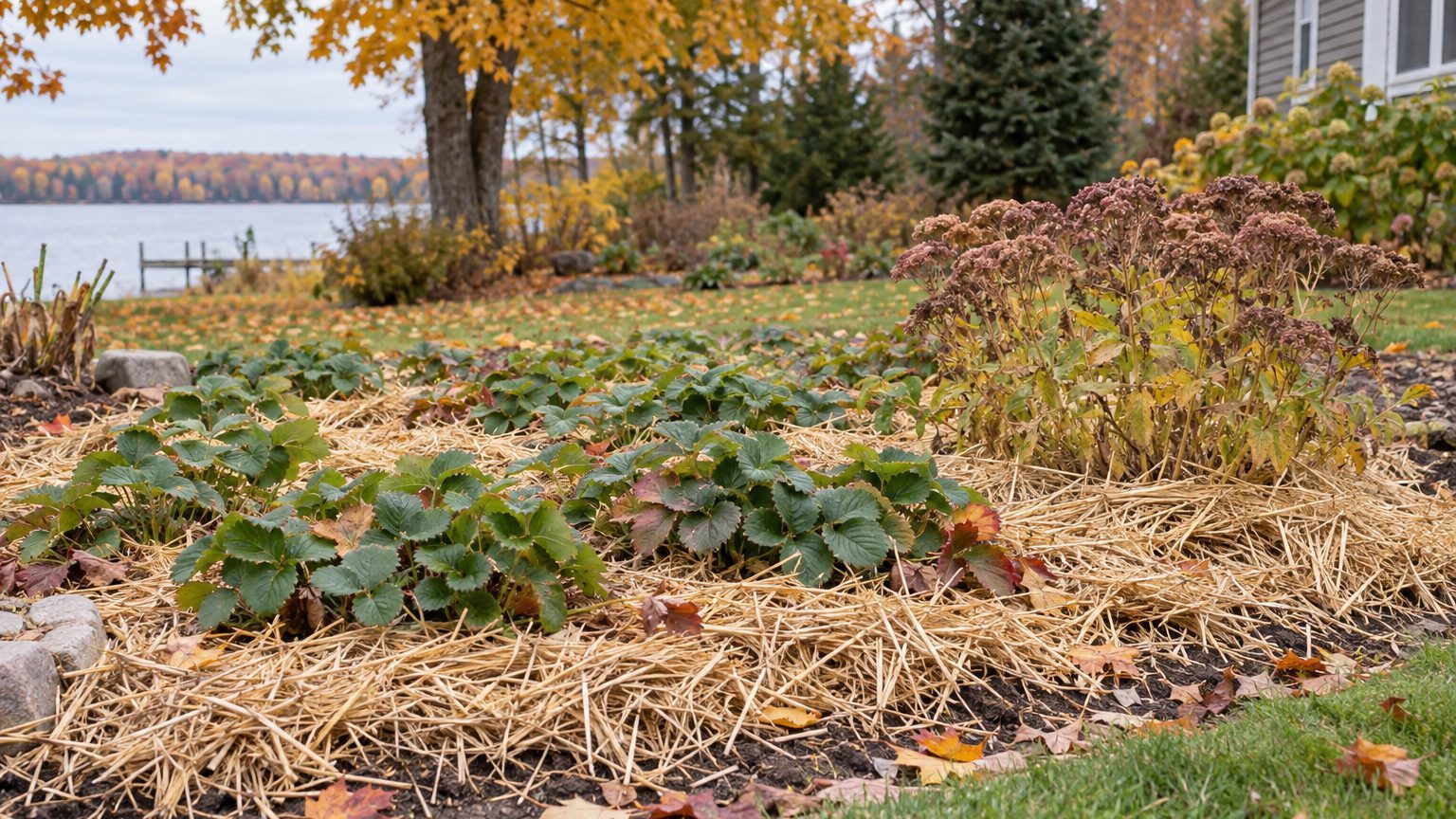

Wait. That’s the short answer for strawberries and perennials alike. In Baltimore, a first 32°F freeze has a 30-70% chance of arriving between October 26 and November 5, according to NOAA’s 1991-2020 climate normals. Winter mulch belongs after that, once the soil surface begins to freeze, not the morning the first frost wilts the basil. Early mulch is the most common winter mistake in Maryland beds. Below: the mechanism, plant-by-plant depth and timing, and the failures that follow a well-meant head start.
When to put winter mulch down in Maryland
Winter mulch does not keep plants warm. It keeps soil at whatever temperature it already is. Think of a cooler lid: it holds cold drinks cold on a hot day, and it would hold warm ones warm just as well. Spread mulch over soil that still carries the heat of September and October, and you have sealed that warmth in, right where crowns and roots would like to be winding down.
The actual job is to keep frozen soil frozen. Maryland winters swing. A bitter week gives way to a 50°F afternoon, then freezes again, and it’s the cycling that hurts shallow roots, not the cold alone. Baltimore’s coldest month has a mean daily minimum of 25.4°F (NOAA NCEI 1991-2020 Climate Normals, the reference station used here). That is an average of the nightly lows, not a record, which means a typical midwinter night sits well under freezing. The ground really does freeze at this latitude, so the logic of holding it frozen applies.
The window, counted from the first frost
Start with the NOAA freeze-probability band for Baltimore: first 32°F freeze between October 26 and November 5. Those are the first freezes of the season, usually light and followed by mild days. Plants are still hardening off. Soil is still warm several inches down. Mulch laid now is premature.
Put winter mulch down after the October 26 to November 5 freeze window has passed, once nights are freezing repeatedly and the soil surface is stiffening or crusting by morning. In a typical year that places the work in the stretch of late fall after those first freezes and before the deepest midwinter cold arrives. A trowel is the best calendar you have. If it slides in easily and the soil under the surface feels cool but loose, wait. If you find a crust or stiff ground, go.
Other parts of the state shift the window, and always in the same direction. The mountains of Garrett and Allegany counties are colder and higher, so freezes come earlier there than in Baltimore, and the mulching window opens earlier on the calendar. The Eastern Shore runs milder, so the freeze (and the mulching) comes later. Check your own county’s frost pattern against the First and Last Frost Dates in Maryland, and see the Maryland guides for other fall jobs.
| Area | First freezes compared with Baltimore | Where the mulch window sits |
|---|---|---|
| Western Maryland (Garrett, Allegany) | Earlier; mountainous and colder | Earlier on the calendar, still after the ground starts to freeze |
| Baltimore area (reference station) | October 26 to November 5 (30-70% probability band, NOAA) | After that range, once nights freeze repeatedly |
| Eastern Shore | Later; milder | Later on the calendar, same ground-freeze test |
Strawberries
A strawberry plant is mostly a crown: a short, stubby stem right at the soil surface, with roots below and leaves above. That position is the problem. Nothing buffers it. In a bare bed, repeated freezing and thawing swells the soil and pushes crowns up, sometimes with their roots snapped. Pushed-up crowns dry out in a cold wind. Even without heaving, bare crowns exposed to hard cold can lose the growing tissue that makes next summer’s flowers.
What to use and how deep
Clean straw is the standard choice, and for good reason. It’s light, it traps air, it lets water drain through, and it does not mat down into a soggy sheet the way whole leaves or grass clippings do. “Clean” matters: straw from a feed store sometimes carries seeds, and hay is worse. A bale labeled weed-free is worth the small premium of asking.
For depth, the figure that holds up comes from a neighboring state’s extension service. The NC State Extension Gardener Handbook says: “A 2-inch to 3-inch layer of mulch suppresses most annual weed seeds and makes it easy to hand-pull any that do germinate.” (NC State Extension Gardener Handbook, chapter 11.) The same handbook calls for a 3-inch layer to reduce water loss and keep soil moisture and temperature even around roots. The two sentences serve different purposes but land on the same order of depth, which is a good reason to stop there. Straw settles after a few rains, so spread it fluffy and let it compress to that range. More is not better; a thick wad over the crowns invites rot.
Timing follows the rule from the first section. In Baltimore, hold the straw until after the first freezes of October 26 to November 5 have passed and the soil is beginning to freeze. Plants need a stretch of cold weather to harden off, and mulch applied while they are still growing can keep them soft. Strawberry beds go on the same schedule even in a cold snap that arrives earlier than usual: wait for the ground, not the weather forecast alone. More on the plant itself in Growing Strawberries.
Spring is the other half of the job. Straw left on too long smothers new growth and holds the crowns cold and wet. Pull the straw off the crowns, rake it into the aisles, and keep it close by as soon as new leaves push up pale yellow-green through the mulch. That timing varies with spring: it comes earlier on the Eastern Shore and later in the western mountains, which also have later last spring frosts. Leave the straw between rows to suppress weeds and keep the berries clean. If a frost is forecast once flowers have opened, a quick re-cover over the plants for the night protects the blossoms.
Perennials and borderline plants
Most established perennials in Maryland do not need winter mulch at all. Hostas, daylilies, sedums and similar plants have lived through colder winters than this for generations. The ones that benefit are plants in a few categories: anything planted this fall and not yet rooted in, shallow-rooted plants that heave out of the ground in thaws (coral bells are the classic example), and plants sitting at the edge of what the zone allows.
That last category depends on where you garden. The USDA Plant Hardiness Zone Map 2023, built on 1991-2020 normals, places Maryland across zones 5b to 8a. Because that is a statewide range, a perennial that sails through winter on the Eastern Shore can be borderline in the mountains. Use the zone as a rough guide only. The USDA system is built on one variable, the average annual extreme minimum temperature, so it says nothing about how often the soil thaws and refreezes. Check your plant tag against your local conditions, and give anything marginal some help.
Fall-planted perennials are the clearest case. Their roots haven’t spread, so the first winter is their hardest. Garden mums, which many people buy for color and then expect to return, often fail for exactly that reason: planted late with no time to root, then left bare. Mulch them after the ground freezes, the same as strawberries.
Herbs deserve a flag. Rosemary and lavender sit near the edge in much of the state, and lavender in particular resents wet crowns, so a damp mulch pile does more harm than the cold. The Getting Perennial Herbs Through the Winter guide covers each herb.
Depth and shape matter more than material. Use the same 2-inch to 3-inch range from NC State Extension, and apply it as a ring around the plant, not a pile on top of it. Leave a collar of bare soil right at the crown or stems so moisture can evaporate and rodents don’t find a tunnel to the bark. That ring is also what separates a protective layer from a “volcano,” the cone that smothers a trunk or crown. The Mulching Without Killing the Plant guide goes through the shape in more detail.
Mulch new and borderline perennials after the ground begins to freeze, in a 2-inch to 3-inch ring that stops short of the crown. Shredded leaves, pine straw and chopped bark all work. Whole leaves do not; they mat.
What goes wrong
Four failures cover most of the damage, and each has a signature.
Mulching too early shows up in spring, not winter. Crowns are soft, black or slimy at the base, and the plant never quite recovers. Soil that was still warm under a blanket stayed active and wet. The cure is the soil test: wait for a crust, not for the first frost.
Matting looks like a gray, slick, layered sheet when you lift the mulch. Whole leaves, grass clippings and wet, finely ground material do this. Water pools under the sheet, air stops moving, and crowns rot. Fluffy straw, shredded leaves and coarse chips prevent it. If a thaw leaves a mat on the surface, fluff it with a rake.
Voles love thick mulch, because it is a roof over a feeding ground. The signs are narrow runways in the soil and bark chewed off at the base of young shrubs and woody perennials, usually found only after the snow melts. Late timing helps, since voles settle in earlier when they have cover. So do the ring and the bare collar from the last section, and keeping mulch off trunks entirely.
Forgetting to uncover is the quiet one. Strawberries buried under straw into spring come up pale, weak and late, and a few don’t come up at all. Check strawberry beds as the weather turns in spring, and pull the straw off the crowns the moment new growth shows under it. It is a five-minute job that, left undone, costs the whole crop.
Common questions
Can I mulch strawberries right after the first frost?
Not yet. In Baltimore the first 32°F freeze falls in the October 26 to November 5 range (NOAA NCEI 1991-2020 Climate Normals), but that first freeze is usually light and followed by mild days. Plants are still hardening, and soil is warm. Wait until the ground begins to freeze, with a crust in the morning and nights regularly below freezing.
Is winter mulch different on the Eastern Shore or in Western Maryland?
The rule is the same and the calendar shifts. Western Maryland is mountainous and colder, so freezes come earlier and mulching can start earlier. The Eastern Shore is milder, so everything moves later. In both places, the test is the ground, not a date.
Can I use shredded leaves instead of straw?
For perennials, yes, if they are shredded and applied in a ring. Whole leaves mat and hold water. For strawberries, clean straw is the better choice because it stays loose over the crowns and drains well.
How deep should winter mulch be?
NC State Extension recommends “a 2-inch to 3-inch layer” for weed suppression and a “3-inch layer” to reduce water loss and keep soil moisture and temperature even. Stay in that range. A deeper layer rots crowns and shelters voles.