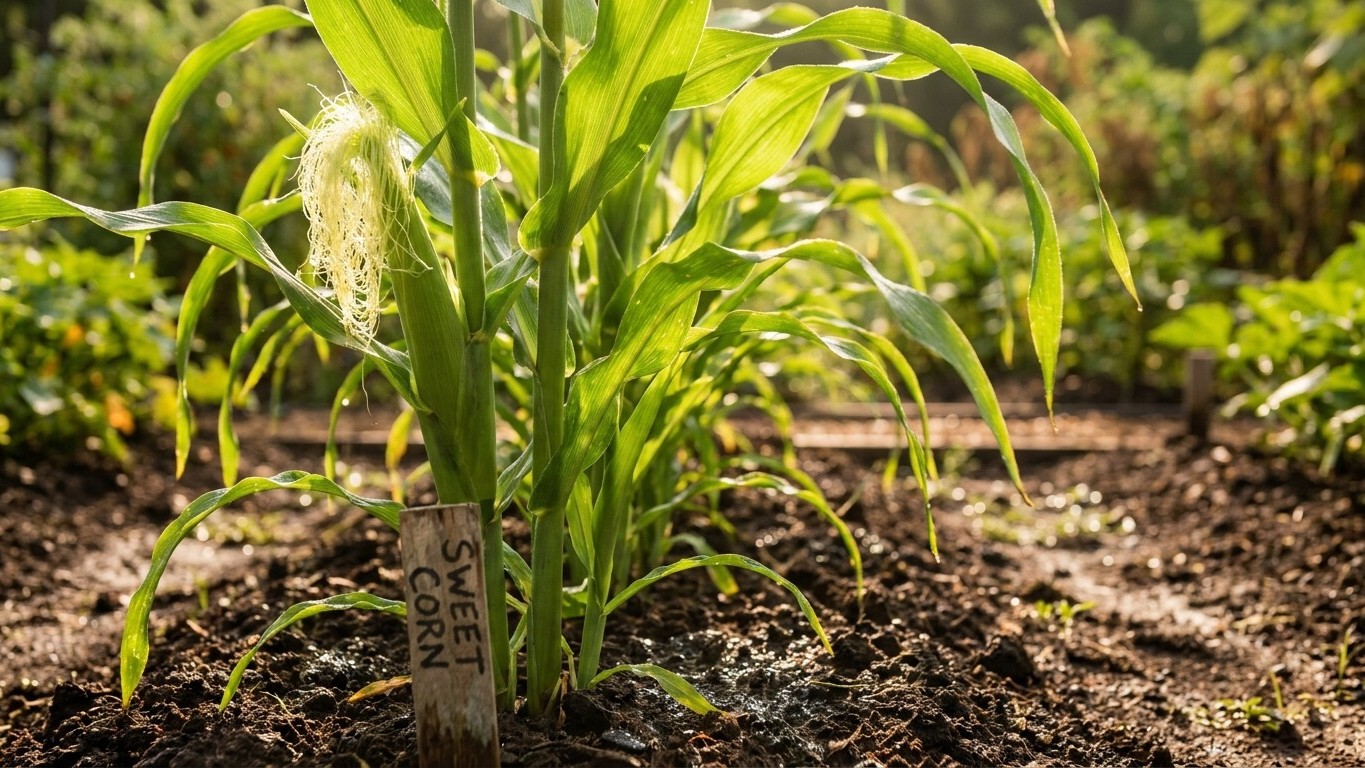

Yes, sweet corn ripens reliably across most of Maryland, from the Eastern Shore through the Piedmont and into Southern Maryland, as long as the soil has actually warmed before planting and the variety’s maturity length fits the season that follows. The one exception sits in the mountains of Western Maryland, where a shorter, later season narrows the margin, particularly for a slow-maturing type. The details below explain why timing matters more than the calendar alone.
The short answer
Soil temperature, not the last frost, is what actually starts the sweet corn clock. Maryland’s last spring frost typically falls between April 3 and April 16, according to NOAA NCEI climate normals, but soil takes longer to catch up. Soil warms more slowly than air, so the point where garden soil holds steady above 60°F, the threshold sweet corn needs to germinate well, arrives well after that frost window closes, not on the same day. Growers who plant the week frost risk passes, assuming the ground is ready, often end up with seed that sits cold and wet instead of sprouting.
That delay matters less than it sounds, because Maryland’s frost-free stretch is generous. The first fall frost lands between October 26 and November 5 across most of the state. Counting from the later end of the spring frost window to the earlier end of the fall frost window still leaves roughly 200 days of frost-free growing time. Even after subtracting the weeks it takes soil to climb past 60°F, there’s comfortably more than 90 days left before autumn cold returns, which is the upper end of what sweet corn needs from planting to harvest.
Summer heat is the other factor worth weighing. The Baltimore reference station averages 24.6 days a year at 90°F or hotter, a measure of heat load rather than an average temperature. That heat accelerates germination and early growth once soil is warm enough, but it also raises water demand through the tasseling and silking stages. A season with room to spare on the calendar can still underperform if the crop dries out during the hottest stretch, so watering consistency matters as much as timing.
Put together, the short answer holds for nearly the whole state: wait for soil, not frost date, to clear 60°F, then count 60 to 90 days depending on the variety, and Maryland’s season has enough room to finish the job before fall frost arrives. The regional wrinkle, covered next, is where that room starts to shrink.
Does a late variety fit here?
A 60-day variety
A fast, 60-day sweet corn fits Maryland with margin to spare almost everywhere in the state. Even allowing several weeks after the spring frost window for soil to warm past 60°F, and even in Western Maryland where that warm-up runs later, there’s still well over 100 days of buffer before the first fall frost between October 26 and November 5. On the Eastern Shore, where conditions run milder, the margin is even wider. A short-season variety is the safer choice for anyone planting later than planned, or gardening at higher elevation where spring lingers.
A 90-day variety
A 90-day variety works out differently depending on where in Maryland it’s planted. Across the Piedmont, Southern Maryland, and the Eastern Shore, the math still holds: soil clears 60°F sometime after the spring frost window, the 90-day count runs through summer, and harvest lands well ahead of the October 26 to November 5 fall frost window, with weeks of cushion left over. In these areas, a slower, often sweeter-maturing variety is a reasonable choice.
In Western Maryland’s mountain counties, Garrett and Allegany, the picture changes. NOAA climate normals flag this region as running weeks later on frost timing, meaning the season starts later and the safe window for finishing a long-maturity crop is compressed on both ends. Stack a delayed soil warm-up on top of a later spring frost, and a 90-day variety loses most of the cushion it enjoys elsewhere in the state. Plainly stated: a 90-day sweet corn does not reliably fit in Western Maryland. Growers there are better served sticking with a 60-day type, or at most something in the 70-day range, and watching soil temperature directly rather than counting on the calendar to work in their favor.
What goes wrong here
- Soil sown too cold. Planting on the frost date instead of waiting for soil to clear 60°F is the most common failure in Maryland gardens. Cold, damp soil rots seed or stalls germination for days. The fix is simple: use a soil thermometer at planting depth rather than trusting the frost date or the look of the weather, and hold off until the reading is consistently above 60°F.
- A variety too late for the season. Choosing a 90-day type where the season can’t support it, mainly in Western Maryland’s higher, cooler counties, leaves ears unfinished when the first fall frost arrives. The remedy is matching maturity length to the region: a 60 to 70-day variety in Garrett or Allegany County, a 90-day variety reserved for the milder Piedmont, Southern Maryland, or Eastern Shore.
- Sweetness lost, and it has nothing to do with climate. When su, se, and sh2 sweet corn types tassel at the same time nearby, cross-pollination turns sweet kernels starchy and tough. This is a garden layout problem, not a weather problem, and no climate fix solves it. The remedy is timing: stagger plantings so different types don’t tassel in the same window, or grow only one type in a season, always set out in blocks of three or more rows rather than a single line, so pollination within the block stays reliable.
Common questions
What week should sweet corn go in the ground in Maryland? There’s no single published date here, and the frost date alone isn’t the right marker. The trigger is soil temperature: wait until soil at planting depth holds consistently above 60°F, which comes later than the April 3 to April 16 last-frost window, not on it.
How do you know when sweet corn is actually ripe? Check three signs together, never one alone: the silks have turned dry and brown, the husks are still moist and green, and juice from a punctured kernel runs milky rather than clear or thick.
Is there enough season in Western Maryland for sweet corn? Yes, for a fast 60-day variety, which still finishes with room to spare. A 90-day variety is a different story: the later spring frost timing in Garrett and Allegany County compresses the season enough that a long-maturity type does not reliably finish before fall frost.
Why did homegrown sweet corn turn starchy or tough this year? The likely cause is two different types, such as an su and an sh2, tasseling at the same time close together and cross-pollinating. It isn’t a weather issue. Stagger planting dates by type, or grow a single type per season, to protect sweetness.