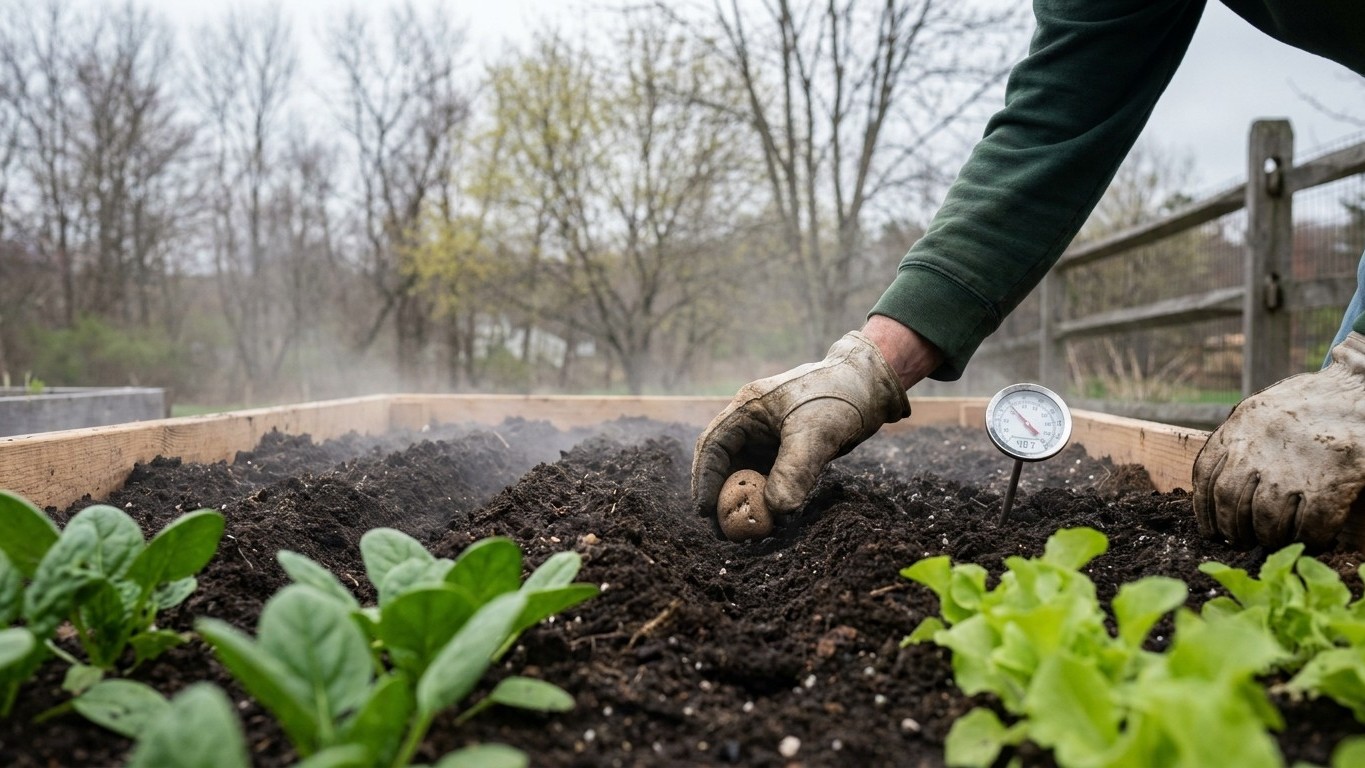

April sits right on top of Massachusetts’ last frost window, so the answer changes week to week. Early in the month, treat the ground as still frost-prone almost everywhere except the immediate coast. By late April, hardy crops go in with confidence and tender ones still wait for May. The safe move is soil temperature and local frost history, not the date on the calendar.
What goes in the ground in April

NOAA’s 1991-2020 climate normals put the last spring freeze at Boston’s Logan Airport between April 1 and April 8, based on the 30-70% probability band for a 32°F freeze. That’s the mildest spot in the state. Inland suburbs, the Connecticut River Valley, and especially the Berkshires run weeks behind that number, so a gardener in Springfield or Pittsfield should treat early April the way a Boston gardener treats March.
What that means in practice: this is a month for cold-hardy crops, not tender ones. Peas can go into workable soil as soon as it’s dry enough to crumble in your hand rather than clump. Spinach, arugula, and loose-leaf lettuce germinate fine in soil that’s still cool. Onion sets and shallots go in early, and seed potatoes can go in toward the back half of the month in most of the state, later in the Berkshires. Radishes and carrots tolerate a light frost once they’ve sprouted, though a hard freeze on tiny seedlings will still set them back.
What’s still a gamble
Tomatoes, peppers, eggplant, squash, beans, and anything else that dies at 32°F stays indoors or under cover through this entire month across nearly all of Massachusetts. Even along the immediate coast, where the frost-free window opens earliest, soil temperatures for these crops usually aren’t warm enough to matter until well into May. Planting them out now doesn’t just risk frost kill, it also stunts growth in cold soil even when a hard freeze doesn’t materialize.
Cold frames and low tunnels earn their keep here. They let a gardener push lettuce, spinach, and brassica transplants out two or three weeks earlier than open ground would allow, and they buffer the swings between a 60°F afternoon and a 28°F night that April in this state is known for.
What to start under cover
Work backward from the frost window instead of a fixed date. Tomatoes need roughly six to eight weeks indoors before they go outside, and they don’t go outside until well after that April 1-8 Logan freeze date has passed for good, later still inland. Counting back from a safe transplant date in mid-to-late May puts tomato seeding in this window, right now, under lights or on a warm windowsill.
Peppers and eggplant need even more lead time, often eight to ten weeks, and they’re slower to germinate in the first place. If they haven’t gone into trays yet, this is close to the last reasonable moment. Fast growers like cucumbers and summer squash need only three to four weeks, so they can wait until closer to the actual transplant date without a problem.
The two ways this goes wrong
Starting too early is the more common mistake. Seedlings that sit in small cells for weeks past their ideal transplant size get rootbound, stretch toward the light, and never fully recover once they’re in the ground. A leggy, pale tomato start almost always underperforms one seeded two weeks later under the same conditions. Starting too late is the opposite failure: peppers seeded now for an outdoor date in late May may never produce a full harvest before the first fall freeze arrives between November 3 and November 14, because they simply run out of growing season. Both mistakes trace back to skipping the arithmetic and going by feel instead.
What is ready to pick
Outdoors, April is thin. Most of what’s coming out of a Massachusetts garden this month was planted the previous fall or survived the winter in place. Overwintered kale and leeks, if they made it through, are often the sweetest they’ll be all year, since cold exposure converts starches to sugars. Sprouting broccoli planted the prior summer sends up its first shoots now in a mild spring.
Rhubarb is the month’s real reward. Established crowns push up stalks worth harvesting by mid-to-late April in most of the state, and a light pull test, twist and lift rather than cut, tells you whether a stalk is ready. Anything under 10 inches is better left to build the plant’s reserves for another few weeks.
Checking the root cellar
Stored potatoes, winter squash, and onions need a look now regardless of what’s happening outside. Squash that’s softening near the stem end or developing sunken, water-soaked spots is on its way out and should be used first. Potatoes sending up long pale sprouts are still edible once the sprouts are snapped off, but they’re losing quality fast. Onions gone soft at the neck won’t recover and are worth pulling from storage before they spread rot to the rest of the batch.
The jobs that matter this month
Soil work comes first. April is the window to test pH and nutrient levels before planting commits you to whatever the soil already has, and to work in compost or amendments while beds are still open. Wet spring soil is easy to damage, though. Squeeze a handful. If it forms a tight ball that doesn’t crumble when poked, it’s too wet to till or dig without compacting the structure for the whole season.
Dormant pruning of fruit trees and berry canes has a real deadline: it needs to happen before buds swell and break. Once leaves emerge, pruning cuts stress the plant and invite disease in a way that dormant-season cuts don’t. Apple, pear, and stone fruit trees, along with raspberry and blackberry canes, should get their structural cuts finished before this month is out.
Everything else on the list
- Order remaining seed now, since popular varieties of tomatoes and peppers sell out by late spring
- Turn compost piles to speed decomposition as temperatures climb
- Clean and sharpen pruners, hoes, and shovels before the season’s heavy use starts
- Repair raised beds, trellises, and fencing while beds are still empty and easy to access
- Scout overwintering pests like aphid eggs on fruit tree bark before populations explode with new growth
None of this is filler. A rotation plan sketched now saves a season of disease buildup later, and a fence repaired before planting is a fence that actually keeps deer out when the seedlings that attract them go in.
What not to do in April
The classic mistake is trusting a warm afternoon over the calendar of frost probability. A run of 65°F days in mid-April feels like permission to set out tomato starts, but that same week can end with a 28°F night, and the plants that looked thriving on Tuesday are blackened by Thursday. Wait for the frost window to close in your specific area, not for a few pleasant afternoons.
Uncovering perennial beds too early carries the same risk in reverse. Pulling back mulch from strawberries or emerging perennials during a warm spell exposes new growth to the next cold snap, and tender new shoots handle frost far worse than dormant crowns did all winter. Leave a thinner layer of mulch in place through the month rather than stripping beds bare at the first mild stretch.
Nitrogen timing trips people up too. Heavy nitrogen applications early in the month, before plants are actively growing, mostly feed weeds and leach away with spring rain instead of reaching the crops that need it. It’s more effective to hold nitrogen-heavy feeding until plants are actually up and growing, then apply it in smaller, timed doses rather than one big dump at planting. And working wet soil to “get ahead” of the season compacts it in a way that takes a full growing season to undo, so a few extra days waiting for soil to dry out is worth more than the days gained by rushing in.
Checking this against your own county
A statewide frost window is a starting point, not an instruction for a specific yard. Massachusetts spans USDA Hardiness Zones 5a to 7b, and that range alone signals how much elevation, distance from the coast, and local terrain shift these dates. The April 1-8 last-frost window comes from Logan Airport, a waterfront, urban station and the mildest reporting point in the state; a garden in the Berkshires or a low-lying inland valley can run two to three weeks behind that.
Before committing tender transplants to the ground, check the UMass Amherst Extension for region-specific guidance and local frost data that accounts for your county’s elevation and microclimate.
Common questions
Can I plant grass seed in Massachusetts in April?
Cool-season grass seed germinates well once soil temperatures climb into the 50s, which typically happens as the month progresses across most of the state. Early April soil is often still too cold for reliable germination, especially inland, so waiting until soil has warmed rather than going by air temperature alone gives better results.
Is it too late to start tomato seeds indoors in April?
Not for most of the state. Since transplant dates fall in mid-to-late May after the frost window closes, seeding tomatoes in early-to-mid April for six to eight weeks of indoor growth still lines up correctly. Waiting past the middle of the month starts to compress that timeline.
When is it safe to move tender seedlings outside in Massachusetts?
Not this month for most of the state. The safe window opens after the local last-frost date, which trails well behind Logan Airport’s April 1-8 average the farther inland or higher in elevation a garden sits. Hardening off seedlings gradually over a week or two before the final move still matters even after that date passes.
What vegetables handle a late frost without protection?
Peas, spinach, kale, and established onion sets tolerate a light frost once they’ve sprouted. Carrots and radishes handle cold snaps reasonably well too, though seedlings just emerging are more vulnerable than established plants. Anything in the tomato, pepper, squash, or bean family has no frost tolerance at any stage and needs full protection or indoor shelter until the danger has passed.