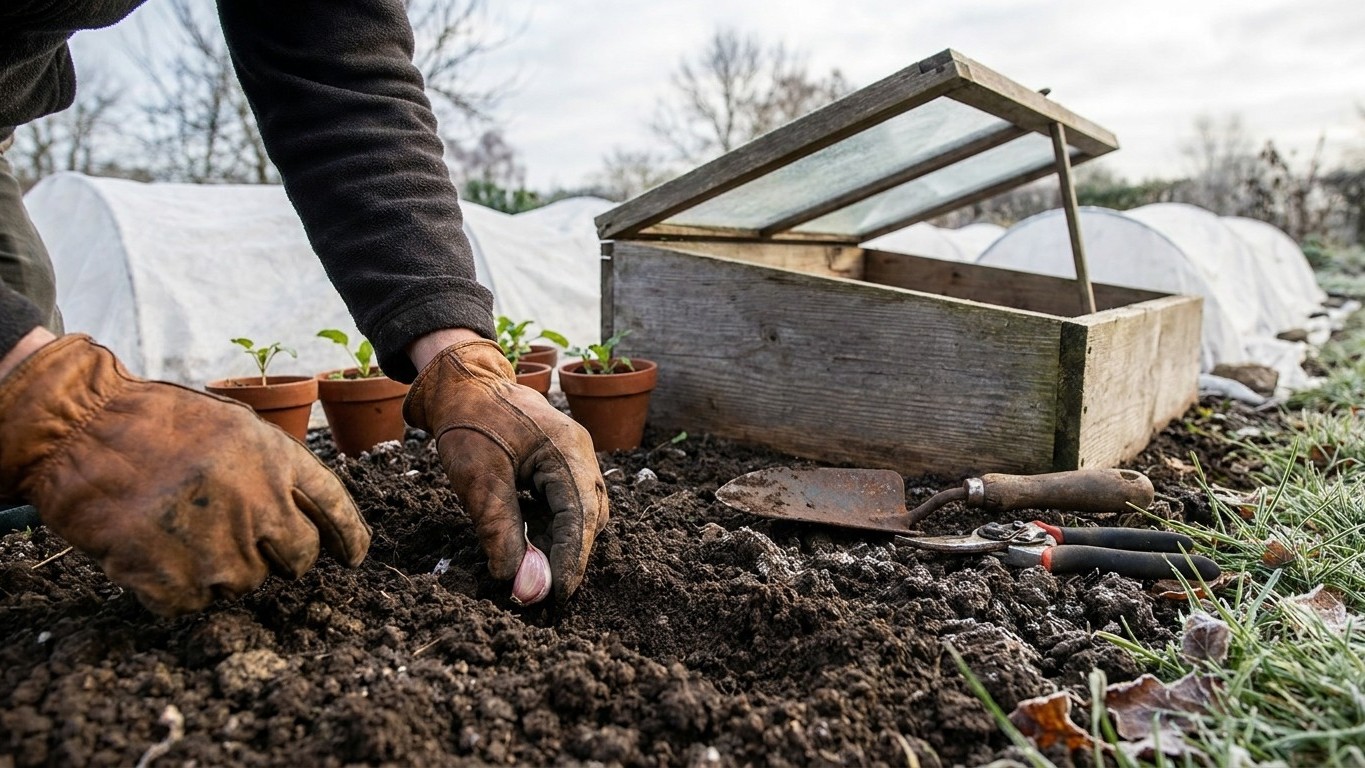

March sits before the frost window even at the mildest edge of Massachusetts, so direct outdoor planting stays limited to the toughest crops. Garlic and shallots can still go in where soil is workable, peas and hardy greens can start under cover late in the month, and cold frames stretch what’s possible. Most of the real work this month happens indoors or with pruners, not a trowel in open dirt.
What goes in the ground in March

The decision here isn’t the calendar, it’s soil temperature and the frost window. At Logan Airport, the mildest recording station in the state, the last spring freeze typically falls between April 1 and April 8, based on NOAA’s 1991-2020 climate normals. That’s the earliest edge of the state’s frost calendar. Inland suburbs, the Connecticut River Valley, and especially the Berkshires run weeks behind that coastal figure, since Logan is a waterfront urban station and consistently the warmest spot in Massachusetts. So for most of the state, March closes out before that window even opens.
That reality rules out tender crops entirely. But it doesn’t mean the ground sits empty. Garlic and shallots can still go in during March if fall planting didn’t happen and the soil has thawed enough to work without turning to mud. Peas tolerate raw, cold soil better than almost anything else in the vegetable garden and can go in as a direct sow once the ground crumbles rather than clumps, particularly in the second half of the month near the coast. Hardy greens like spinach and arugula can follow the same rule, ideally under a cold frame or row cover for insurance against a hard freeze before that April window closes.
Bare-root and dormant plantings belong here too. Fruit trees, brambles, and asparagus crowns are typically installed while still dormant, and March is often the last stretch to get that done before buds swell. Rhubarb divisions go in the same way. If the goal is an earlier harvest without waiting on the soil at all, digging a rhubarb crown and forcing it in a dark, cool spot indoors produces tender stalks well ahead of anything the outdoor bed will offer. Chicory can be forced the same way, in a bucket in a dark basement, for a crop of blanched chicons that has nothing to do with what’s happening outside.
What to start under cover
Seed starting in March runs on arithmetic, not habit. Every seed packet lists a number of weeks the seedling needs before it’s ready to move outdoors, and that number gets counted backward from the local last-frost window, not from a date on a calendar page. Since Logan’s last freeze runs April 1 to April 8 and inland areas trail behind that, a gardener working from the coastal end of the range starts crops earlier than someone in the Berkshires growing the same variety.
Matching lead time to the crop
Long-season crops need the earliest start; short-season crops can wait. Onions, leeks, and celery take the longest runway and are usually the first seeds started under lights in late winter. Tomatoes, peppers, and eggplant come next, needing roughly six to eight weeks of indoor growth before they’re ready for the garden. Cabbage, broccoli, and other spring brassica transplants fall in a similar window.
| Crop group | Typical lead time before transplant |
|---|---|
| Onions, leeks, celery | 10-12 weeks |
| Tomatoes, peppers, eggplant | 6-8 weeks |
| Spring brassicas (cabbage, broccoli) | 5-7 weeks |
The two ways this goes wrong both come from ignoring that backward count. Start too early and the seedlings outgrow their pots weeks before the ground or the weather is ready, turning into leggy, rootbound plants that sulk after transplant instead of taking off. Start too late, especially with onions or leeks, and the plant never builds the size it needs before the season pushes it to bulb or bolt. The fix in both directions is the same: work from the frost window that applies to the actual county, not a generic date, and adjust the start date to match.
What is ready to pick
Outdoors, March offers little in most of Massachusetts, and there’s no point pretending otherwise. But the garden isn’t the only place food is coming from this month. Anything left standing under snow or straw, like overwintered kale, leeks, and Brussels sprouts stalks, can still be dug or cut once the ground softens enough to get a fork into it, and cold has usually sweetened them rather than ruined them.
A cold frame or low tunnel that’s been running since fall may still be holding spinach, mache, or claytonia, all of which handle the shoulder season better than almost anything else in the garden. Indoors, sprouts and microgreens on a windowsill or under a light fill the gap with almost no lead time, ready in a week to ten days from seed.
The other harvest this month is really an inspection. Stored squash, potatoes, onions, and garlic need a check-over now, since this is typically when the weakest ones start to go. Soft spots, sprouting eyes, or a sour smell mean that item gets used or composted immediately, before it takes neighbors down with it in storage. If a rhubarb crown or chicory root went into forcing back in early March, this is also roughly when that indoor harvest comes ready, a small but real payoff while the outdoor beds are still waiting.
The jobs that matter this month
March carries more weight for the season than the empty beds suggest. Dormant pruning of fruit trees, brambles, and grapevines needs to happen before buds break, and in most of the state that window is still open through this month, making it the last real chance to shape a tree without cutting into active growth. Miss it, and pruning has to wait until after harvest, costing a season of better light and airflow through the canopy.
Seed ordering belongs on this month’s list too, and not as an afterthought. Popular varieties sell out well before planting season, and a gardener who waits until the ground is workable to place an order is choosing from whatever’s left. The same logic applies to planning next season’s rotation: deciding now which bed grew tomatoes, which grew brassicas, and where the legumes went, makes it far easier to avoid replanting the same family in the same soil and inviting the pests and diseases that build up when rotation slips.
Soil testing pays off precisely because there’s still time to act on the results. A test done now leaves weeks to work in lime, sulfur, or compost before anything goes in the ground for real. Compost piles benefit from a turn as the weather softens, speeding up a process that’s been nearly stalled all winter. Tools deserve the same attention: a hoe or pruner sharpened now saves effort on every cut and chop for months afterward. Raised beds, cold frames, and fencing that took a beating over winter are easier to repair now, before they’re full of seedlings and impossible to get at. None of this is filler work. Skip it in March, and the cost shows up in April and May.
What not to do in March
The classic mistake is trusting the air instead of the soil. A run of 60-degree afternoons feels like spring, but the ground underneath is often still cold, and the frost window doesn’t actually close until April 1 to April 8 even at Logan, the mildest station in the state. Planting tomatoes, peppers, or other warm-season crops outside on the strength of a warm week means losing them to the next freeze, which is still well within range.
A related error is pulling mulch or row cover off beds too early after a mild stretch. That layer is doing real work insulating overwintered greens, perennial crowns, and soil biology from temperature swings, and stripping it off during a warm spell leaves everything exposed right when a cold snap can still land.
Fertilizing on the same optimistic logic is another waste. Nitrogen applied to soil that’s still cold and to plants that aren’t yet in active growth doesn’t get taken up efficiently, and much of it can leach away before roots are working hard enough to use it. It’s better held until growth visibly resumes.
Working wet soil rounds out the list of avoidable damage. Stepping into a bed or turning it over while it’s still soggy compacts the structure, particularly in the state’s heavier clay soils, and that compaction can hamper root growth for the rest of the season. The soil is ready when it crumbles in a hand, not when it merely looks dry on top.
Checking this against your own county
A state-wide month is a starting point, not an instruction. Massachusetts spans USDA hardiness zones 5a to 7b, and that spread alone shows how different the same month can look between the Berkshires and the coast. Elevation, distance from the ocean, and simple north-south position all shift real frost dates by weeks in either direction from the coastal figures cited here. The most useful next step is checking those numbers against a specific address, which is exactly what the UMass Extension service is built to help with, alongside the state’s own planting calendar resources.
Common questions
Can tomatoes go outside in March in Massachusetts?
No. The last spring freeze runs April 1 to April 8 even at the mildest coastal station, and inland areas trail behind that. Tomatoes started indoors in March should stay there until well past that window closes locally.
Is it too late to plant garlic in March?
Garlic planted in fall generally performs better, but a March planting in workable soil can still produce, just with smaller bulbs than a fall-planted crop gets by harvest.
What’s the earliest thing that can be direct-sown outdoors?
Peas are usually the first crop in, tolerant of cold, workable soil well before the frost window closes. Hardy greens like spinach can follow under a cold frame or row cover for extra protection.
Why does the same month look so different across the state?
Massachusetts covers USDA zones 5a to 7b, and the coastal frost data cited here comes from a waterfront station that’s consistently milder than inland or high-elevation spots. A county-specific check through UMass Extension gives a far more accurate window than a single statewide date.