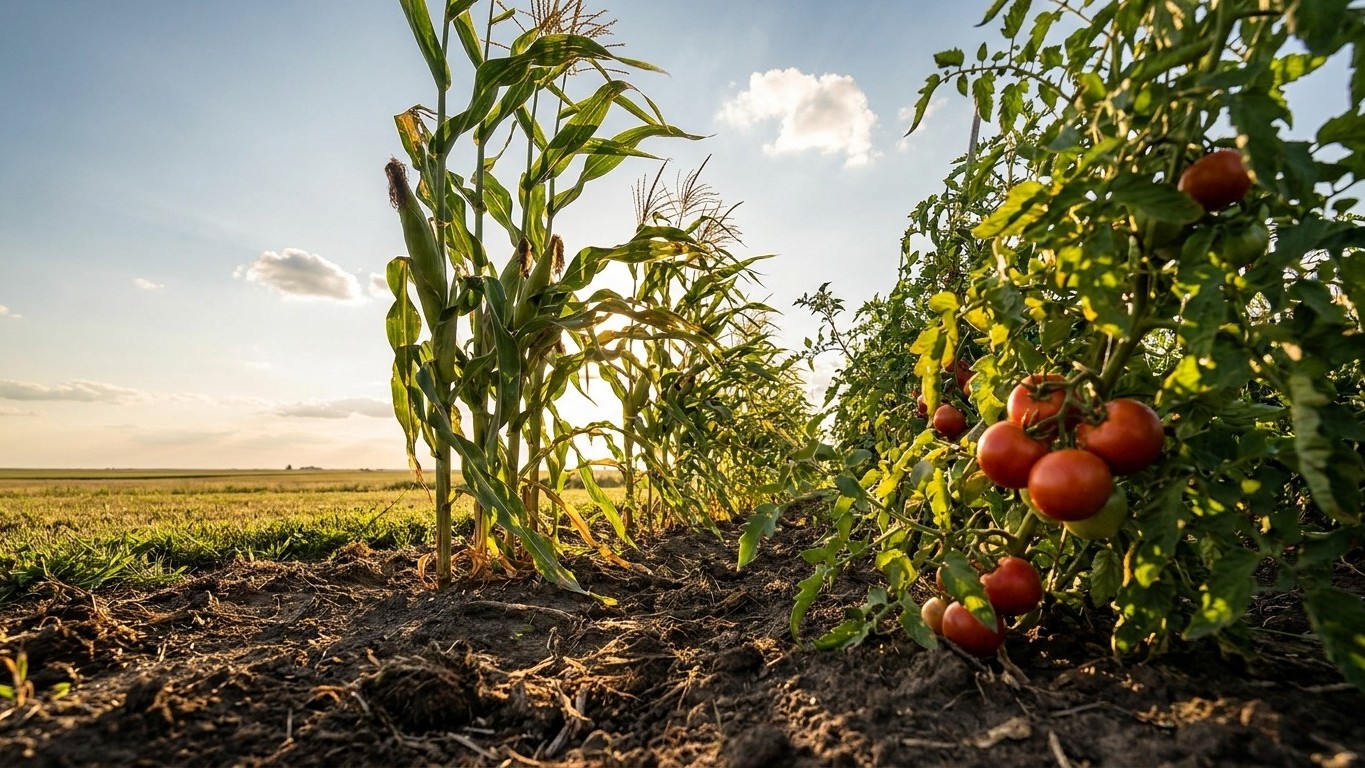

Sweet corn is ready roughly 60 to 90 days after planting, and planting has to wait for warm soil, not a calendar date. In Massachusetts that means starting well after the last frost. Once the ear is picked, the clock runs the other way: sugar drains out of the kernels quickly, faster in heat and faster in some genetic types than others. Timing the harvest matters almost as much as timing the seed.
The short answer
Soil reaches 60 F well after the last frost, and the two dates should never be treated as one. At the Boston Logan station, NOAA’s NCEI Climate Normals put the last spring freeze between April 1 and April 8 (that is the 30 to 70 percent probability band for 32 F). The ground does not match the air. It takes weeks more of spring sun to warm the top few inches to 60 F. I can’t give you a calendar date for that, because none is published here, and a date would be a guess. A soil thermometer is the instruction.
Utah State University Extension sets the working conditions: soil above 60 F, then 60 to 90 days from planting. Clemson Extension is more precise about the reading. Don’t plant before the soil temperature at the 4-inch depth is at least 50 F, and wait to plant extra-sweet varieties until it reaches 65 F. Keep the depth in mind, because a surface reading is warmer and will send you out too early. The two thresholds are not interchangeable. A supersweet seed sown into 50 F soil tends to rot rather than sprout, which is why a gardener can do fine one year and fail the next just by switching varieties.
Then comes the question of whether 60 to 90 days fit before fall. At the same Logan station, the first fall freeze falls between November 3 and November 14. Count from the early-April frost to early November and you get 209 to 227 days, well over twice the longest corn clock. Even if soil warming eats a month or more of that, a coastal gardener has room.
Logan, though, is a waterfront urban station and the mildest spot in the state. Inland suburbs and the Berkshires frost earlier in fall and later in spring, so their margin is thinner. A figure for those places is not published here. The method is simple: take the date your soil reads 60 F (or 65 F for extra-sweet), add the variety’s days to maturity, and compare the result with your own area’s first fall frost. For the sowing side of this, see When to Sow Sweet Corn in Massachusetts.
Two clocks, two questions
The 60 to 90 days run from planting. They tell you whether a variety fits the season. A second, shorter clock starts when the silks first appear, and a rough guide is 17 to 24 days from silk emergence to the picking window. The first clock is for choosing seed, the second for choosing a week. Don’t merge them.
Once the ear is close, use three signs together: silks dry and brown, husk still moist and green, and a punctured kernel that spurts milky juice. Any one alone misleads. Dry silks with clear juice mean the ear is early, and a tight green husk can hide a kernel that has already gone starchy.
Does a late variety fit here?
It depends on where in the state you garden, and it depends on the arithmetic more than the climate label. The two ends of the range behave very differently.
A 60-day variety
An early type fits almost anywhere in Massachusetts. Say the soil reaches 60 F a month or more after the last frost. Sixty days from that point still lands comfortably ahead of a November freeze on the coast, and in cooler inland towns it leaves a cushion for a slow spring or a cold snap that stalls growth. It is also the one that allows a second sowing later, since you aren’t racing the first frost.
Early corn has a downside that has nothing to do with the weather. It tends to come in all at once. If a single sowing matures within a few days, you have a week or so of very good corn and then nothing. Staggering plantings spreads the harvest, though (as the next section explains) that has to be done with the tasseling issue in mind.
A 90-day one
On the coast, a 90-day variety fits. Take the generous end of the soil-warming delay and you still have well over 90 days before the first fall freeze at the Logan station, with weeks to spare. Extra-sweet types start later, since they want 65 F soil, so the margin shrinks a bit but doesn’t vanish.
Inland and in the Berkshires, I can’t say it fits without your local dates. Frost comes earlier in fall and leaves later in spring there, and that squeezes both ends of the window at once. A late variety might still work in a warm year in a sheltered suburban yard. In a high, frost-prone spot it may not, and if your count from 60 F soil plus 90 days runs past your first frost, the answer is plain: don’t plant it. Pick an earlier type rather than gamble on a warm October.
What goes wrong here
Most failures in Massachusetts come down to three causes, and only the last one has nothing to do with the weather. For the insect and animal side, see What Eats Corn in Massachusetts, and When.
- Soil sown too cold. Seed planted by the calendar rather than the thermometer sits in ground that is still too cool. Extra-sweet seed is the most vulnerable because it needs 65 F at the 4-inch depth, and it rots rather than sprouts. Remedy: push a thermometer 4 inches down in the morning, wait for the number for your type (50 F ordinary, 65 F extra-sweet), and ignore the last-frost date entirely.
- A variety too late for the season. A 90-day type sown after a slow spring can meet a fall freeze with the ears still unfilled. This is more likely inland and in the Berkshires than at the coast. Remedy: add the days to maturity to the date your soil reaches its threshold, compare with your local first frost, and drop to an earlier type if the margin is thin.
- Sweetness lost to the neighbors. This one is not climate. Sweetness is lost when su, se and sh2 types tassel at the same time, and the corn ends up starchy. The source gives no isolation distance, so I won’t offer one. The condition is timing: the types must not tassel together. Remedy: grow one type, or sow different types so their tasseling falls at different times, and plant each in blocks of three or more rows rather than one long single row, as Utah State University Extension advises.
A fourth problem shows up after the harvest, and it is the reason for the old advice about running from the garden to the pot. Clemson Extension says it bluntly: “Sweet corn loses sugar from the kernel rapidly at high temperatures… Sweet corn can be stored under optimal conditions for about five days, but will lose sweetness with each day of storage.” About five days is a ceiling under the best conditions, not a promise. The Boston reference station averages 10.2 days a year at 90 F or more, so a hot spell is not routine, but an ear sitting warm on a counter loses sugar quickly all the same. Genotype changes the pace: su loses sugar fastest, se holds it longer, and sh2 holds it longest. If you can’t pick and eat within hours, that is the practical reason to choose se or sh2.
For the full growing picture, start with Growing Sweet Corn in Massachusetts.
Common questions
Is the last frost date the day to plant sweet corn?
No. Soil reaches 60 F well after the last frost, which at the Logan station falls between April 1 and April 8. Plant by soil temperature at the 4-inch depth, not by the frost date.
How can I tell an ear is ready to pick?
Look for three signs together: dry brown silks, husks that are still moist and green, and milky juice when you puncture a kernel. Any one of them alone can mislead you.
How long does picked sweet corn stay sweet?
Clemson Extension says it can be stored under optimal conditions for “about five days, but will lose sweetness with each day of storage.” Five days is the best case. Su types fade fastest, se types hold longer, and sh2 types hold longest.
Can I grow su, se and sh2 types in the same garden?
Yes, as long as they don’t tassel at the same time, because that is what costs the sweetness. No separating distance is published in the source, so build the plan around timing and keep each type in blocks of three or more rows.