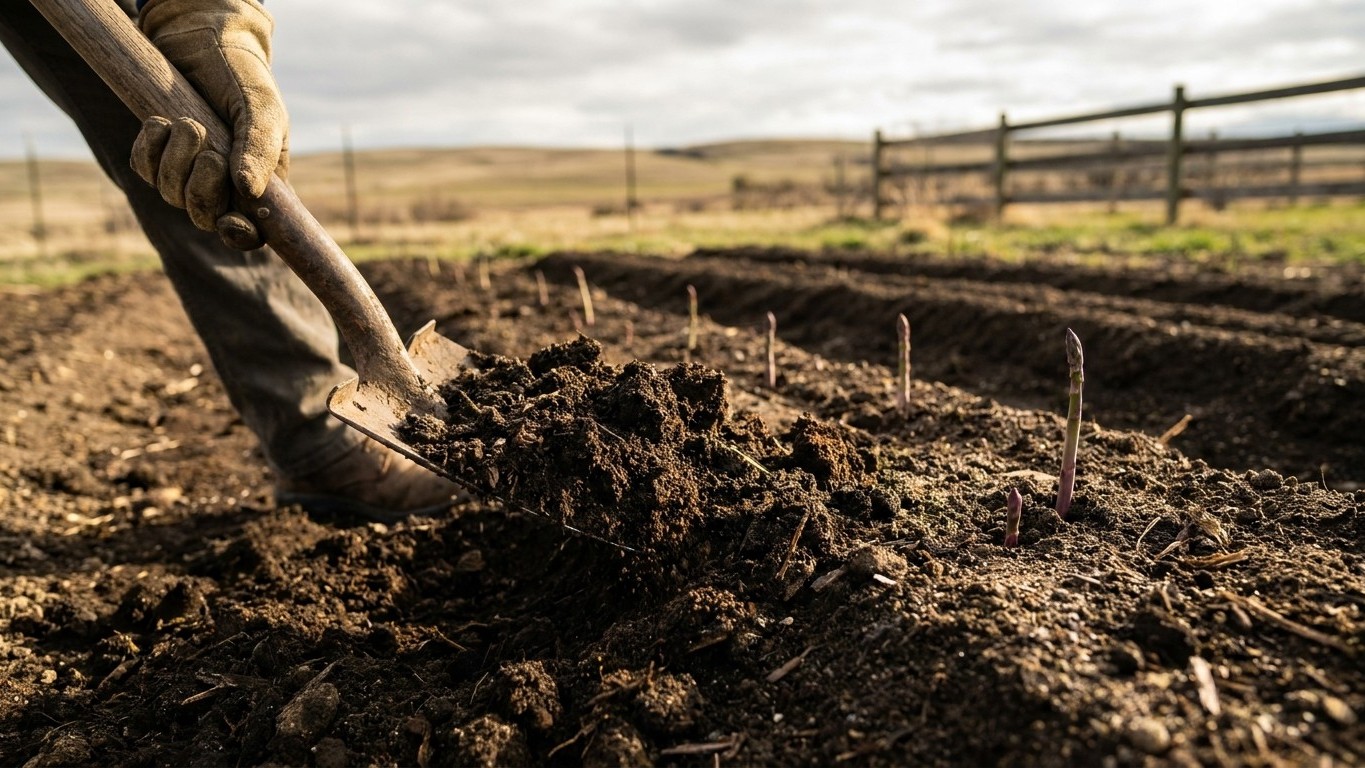

Vermont’s official soil, the Tunbridge series, drains well by nature, which lines up neatly with the one rule asparagus cares about. But a bed planted this spring will still be producing spears when your kids are in high school. That timeline changes how much this decision matters.
The short answer
A soil report can tell you a lot, but it can’t tell you what to do with fifteen years of commitment. That’s the length of time an Asparagus Bed typically stays in the ground once it’s established, per Utah State University Extension: crowns go in, nothing gets harvested for three years, and then the same patch of dirt feeds you for a decade or more after that. Knowing When to Plant Asparagus Crowns in Vermont matters just as much as the soil itself, since you don’t get to change your mind in year four because the drainage turned out to be wrong.
Vermont’s named state soil, the Tunbridge series, happens to be built for exactly this kind of long-term planting. It’s sandy at the surface, 79 percent sand against 21 percent clay with no measurable silt, and it’s classified as well drained. Water moves through it rather than sitting in it, which is the single soil requirement Utah State’s asparagus guidance actually makes: “most soils will do provided they are well drained.” Nothing else about pH or fertility is specified in that source, so don’t let a fertilizer label or a garden forum talk you into chasing a number that isn’t published here.
That said, the Tunbridge series describes the ground under conifers across upland Vermont. It is not a verdict on the specific patch behind your garage. Soil surveys map broad landscape units; river-bottom ground in the Champlain Valley, fill dirt around a newer subdivision, or a low spot that collects runoff after every storm can behave nothing like the mapped series, even a few hundred yards away. The organic-matter figure recorded for this series’ surface horizon runs unusually high, which reflects a natural forest litter layer rather than a worked vegetable bed, another reason not to treat the state soil as a stand-in for your yard.
The practical move is simple: dig a hole about a foot deep after a hard rain and watch it. If water is gone within a few hours, you’re in Tunbridge-like territory and asparagus will be fine where it sits. If water lingers overnight, don’t fight that ground for fifteen years. Build a raised bed, or amend a planting trench with coarse sand and compost before the crowns ever go in. Will Vermont Soil Hold an Asparagus Bed for Fifteen Years? A cheap drainage test now costs you an afternoon. Getting it wrong costs you a decade of soggy, rotting crowns you can’t easily replace.
Will the summer here water it for you?
Rain alone won’t carry an Asparagus Bed through a Vermont summer, though it gets partway there. NOAA’s 1991-2020 climate normals for the reference station in this region put June, July, and August rainfall at 4.26, 4.06, and 3.54 inches, respectively, for a season total of about 11.9 inches. Utah State’s watering guidance calls for 1 to 2 inches every other week during the bed’s first two years, then a lighter 1 to 2 inches every three weeks once it’s established. Line those two numbers up and here’s what a gardener actually needs to do:
- Track the every-other-week target for a new bed: roughly 1 to 2 inches per fourteen days works out to something like 2 to 4 inches a month, and June and July each deliver just over 4 inches naturally, so a wet June or July can nearly cover it on its own.
- Watch August closely. At 3.54 inches, it’s the driest of the three summer months on the region’s normals, and if that month arrives as a couple of heavy thunderstorms rather than steady rain, most of it runs off a sloped bed instead of soaking into the root zone.
- Once the bed matures and the every-three-weeks schedule kicks in, natural rainfall usually covers the requirement in an average summer, but “average” is doing a lot of work in that sentence.
- Keep a rain gauge on the actual bed, not just a general sense of how wet the summer felt. Sandy, well-drained ground of the kind common across the state also drains water away from roots faster than heavier soils hold it, so a technically adequate monthly rainfall total can still leave the top few inches dry between storms.
- Supplement by hand or drip line whenever ten days pass without measurable rain, rather than watering on a fixed calendar. The bed’s actual moisture, not the forecast, is what should decide the schedule.
None of this is a guarantee. These are 30-year averages for one reference station, and a slope, a nearby lake, or an unusually dry stretch changes the picture for any given yard in any given year.
When to put the crowns in
Crowns go into the ground in early spring, which for most of Vermont means timing the planting around the last expected frost rather than a fixed date on the calendar. NOAA’s 1991-2020 normals put the last spring freeze for the region’s reference station somewhere around April 30 to May 10, based on the 30 to 70 percent probability band for a 32F freeze. That’s a mean, not a promise. A given spring can arrive two weeks early or two weeks late, and this reference point comes from a station near Lake Champlain, the mildest corner of the state. Gardeners in the Green Mountains or the Northeast Kingdom should expect the safe planting window to land noticeably later.
Crowns go into furrows about 8 inches deep. Rather than filling the trench in all at once, backfill it gradually across the season, adding roughly 2 inches of soil back over the crowns every couple of months as the emerging shoots grow taller. This gradual approach protects tender new growth while still letting the plant push upward into loosened soil each time.
Seed is the alternative route, though it adds an extra year before the plant reaches transplant size, on top of the three-year wait before any harvesting starts. Most home gardeners skip it for that reason and buy crowns instead, since crowns are already a year or two old when they arrive.
Variety selection is worth a note here, if only because so little about it is actually documented. Utah State University Extension names four options, distinguished by nothing but their reproductive type:
| Variety | Type |
|---|---|
| Jersey Giant | All-male |
| Jersey Knight | All-male |
| UC 157 F1 | Male and female |
| Purple Passion | Male and female |
No flavor comparison, no yield figures, and no stated reason to prefer one over another appear in that source. All-male varieties are sometimes chosen because the plants don’t put energy into producing seed, but that reasoning isn’t part of the cited guidance, so treat it as a general note rather than published fact.
Checking this against your own county
A climate normal describes a reference station, not your backyard, and a state soil series describes a representative mapped unit, not the dirt under your lawn. Before you commit a spot to fifteen years of asparagus, run both numbers past someone who knows your specific county. The University of Vermont Extension, the state’s land-grant extension service, can help confirm your local frost window, check whether your particular soil series drains the way the state soil does, and flag anything unusual about your microclimate, whether that’s a low frost pocket, unusually heavy clay, or a shortened growing season at higher elevation. Their office can be reached through the UVM Extension website, and a local soil test through that same office is the fastest way to replace a state-level average with an actual number for your ground.
Common questions
How soon can I harvest asparagus after planting?
Not until the third year. Utah State University Extension is specific on this: no spears get cut in years one or two, no matter how vigorous the plant looks. Patience here isn’t optional, it’s how the crown builds enough root reserve to support over a decade of future harvests.
How long does an asparagus harvest season last once the bed matures?
Harvest windows lengthen as the bed ages, starting around four weeks in year three and extending to six, then eight weeks in following years, per the same source. But the real signal to stop cutting isn’t a date on the calendar. It’s the spears themselves: once most of them come up thinner than a pencil, that’s the plant telling you to let the rest go to fern for the season.
Does asparagus need a certain amount of winter cold to grow well in Vermont?
That specific figure isn’t published in the source used here. Chilling requirements are commonly discussed for fruit trees, but Utah State’s asparagus guidance doesn’t state one, and Vermont’s cold winters aren’t a documented concern one way or the other in that guidance. Don’t take the state’s hardiness zone as a stand-in for a chilling number; it isn’t one.
Does soil pH matter for asparagus in Vermont?
The cited Utah State University Extension source doesn’t specify a pH requirement at all, and the Tunbridge series’ strongly acid surface reading (around pH 3.5) describes an undisturbed forest floor, not a cultivated garden bed treated with lime or compost over years of use. If you want an actual pH number for your planting site, a local soil test through UVM Extension is the way to get one rather than relying on the state soil’s mapped surface value.