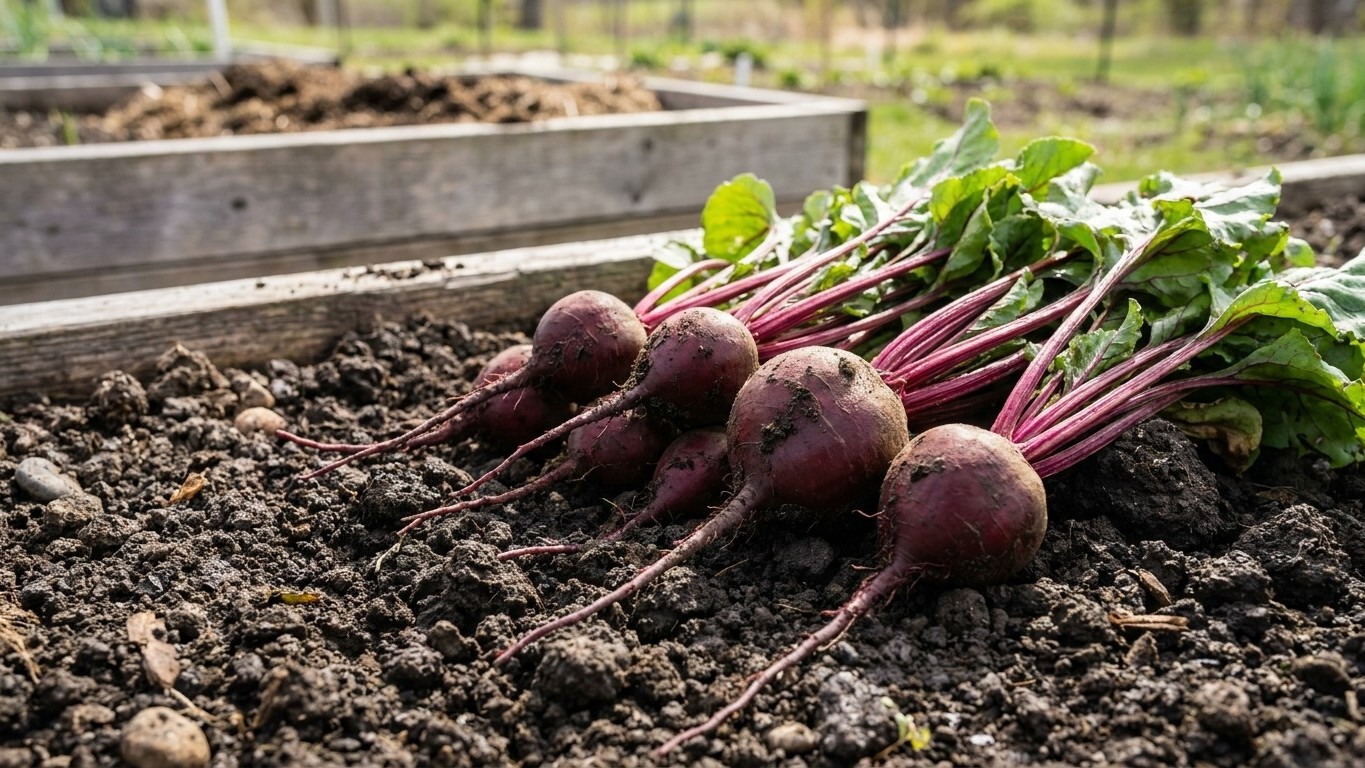

Pull beets when the roots reach the size on the seed packet. Sown in place, that takes 60 to 80 days from seeding. Store them topped at 33 to 36 °F rather than at freezing, which contradicts what works for carrots. USDA’s storage handbook finds more black spot and rot at 32 to 34 °F than a few degrees warmer. In Michigan, the last spring frost falls around April 30 near Detroit and in early to mid May across most of the Lower Peninsula. A row sown then finishes in summer, and a later sowing supplies the cellar.
Why colder is not better for beets
Gardeners who store carrots, parsnips and turnips learn one rule early: get them as close to freezing as you can without crossing the line. Beets break that rule. The chapter by F. Adamicki in USDA Agricultural Handbook 66 puts topped beets at 1 to 2 °C, which is 33 to 36 °F, with 98% relative humidity. It also reports that storage at 0 to 1 °C (32 to 34 °F) produces more black spot and rot than slightly warmer storage.
That gap is only a degree or two. It is the difference between the back wall of a refrigerator, where lettuce freezes, and a shelf near the door. A gardener who reasons “colder keeps longer” will put a crate of beets in the coldest spot available and end up with more spoiled roots than if the crate had sat a few degrees higher.
Humidity matters as much as temperature. A reading of 98% is close to saturated air, the feel of a damp cellar rather than a dry basement. Dry air pulls water out of a root faster than the root can spare it, and a shriveled beet is a lost one even when no rot ever sets in.
How long do beets keep with the leaves on?
The same handbook says bunched beets, meaning roots still attached to their tops, can be kept for about 10 to 14 days at 32 °F and above 98% humidity. Treat that as a ceiling reached only under ideal conditions. A kitchen counter, a warm porch or a drawer that is a little too dry will cut it short. The leaves keep drawing moisture out of the root, so the practical advice is to top beets first, leaving a short stub of stem, whenever they are headed for longer storage.
The handbook’s numbers fit in one small table.
| Setup | Temperature | What the handbook says |
|---|---|---|
| Bunched, leaves on | 32 °F, above 98% humidity | About 10 to 14 days |
| Topped roots | 33 to 36 °F, 98% humidity | The target for storage |
| Topped roots at 32 to 34 °F | Slightly colder | More black spot and rot than at higher temperatures |
| Pit (clamp) or cellar | No lower than 31 °F, no higher than 41 °F | The outer limits for the space |
Notice that the bunched figure and the topped target sit side by side without conflict. The bunched figure is a short holding period for roots with leaves, and the topped range is what you aim for once the tops are off and the roots are going into the cellar for the long haul.
Where in the house that actually is
A refrigerator runs colder than the 33 to 36 °F target, at least in spots, and a heated room runs far warmer. A kitchen at normal living temperature softens a beet in days. The handbook gives a wider envelope for a cellar or pit, which should stay between about 31 and 41 °F. Any space that holds inside that band is a candidate, and the lower half of the band is better than the upper half.
In a Michigan house, the closest match is usually an unheated basement. Look for a corner along a north or east foundation wall, away from the furnace, the water heater and any ductwork. A walled-off cold room under a porch works even better. An unheated attached garage is a gamble, because a Michigan January can push it below 31 °F, and a freeze is the one thing the handbook says to avoid. A bulkhead stairwell or a window well with an insulated lid can also hold the right range through much of the cold season.
Guessing is the mistake to avoid. Put a min-max thermometer next to where the crates will sit and read it after a week or two in the fall, looking at the low and the high rather than the number on the dial at that moment. If the low dips under 31 °F, move the crates away from the wall or add insulation. If the high climbs past 41 °F, look for a cooler corner. A cheap hygrometer helps too, since the target humidity is so high. Many gardeners pack roots in slightly damp sand to hold moisture close to each beet, but any method that keeps the air around the roots damp serves the same end.
Size matters as well. The handbook is explicit that large roots keep much better than small ones, because they lose water and shrivel more slowly. So keep the largest roots for the cellar and eat the small ones first. Put a handful of small beets into storage and they will be the first to go soft, and you will have given up good eating in September for compost in December.
When are beets ready to pull in Michigan?
Beets are sown in place, so the 60 to 80 days on a seed packet run from seeding and never from a transplant. A row sown right at the last spring frost, about April 30 near Detroit or early to mid May across most of the Lower Peninsula, reaches pulling size in summer. To check a row without disturbing it, look at the root shoulders pushing up at the soil line and compare them to the size the packet promises. Roots pulled small are tender, and they are the ones to eat right away.
The storage crop comes from a later sowing. Count back 60 to 80 days from the first hard freeze in your area so that the roots finish sizing before the ground locks up. Your county MSU Extension office can tell you the typical date for your location, and it varies considerably between the southern counties and the Upper Peninsula. For the full season of work before harvest, see Growing Beets in Michigan.
Two different failures can spoil a crop before you ever pull it, and they need different fixes. Water stress in the first 6 weeks causes premature flowering, which pulls the plant away from root growth. Heat above 85 °F combined with water stress later in the season makes the root woody. The first is a problem of the seedling stage, the second of midsummer. Steady moisture early helps with the first, and mulch and watering during hot spells help with the second.
Michigan’s state soil, the Kalkaska series, shows what much of the state’s ground tends to do. It is a sandy Spodosol, 86 percent sand, 5 percent clay and 9 percent silt, somewhat excessively drained, with a surface pH about 4.7. The mapped surface layer is natural forest litter at about 75.0 percent organic matter, which a cultivated bed will not match. Sandy ground like that sheds water quickly, which makes early thirst easy to cause. Beets want deep, sandy, well-drained soil rich in organic matter, and Utah State University Extension advises no more than 1 inch of composted organic matter per 100 sq ft. Your own garden may be nothing like the state soil, so a soil test gives you your real numbers. More on what the root meets underground is in Beet Soil in Michigan: What the Root Will Meet, and What Eats Beet in Michigan, and When covers what chews the tops while the roots size up.
Common questions
How can I tell a beet is ready without pulling the whole row?
Brush the soil back from one root. If the shoulder has reached the size on the seed packet and the days from seeding fall within 60 to 80, start pulling. Leave the rest to size up a little longer, and pull the largest first so the smaller roots get room.
Can I keep beets in the refrigerator?
For a short stretch, yes. Bunched beets last about 10 to 14 days at 32 °F and above 98% humidity, and only under ideal conditions. Top them first. Use a thermometer in the drawer, because the cold spots near the back can run below the 33 to 36 °F target for topped roots, and a freeze ruins them.
Does a big beet turn woody?
Size alone is not the cause. Utah State University Extension ties woodiness to heat above 85 °F combined with water stress. For storage, large roots are the better choice, since they shrivel more slowly than small ones.
What temperature should a cellar or pit stay between?
The handbook says a cellar or pit should not drop below 31 °F or climb above 41 °F. Within that band, aim for 33 to 36 °F for topped roots, because storage at 32 to 34 °F produces more black spot and rot than slightly warmer storage.