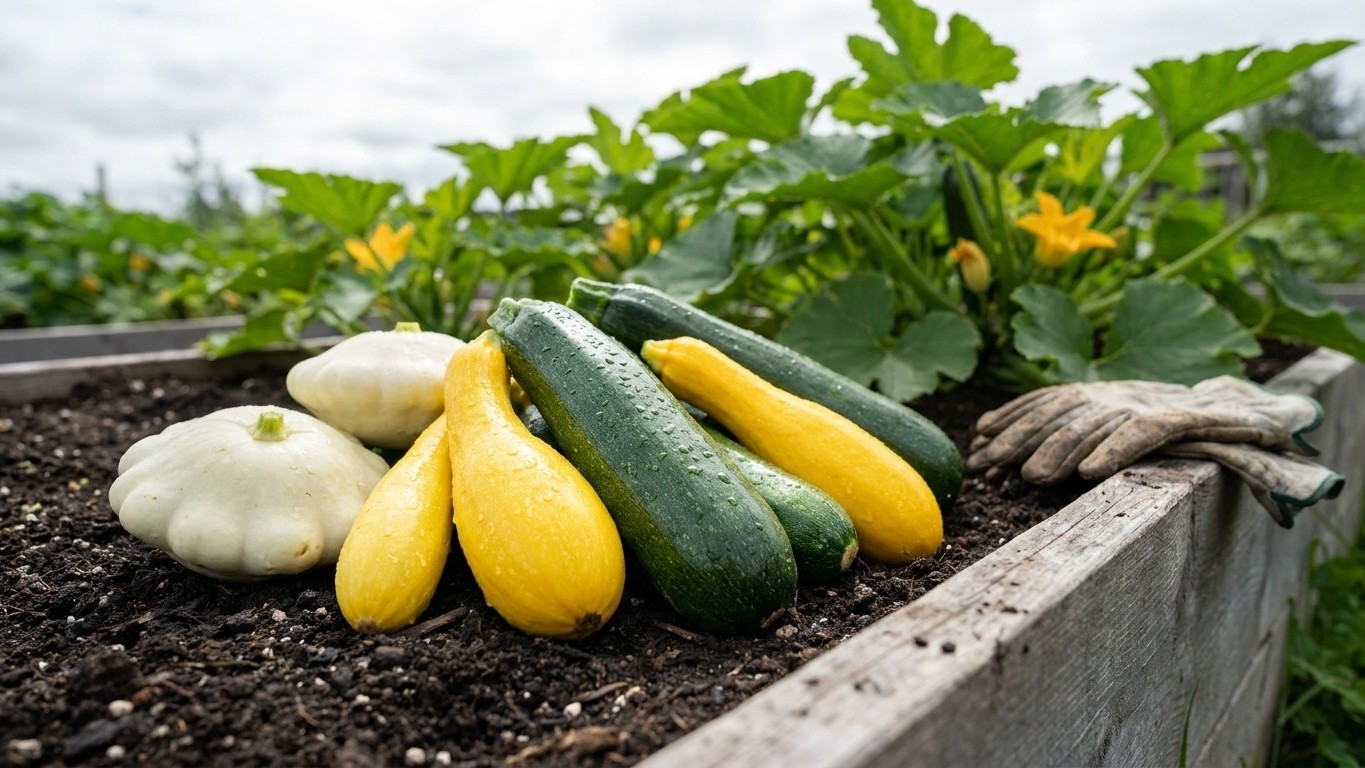

For most of Michigan, fast-maturing bush types (zucchini, yellow crookneck, straightneck, and pattypan) are the safest bet. The state’s short-to-moderate frost-free window and modest heat load favor squash that fruit within 45 to 55 days rather than anything bred for a long, scorching summer.
The short answer for Michigan
Summer squash is already one of the fastest vegetables in the garden, and that speed is exactly what makes it forgiving here. Michigan’s growing season runs from a last spring frost around April 30 in the Detroit area (a bit later, early to mid-May, across most of the Lower Peninsula) to a first fall frost between October 6 and October 21 in zone 6a. That gives a frost-free stretch of roughly five months in the warmer pockets of the state, which is plenty for any bush-type Summer Squash to produce multiple pickings before the season closes out.
Heat is the other half of the equation, and Michigan doesn’t have much of it to spare. The reference station near Detroit averages only 10.3 days a year at or above 90°F. That’s a modest heat load compared to states where squash vines bake through July and August. Practically, it means Michigan gardeners should skip novelty types marketed for long, blistering summers and stick with varieties that set fruit reliably in moderate warmth: standard zucchini, yellow crookneck, straightneck, and scallop-shaped pattypan types all fit that description.
Vining or trailing summer squash types, which need more room and generally more heat to push out a heavy crop, are a harder sell here. Bush habits stay compact, mature faster, and tolerate the cooler nights that show up even in mid-summer across northern counties. If space is tight or the season feels uncertain, a bush type is the lower-risk choice.
One more piece of the short answer: succession planting works in Michigan’s favor. Because the frost-free window is long enough for two or even three plantings of a fast type, gardeners aren’t locked into getting one sowing exactly right. A second round of seed three to four weeks after the first extends the harvest into September and hedges against a rough early start. That flexibility is the real advantage a fast-maturing type gives a Michigan garden, more than any single variety name.
So the decision by type comes down to this: choose compact, quick-fruiting types over sprawling or heat-hungry ones, and use the extra weeks in the season for a second sowing rather than a slower variety.
What will not work here
Michigan’s summer isn’t dry, and that’s the detail that trips up a lot of squash plantings. June, July, and August bring about 10.0 inches of rain between them, with August, typically the driest month, still averaging 3.26 inches. That’s a humid pattern, not an arid one, and summer squash grown too close together in that kind of moisture is where powdery mildew and other foliar diseases take hold. Wide spacing and good airflow matter more here than in a drier climate, and any variety description that assumes tight spacing for a hot, dry garden is describing a different state.
Rain that falls as a single thunderstorm behaves differently than the same amount spread evenly, and Michigan gets plenty of the storm-cell kind. Water tends to run off rather than soak in in a heavy downpour, especially on clay soils that hold moisture near the surface and stay wet for days afterward, which raises disease pressure even further on crowded plantings. On sandy soils, the opposite problem shows up: that same rain drains through fast, and a gardener can be misled by a wet-looking week into skipping watering they actually need.
Heat-loving squash relatives bred for regions with long runs of 90-plus-degree days are a poor match for a state that only averages 10.3 such days a year. Those varieties are bred to set fruit fastest under sustained heat stress, and in Michigan’s milder pattern they simply take longer to ramp up production, if they ramp up at all. Gardeners who’ve grown squash in a hotter state and try to replicate that experience here with the same variety often end up disappointed by a slow, uneven start.
The far north of the state is a separate problem entirely. In the coldest pockets, any variety, however fast, needs a warm start indoors or under cover, because direct-seeding into cold soil after a late last frost eats into the harvest window before the plant even breaks ground. A type bred for a 100-day season has no business going into a Michigan garden that might only offer 90 usable days after a slow, cold spring.
What changes across Michigan
Michigan spans USDA hardiness zones 4a through 6b, which is a wide enough range that there’s no single planting answer for the whole state. That spread, based on the USDA Plant Hardiness Zone Map’s average annual extreme minimum temperature, separates the Upper Peninsula and far northern Lower Peninsula (the colder 4a end) from the milder counties near Lake Michigan and the southeast (closer to 6b). A gardener in one zone and a gardener in the other are effectively working with different growing seasons, even though both are “Michigan.”
In the colder zones, the practical shift is starting squash indoors rather than direct-seeding, and choosing the fastest-maturing bush types available so there’s margin if the first fall frost arrives on the early side of its typical window. A shorter effective season also makes succession planting riskier; a second sowing that would easily finish in a warmer zone might run out of time in a colder one.
In the warmer zones, closer to the Detroit reference conditions used elsewhere in this guide, the frost-free window is longer and more forgiving, which opens the door to two full plantings and a wider choice of type without much added risk. Lake effect also plays a role that a hardiness zone number alone doesn’t capture: areas near Lake Michigan and Lake Huron often see delayed spring warming and moderated fall cooling, which can shift both planting and harvest timing by a week or two compared to inland spots at the same latitude.
None of this replaces knowing your own zone. Because the range runs from 4a to 6b, a gardener should check the USDA Plant Hardiness Zone Map for their specific county rather than assume Detroit-area timing applies everywhere, or that a Upper Peninsula planting date applies downstate.
Where to check this for your own county
A state-level answer can tell you what type of summer squash generally suits Michigan’s season and heat, but it can’t tell you the exact week to plant in your county, and it shouldn’t try to. That’s what a county-level extension recommendation is for, and it will beat anything written at the state level every time.
Michigan State University Extension is the source to use. Its outreach directory connects a gardener to county-specific offices and the Michigan Garden Calendar referenced earlier in this guide. Two things are worth pulling from that resource specifically: the local planting calendar for your county, which accounts for microclimate differences the statewide frost dates can’t, and any variety trial results MSU Extension has published for squash performance in your region.
Variety trials matter more than they might seem to. A bush zucchini or crookneck type that performs well in a university trial plot in one Michigan county has been tested against that county’s actual disease pressure, soil, and season length, not against a generic description. That’s a level of specificity no state-wide article, including this one, can offer.
If your county’s cooperative extension office publishes its own calendar or variety list, treat it as the more current and more locally accurate answer. The county office exists to apply that mechanism to your specific soil and microclimate. Use both, but let the county office have the final word.
Checking this against your own garden
Every date and average in this guide is a starting point, not a guarantee, and the garden itself will tell you more than any calendar once the season is underway. Three things are worth watching directly.
Soil warmth by feel is the first. Summer squash seed germinates slowly and unevenly in cold soil, so if the ground still feels cool and damp to the touch rather than warm and dry a few inches down, it’s worth waiting, regardless of what the calendar date says. A patient week here often outperforms an anxious early planting.
The first flush of male flowers is the second. Summer squash plants typically produce male flowers before female ones, and that first flush is a sign the plant has moved from vegetative growth into reproductive mode. If male flowers show up but no fruit-bearing female flowers follow within a week or two, it’s usually a heat or stress signal worth watching rather than a variety failure.
First true leaves, the leaves that appear after the initial seed leaves and actually look like squash foliage, mark the point where a young plant has established itself enough to handle a bit of stress. Their size and color say a lot about the specific spot they’re growing in: pale, slow-to-appear true leaves often point to a cooler or less fertile microclimate than the county average, while quick, deep-green growth suggests conditions running warmer or richer than the regional norm. That’s information no frost date or hardiness zone map can give a gardener, because it comes straight from the plant standing in the actual soil.