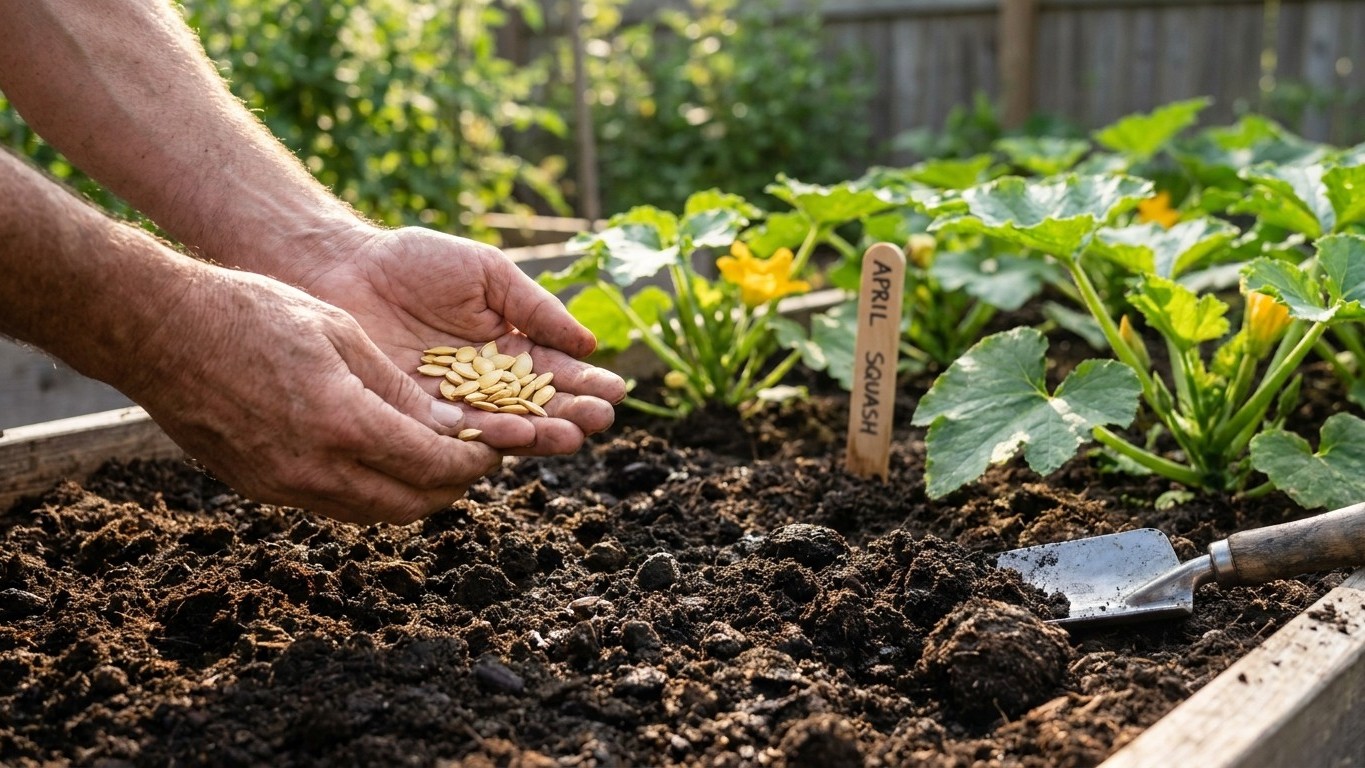

Summer squash goes into Michigan ground after the soil has warmed past 60°F and the last spring frost has passed, which lands around late April near Detroit and stretches into mid-May across most of the Lower Peninsula. Wait for warm soil, not just a calendar date, and you avoid the rot that kills early-planted seed.
The short answer for Michigan
Plant Summer Squash outdoors once the soil has warmed and the risk of frost has dropped low, which for the Detroit area centers on around April 30 and for most of the rest of the Lower Peninsula runs early to mid May, according to MSU Extension’s frost-free date data. That date is a 50% probability threshold, not a guarantee: it’s the point where the odds of another freeze drop to roughly even, so gardeners who want a safer margin often wait one to two weeks past it before direct-seeding.
Squash seed itself adds a second condition on top of the frost date. The seed wants soil at 60°F or warmer to germinate reliably, and cold, wet spring ground in Michigan clay often lags behind the air temperature by a week or two. That’s why the practical sowing window in most of the state runs from mid-May into the first days of June, even though the frost date alone might suggest late April is fair game in the warmest pockets near Lake Erie and Detroit.
On the back end, the first fall frost gives the other bookend. MSU Extension’s Michigan Garden Calendar puts it at October 6 to October 21 for zone 6a conditions. Count backward from that date and most summer squash varieties, which mature in 45 to 65 days, still have comfortable room even with a mid-May start. The season isn’t the limiting factor for the crop itself in southern and central Michigan; it’s soil temperature and frost timing at the front end that decide whether early seed rots or thrives.
What the frost dates actually measure
Neither frost date is a promise. They’re historical averages built from decades of station records, meaning any given year can still deliver a surprise freeze after the “safe” date or an early one before the fall cutoff. Treat the April 30 to mid-May window as the point where the odds favor you, not as an insurance policy, and keep a row cover or bucket handy for the first two weeks after transplanting just in case a late cold snap sneaks through.
What will not work here
Planting before the soil has warmed is the single most common failure in Michigan gardens. Squash seed sown into cold, damp clay in early April doesn’t just germinate slowly, it often rots outright before it ever breaks the surface, especially in a wet spring. Waiting past the frost date isn’t overcaution here; it’s a response to how slow clay-heavy Michigan soils are to warm compared to sandier ground farther south.
Water management trips up a lot of gardeners who assume Michigan summers are wet enough to skip irrigation. Summer rainfall across June, July and August averages about 10.0 inches, with August running the driest at 3.26 inches. That’s not a drought number, but it’s uneven, and a string of dry weeks in August combined with the season’s heat load, an average of 10.3 days a year at or above 90°F, can stress plants that gardeners assumed were covered by “normal” rain totals. A single summer thunderstorm dumping an inch in twenty minutes mostly runs off rather than soaking into clay, so the rainfall total on paper overstates what the roots actually get.
Humidity is the other side of that same coin. Michigan’s summer rain doesn’t arrive as a steady drizzle; it comes in bursts, followed by muggy stretches that keep leaf surfaces damp. Squash planted at tight spacing in that pattern is an open invitation to powdery mildew, which shows up as pale, dusty patches on the leaves by mid to late summer. Wider spacing than the seed packet’s minimum, plus watering at the base instead of overhead, cuts that risk substantially.
Finally, a long-season winter squash variety mistaken for a summer squash, or a summer squash planted very late in the northern part of the state, can run out of runway. The gap between a mid-May start and the earliest October frost dates is generous for most summer squash, but it shrinks fast for anyone who delays planting into late June while waiting out a cool spring.
What changes across Michigan
Michigan’s USDA hardiness zone range runs from 4a to 6b, which is a wide spread for one state and means there is no single planting date that fits the whole map. Zone 4a conditions, found in the coldest interior and northern parts of the state, mean a shorter frost-free season and a later safe planting window than the 6b conditions found near Lake Michigan’s and Lake Erie’s moderating shorelines.
The practical effect for a gardener is straightforward even without knowing their exact zone number: the closer a garden sits to Detroit or another southern, lake-moderated location, the earlier that April 30 frost date applies and the longer the growing season runs into October. Move north, inland, or to higher ground, and both ends of the season compress, meaning both a later safe planting date and an earlier fall frost risk.
That compression matters most for anyone growing a slower-maturing summer squash variety or planning a second succession planting in July. A gardener in a warmer, southern pocket of the state might get away with three staggered sowings between mid-May and early July. Someone in a colder zone further north or inland may only have a reliable window for one or two plantings before the fall frost risk starts closing in.
Because the range spans three full hardiness zones, there’s no way to give one planting date that’s accurate for the whole state. The USDA Plant Hardiness Zone Map is the tool for narrowing that down to an actual location, since it’s built specifically to show where the zone boundaries fall across Michigan’s varied terrain, from the lake-moderated south to the colder interior and north.
Where to check this for your own county
Everything above is a state-level picture, built from a reference station and averaged frost dates that smooth over a lot of local variation. A county sitting right on Lake Michigan’s shoreline can run noticeably warmer in spring than a county forty miles inland at the same latitude, and a state-level page like this one can’t capture that difference.
Michigan State University Extension is the source built to close that gap. Its outreach and county office directory lets a gardener find the office covering their specific county. What’s worth looking for once there is twofold: a local planting calendar tuned to that county’s frost data rather than the statewide average, and any variety trial results MSU Extension has published for squash and other vegetables grown under that county’s specific soil and climate conditions.
A county-level recommendation will always beat a state-level one, simply because it’s built from more local data. This page works from statewide frost dates and a single reference weather station near Detroit, which makes it a reasonable starting point but not a substitute for what the local extension office knows about a specific ZIP code’s microclimate, soil type, and pest pressure. Anyone gardening near a lake, on a slope, or in a low frost pocket should treat the county office as the tiebreaker whenever its recommendation differs from the general dates given here.
Some gardeners also time this by the Moon: when to plant zucchini by the moon, as almanac tradition rather than fact.
Checking this against your own garden
Every date in this article is an average built from decades of weather records at one reference station. A gardener’s own plot will confirm or contradict those numbers faster than any calendar can, and three simple observations do most of that work.
Soil warmth by feel is the first and most direct check. Cold, damp soil that feels chilly to the back of a bare hand in the top few inches is still too cold for squash seed, regardless of what the calendar says about frost dates having passed. Warm, slightly dry-feeling soil at that same depth is the real signal that germination conditions have arrived.
The first flush of male flowers on an established squash plant is the second marker, and it tells a gardener the plant has moved past early establishment into active growth. Male flowers typically show up before the female flowers that actually set fruit, so seeing them is an early, useful sign that the plant found the season’s conditions favorable, well before any squash appears.
The appearance of the first true leaves, the second set that emerges after the rounder seed leaves, marks the point where a seedling has switched into normal photosynthesis and growth. A slow gap between seed leaves and true leaves often points to soil that’s still cooler than ideal, even in a garden that technically cleared the average frost date weeks earlier. Watching for that gap tells a gardener more about their specific patch of ground than any regional average can.