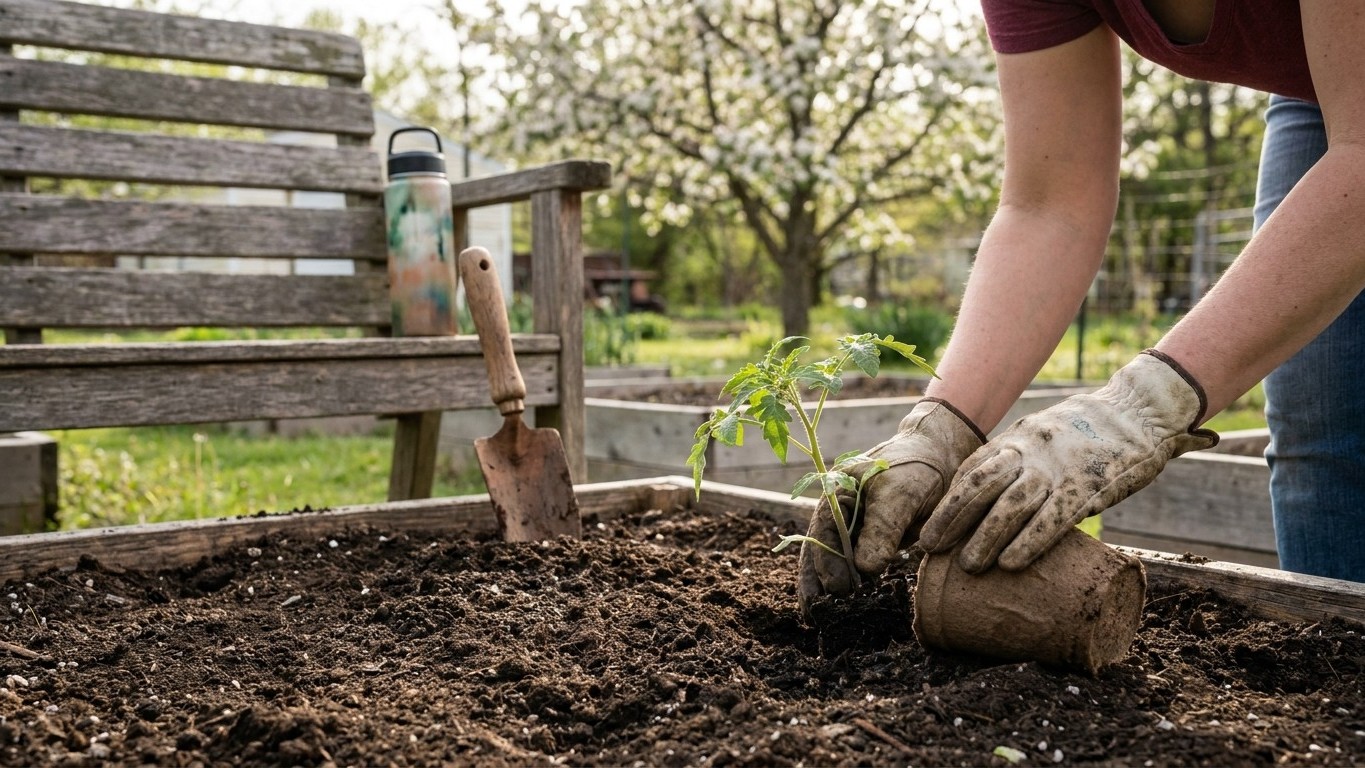

April 30 is the hinge Michigan tomato growers plant their whole season around — the average last spring frost for the Detroit area, with the rest of the Lower Peninsula clearing danger by early to mid May. Set transplants out before that and cold soil just stalls them, no matter how mild the afternoons feel. The real work is counting backward and forward from that date, weighing it against your first fall frost in October, to see how much growing season you actually have to spend.
What this comes down to in Michigan

Michigan’s tomato planting date isn’t a single day on a calendar. It’s the space between two frost windows. MSU Extension puts the last spring frost at around April 30 in the Detroit area, with most of the Lower Peninsula clearing frost risk somewhere in early to mid May. Everything before that window is soil too cold for a transplant to do anything but sit and sulk, no matter how warm the air feels.
The season closes at the other end just as firmly. MSU Extension’s Michigan Garden Calendar lists the first fall frost for zone 6a at October 6 to October 21, and that’s the point where an unripe tomato plant stops producing anything worth harvesting. Between those two windows sits the entire growing season a Michigan gardener has to work with, and depending on where in the state you garden, that stretch runs from a comfortable five months down to considerably less.
That’s why the transplant date and the variety you choose aren’t separate decisions. The date you can safely set plants outside is fixed by your local frost window, but how much of the remaining season you actually need depends on the cultivar’s days to maturity. We cover that matching process in full on our page on Tomato Varieties That Ripen in Time in Michigan, and it’s worth reading alongside this one rather than instead of it.
USDA’s Plant Hardiness Zone Map, built on 1991-2020 climate normals, puts Michigan across zones 4a to 6b, a wide enough spread that no single planting date can cover the whole state. A gardener near Detroit is often several weeks ahead of one gardening farther north or at higher elevation. Treat the Detroit-area figures as your starting point, not your final answer, and adjust using the method in the next section.
Working it out for your own garden
The math is the same every year even though the exact dates shift with the weather. Take your local frost window, account for the week or two a transplant typically needs before it’s safe to trust the soil has caught up, then check a variety’s days to maturity against what’s left before the first fall frost. A range minus a number of weeks gives you another range, not a single day, and that’s the honest answer here.
Starting from MSU Extension’s Detroit-area figure of around April 30 for last frost, most Lower Peninsula gardeners land in a mid-May transplant window once the soil itself has warmed rather than just the air. That range moves earlier or later depending on how close you are to Detroit and how the particular year is running.
A short-season variety that clears the window easily
Take Sun Gold, an indeterminate cherry tomato listed at 57 days from transplant. Set out in mid May, it reaches its first ripe fruit in early July by the catalogue count. Counting forward from early July to the start of fall frost, October 6 to October 21 per MSU Extension, leaves roughly 88 days of margin. That’s why a fast cherry tomato is close to foolproof here even in a cool, late spring.
A long-season variety that runs it close
Now take Amish Paste, an indeterminate sauce tomato at 85 days from transplant. Set out at the same mid-May point, its first ripe fruit doesn’t arrive until early August. That still leaves about 60 days of margin before the earliest fall frost date, but a cold, wet spring that pushes transplanting back even two weeks eats directly into that cushion. An 85-day variety carries far less room for error than a 57-day one, and that gap matters more in a state where the frost-free season is already short.
The table below shows how that margin narrows as days to maturity climb, using a mid-May transplant date and the Detroit-area fall frost window as the fixed points.
| Variety | Days to maturity | Type | First ripe from mid-May transplant | Margin before frost |
|---|---|---|---|---|
| Sakura | 55 | Indeterminate | Early July | 90 days |
| Sun Gold | 57 | Indeterminate | Early July | 88 days |
| Jasper | 60 | Indeterminate | Mid July | 85 days |
| Amalfi | 68 | Determinate | Late July | 77 days |
| Brandywine | 78 | Indeterminate | Late July | 67 days |
| Amish Paste | 85 | Indeterminate | Early August | 60 days |
What changes across the state
The Detroit-area figures from MSU Extension are a reference point, not a statewide rule. Michigan’s two peninsulas and its position between four Great Lakes mean the frost window shifts noticeably depending on where in the state you garden.
Land close to Lake Michigan or Lake Huron tends to warm more slowly in spring and cool more slowly in fall than inland ground at the same latitude, because the lake holds heat and releases it gradually. That effect can push both the last spring frost and the first fall frost later along the immediate shoreline, sometimes extending the usable season even as it delays the safe transplant date.
Move north or up in elevation and the pattern reverses. The Upper Peninsula and the higher, inland parts of the northern Lower Peninsula sit in USDA’s colder 4a to 5b bands, well below the 6a to 6b bands common in the southeast near Detroit. A grower in one of those colder zones should expect a later safe transplant date and an earlier fall frost than the Detroit figures suggest, which shortens the season from both ends at once.
Local terrain matters even within a single county. A low spot that collects cold air overnight, sometimes called a frost pocket, can run several degrees colder at ground level than a garden just a short walk away on higher ground. Two gardens in the same county can have meaningfully different frost dates if one sits in a hollow and the other on a slope, which is one more reason to treat any single published date as a starting point rather than an instruction to follow exactly.
The mistakes this state punishes

The most common mistake is trusting a warm week in April. Michigan often gets a stretch of 60- or 70-degree days well before MSU Extension’s frost-free date arrives, and it’s tempting to get transplants in the ground while the weather feels done with winter. Soil temperature lags well behind air temperature, and a transplant set into cold, wet soil usually stalls, turns purplish from cold stress, and becomes far more vulnerable to root disease than one put in a couple of weeks later into warmer ground.
The second mistake is picking a variety for its flavor or size without checking its days to maturity against the season actually available. A gardener in a colder part of the state who plants an 85-day paste tomato like Amish Paste on the same schedule as a Detroit-area gardener starts with less margin to begin with, and a cool, wet spring that delays transplanting can turn a workable season into one that ends before the fruit fully ripens. Match the variety to the season you have, not the one you wish you had, and lean toward a shorter days-to-maturity figure anywhere outside the state’s warmest counties.
The third is ignoring the pest calendar that runs alongside the planting calendar. Several of the insects and diseases that show up on Michigan tomatoes arrive at fairly predictable points in the season, and treating a plant only after damage is visible usually means treating it too late to save much fruit. The specifics of which pests to watch for and when are covered on our page on Tomato Pests in Michigan: Which Ones Actually Show Up Here, worth reading before you see the first chewed leaf rather than after.
Checking this against your county
Every figure on this page is anchored to the Detroit area, and MSU Extension is clear that the rest of the Lower Peninsula runs anywhere from a few days to a few weeks behind it, with the Upper Peninsula further behind still. Before you commit a transplant date to memory, check it against your own county’s numbers rather than assuming Detroit’s window applies where you garden.
The place to do that is your county’s MSU Extension office, part of Michigan State University’s land-grant extension network, which tracks local frost data and keeps current tomato planting guidance for the state. A call to your county office is worth more than any statewide average, especially if you garden near a lake shore, in a low-lying frost pocket, or well north of Detroit. For the broader steps of getting a tomato crop through a Michigan season, our guide to growing tomatoes in Michigan covers what happens after transplanting.
Common questions
Can I plant tomatoes in Michigan in April?
Not as a rule. MSU Extension’s frost-free date lands around April 30 near Detroit and later than that across most of the Lower Peninsula, so an April transplant date almost always means cold soil and a real risk of frost damage. A few warm days in April don’t change the soil temperature underground.
What happens if I plant too early?
The plant usually survives a light frost brush but stalls badly in cold soil, showing purple-tinged leaves and little new growth for weeks. It often ends up smaller and later-fruiting than a transplant set out on schedule into warmer ground, so early planting rarely gains you anything.
Do I need to start tomato seeds indoors or can I direct sow?
Michigan’s frost-free season is short enough that almost every gardener here starts tomatoes as transplants, either homegrown indoors or bought from a nursery, rather than direct-sowing seed outside. Direct-sown tomato seed would need extra weeks that most of the state’s growing season doesn’t have to spare.
How do I know if my last frost date is different from Detroit’s?
Check with your county’s MSU Extension office, since the Detroit-area figure is a reference point and not a statewide number. Distance from the Great Lakes, elevation, and low-lying frost pockets can all push your own last frost noticeably earlier or later than the Detroit window.