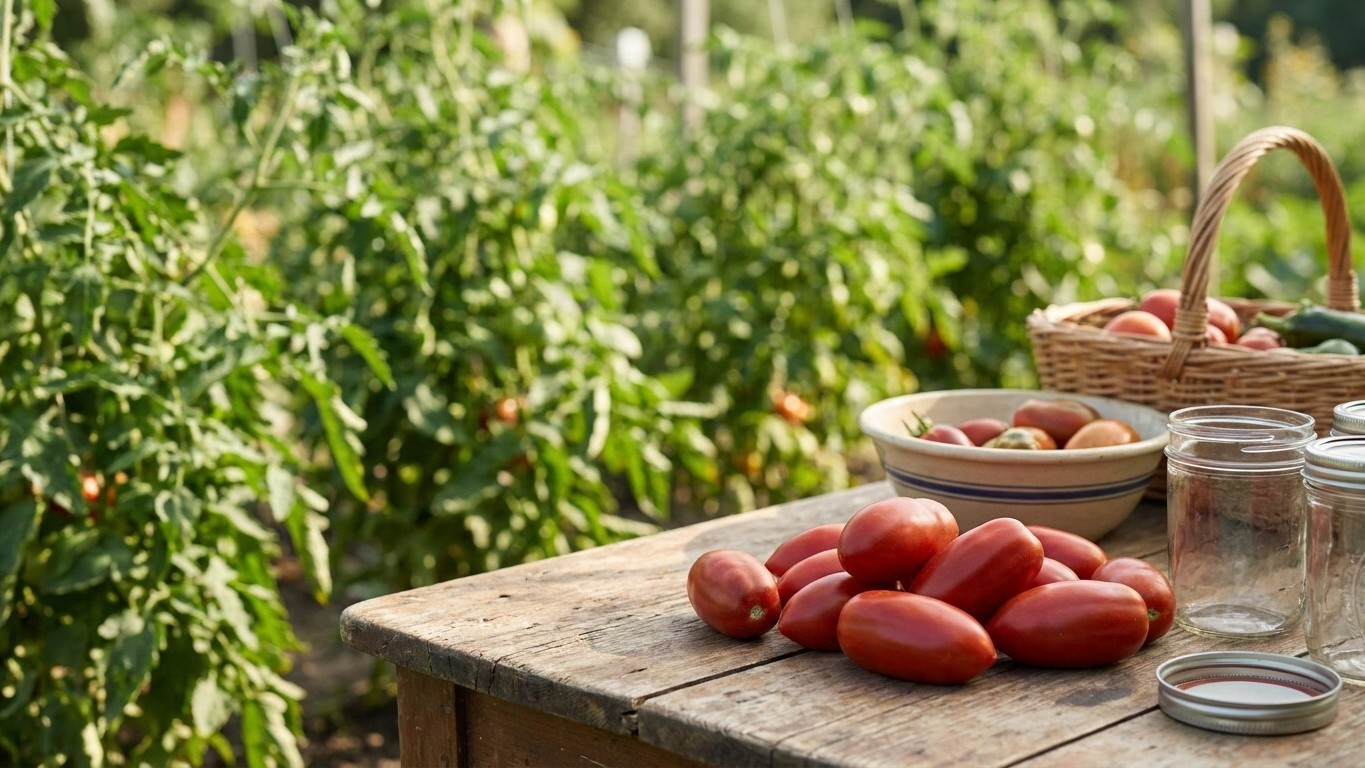

Amish Paste is an heirloom, indeterminate paste tomato bred for sauce and canning, and it reaches first ripe fruit about 85 days from transplant. That maturity window is long enough that it only makes sense where the frost-free season runs comfortably past three months. Check your region’s average first and last frost dates before you set out transplants, since this variety punishes a late start more than most paste types.
What Amish Paste actually is

Amish Paste is an heirloom, open-pollinated tomato that Seed Savers Exchange has distributed since the 1980s, originally sourced from an Amish farm in Wisconsin. It carries 80 to 85 days to maturity, counted from the day you set out a transplant, not from the day you sow seed indoors. That distinction matters because a gardener who starts counting from seed will expect fruit two to three weeks earlier than it actually arrives.
The plant is indeterminate, meaning it keeps growing and setting new trusses until frost or disease stops it, rather than ripening in one flush and quitting. That habit calls for a permanent stake, cage, or trellis built to at least five or six feet, and for spacing that gives each vine room to climb without shading its neighbors. Fruit runs 8 to 12 ounces, oxheart to plum shaped, red when ripe, with the dense, low-moisture flesh and small seed cavity that make it a sauce and paste tomato rather than a slicer. Gardeners who want a fresh-eating heirloom of similar vine habit but a completely different fruit should look at Brandywine, a large pink slicer that shares the indeterminate habit but none of the paste tomato’s dry flesh.
As with most tomato varieties, the days-to-maturity figure on the seed packet assumes a stocky, hardened-off transplant going into warm soil, not one held too long in a pot or shocked by a late cold snap.
What Amish Paste is good for
Amish Paste earns its name at the cutting board, not the salad bowl. Its flesh is dense and its seed cavities are small, so there’s little of the watery gel that fills a slicing tomato. Cook that flesh down and it thickens into sauce on its own timeline, without an hour of simmering off excess liquid first. That same low water content is what makes it worth the trouble of canning: less volume boils away, so a given basket of fruit yields more finished sauce or paste than the same weight of a slicer would.
That same dense, low-moisture flesh that makes Amish Paste ideal for the stove also limits it as a raw, eating tomato. Eaten raw, dense low-moisture flesh reads as dry and mealy rather than juicy, and the flavor doesn’t get the chance to bloom the way it does in a tomato bred to be sliced and salted. If you want a wedge of tomato that drips down your wrist, this is not that tomato. Its job is on the stove, cut into pieces and reduced, or packed into jars for winter.
Because the plant is indeterminate, fruit doesn’t arrive all at once. You’ll pick a handful every few days over a long season rather than facing one large harvest to process in a weekend. That suits a kitchen that wants to make small batches of sauce regularly, or freeze fruit as it comes in and can everything together later. It’s less convenient if your goal is a single big canning day, since you’ll need to hold or freeze early fruit until enough accumulates.
No specific flavor profile for Amish Paste is documented beyond what the category implies: concentrated, less acidic-tasting tomato flavor typical of low-water paste types, without the bright sharpness some slicers carry. Anyone wanting that fresh, juicy eating experience should plan on growing a slicer alongside it rather than expecting this variety to do both jobs.
Where it ripens in time, and where it is a gamble
The arithmetic
Start from the frost-free window in your area, then work backward. Subtract roughly two weeks after the last frost before the soil is warm enough to set out transplants without stunting them, then subtract Amish Paste’s 80 to 85 days to maturity. Whatever is left is your picking window, the stretch where ripe fruit actually forms before the first fall frost ends the season. A margin under thirty days is a single flush, and a cool year can erase it entirely.
Where the margin runs negative
In Yukon, measured at Whitehorse, transplants go out mid June and the frost-free window closes so early that the math runs negative: the first ripe fruit would land about 18 days after the average first fall frost. Nunavut, measured at Rankin Inlet, is tighter still, with transplants going out in early July and a shortfall of about 13 days. Neither region gets Amish Paste to a ripe fruit in an open garden. A heated greenhouse or high tunnel is the only way around it, and even then the season’s accumulated warmth runs far short of what a paste tomato needs to fill out a fruit.
Northwest Territories, measured at Yellowknife, sets out in early June and gets to a first ripe fruit by early September, leaving about 17 days before frost. That is technically positive, but it is one flush, not a harvest, and a cold snap in August can still take it. Alberta, measured at Calgary, along with Manitoba and Saskatchewan, measured at Winnipeg and Saskatoon respectively, all fall in a 17 to 24 day range. These are places where an early-maturing slicer like Early Girl earns its keep precisely because Amish Paste’s extra three to four weeks of maturity time is a luxury the frost calendar does not allow.
Where the margin is comfortable
Move to the far end of the range and the math stops being the constraint. Texas, measured at Houston, and Louisiana, measured at New Orleans, both carry well over 170 days of margin, and Florida at Jacksonville and Nevada at Las Vegas are close behind. In those places the 80 to 85 day maturity window fits twice over, with room left for a second planting later in the year. The constraint there is not frost. It is heat, covered in the next section.
| Territory | Reference station | Days of margin | Verdict |
|---|---|---|---|
| Yukon | Whitehorse | -18 | Impossible outdoors |
| Nunavut | Rankin Inlet | -13 | Impossible outdoors |
| Northwest Territories | Yellowknife | 17 | Risky, one flush |
| Alberta | Calgary | 19 | Risky, one flush |
| Texas | Houston | 176 | Comfortable, two crops possible |
| Louisiana | New Orleans | 213 | Comfortable, two crops possible |
The two ways a season goes wrong
A long frost-free window is not the same as a good tomato season. Two limits sit underneath the frost table and neither shows up in a simple date range.
Not enough accumulated warmth
In the northern territories, the frost-free window can be long enough on paper while the total heat accumulated over that window is still short. Tomato fruit needs sustained warm days to fill out, not just days above freezing, and flowers will not set fruit at all once nights fall below 50F. Alberta and the Northwest Territories both post positive margins on the frost calendar, but their accumulated warmth for the season runs low enough that a paste tomato needing 80 to 85 days can stall partway through, leaving green fruit that never colors before frost.
Too much heat
In the deep South, the opposite problem cancels out an otherwise generous frost window. Once daytime temperatures push past roughly 86F, tomato pollen becomes sterile and blossoms drop without setting fruit. In Texas, Louisiana, and Florida that dead zone runs through the hottest months of summer, which is why growers there plant a spring crop early enough to finish before the heat arrives, then a second crop in late summer timed to ripen after it breaks, rather than expecting one continuous harvest.
For Amish Paste specifically, the northern limit matters more than the southern one. Its 80 to 85 day span asks for a long stretch of sustained warmth to fill out fruit, which is exactly what short, cool seasons cannot supply even when the frost dates look workable on paper. In the South, the same long maturity window is an advantage: a grower there has enough calendar on both sides of the summer heat gap to fit a full Amish Paste crop into the spring window alone, without needing to rush it.
What it resists, and what it does not
Seed catalogues list no disease-resistance code for Amish Paste. Unlike hybrids bred with letters such as V, F, or N on the tag, this heirloom carries none of the genetic resistance to verticillium wilt, fusarium wilt, or nematodes that those codes represent. That does not mean it fails against every threat, just that nothing in its breeding was selected for resistance, so whatever protection it gets comes from soil health, rotation, and airflow rather than genetics.
No genetic resistance, so cultural control carries the weight
In practice, the diseases most likely to cut a season short are foliar fungal problems: early blight and septoria leaf spot, both of which spread fastest in humid weather when leaves stay wet overnight. Because Amish Paste is indeterminate and keeps a dense canopy of foliage all season, it holds moisture longer than a compact determinate plant does, which raises the odds of both diseases wherever summer humidity is high. Pruning the lower foliage and mulching to keep soil from splashing onto leaves does more for this variety than any spray, since there is no genetic backstop to fall back on once foliage gets wet and stays that way.
Blossom end rot, a calcium-uptake problem tied to uneven watering rather than a pathogen, shows up on paste tomatoes as a flat, sunken brown patch on the fruit’s blossom end. Amish Paste is not unusually resistant or susceptible to it beyond what irregular watering causes in any variety. Consistent soil moisture through fruit set matters more here than in a smaller-fruited slicer, simply because a paste tomato carries more flesh per fruit for a calcium shortfall to show up in.
Growing it without the usual mistakes
Because Amish Paste is indeterminate, treat it like a permanent vine rather than a bush that outgrows a small cage. Set stakes or a trellis before you plant, not after, sinking each post at least a foot into the ground so it can hold a heavy, fruit-laden vine through a summer storm. Space plants at least two to three feet apart in the row. The tight canopy this variety produces holds humidity against the leaves, and cramped spacing makes the foliar disease risk described above worse, not just cosmetic.
Feeding and the mistake its timing invites
Because it keeps setting new trusses until frost, do not cut off nitrogen the way you would with a determinate variety that ripens in one flush. A determinate paste tomato benefits from easing off fertilizer once fruit sets, so the plant puts energy into ripening rather than more vine. Amish Paste needs the opposite: steady, moderate feeding through the season to keep producing new flowers, tapering off only in the last few weeks before your expected frost date, when new fruit set would not have time to mature anyway.
The mistake its 80 to 85 day timing invites is starting too late and then trying to make up time with heavy nitrogen, which pushes leafy growth at the expense of fruit set. Instead, get transplants into warm soil as early as your local frost data allows, and if you are in a short-margin territory, use black plastic mulch or a low tunnel to add heat to the root zone rather than pushing the plant with fertilizer it cannot use fast enough. Pinch suckers selectively rather than aggressively. Amish Paste’s yield depends on keeping enough foliage to shade the fruit from sunscald while still letting air move through the canopy, a balance that a hard, high-and-tight pruning style tends to wreck.
Common questions
Is Amish Paste the same as a Roma tomato?
No. Roma is a determinate hybrid bred for a single heavy flush, while Amish Paste is an indeterminate heirloom that keeps producing until frost. Amish Paste fruit also runs larger, 8 to 12 ounces against Roma’s typical 2 to 3 ounces, and has a more irregular, oxheart shape rather than Roma’s uniform egg shape.
Why are my Amish Paste tomatoes cracking?
Cracking on paste tomatoes usually follows a dry spell broken by heavy watering or rain, which swells the fruit faster than the skin can stretch. Keep soil moisture even with mulch and a regular watering schedule rather than letting the plant dry out between soakings.
Can I save seed from Amish Paste for next year?
Yes, and that is one of the reasons growers keep it in rotation. As an open-pollinated heirloom, its seed breeds true to type as long as you isolate it from other tomato varieties by distance or timing to avoid cross-pollination, then ferment and dry the seed before storage.
How many plants do I need for a canning batch?
That depends on your household and how much sauce you can, but paste tomatoes are typically grown in higher numbers than slicers because more fruit is needed to reduce down to sauce or paste. Check your state extension service’s canning guides for volume-to-yield ratios rather than guessing, since water content and cooking method both change how much raw fruit a batch needs.