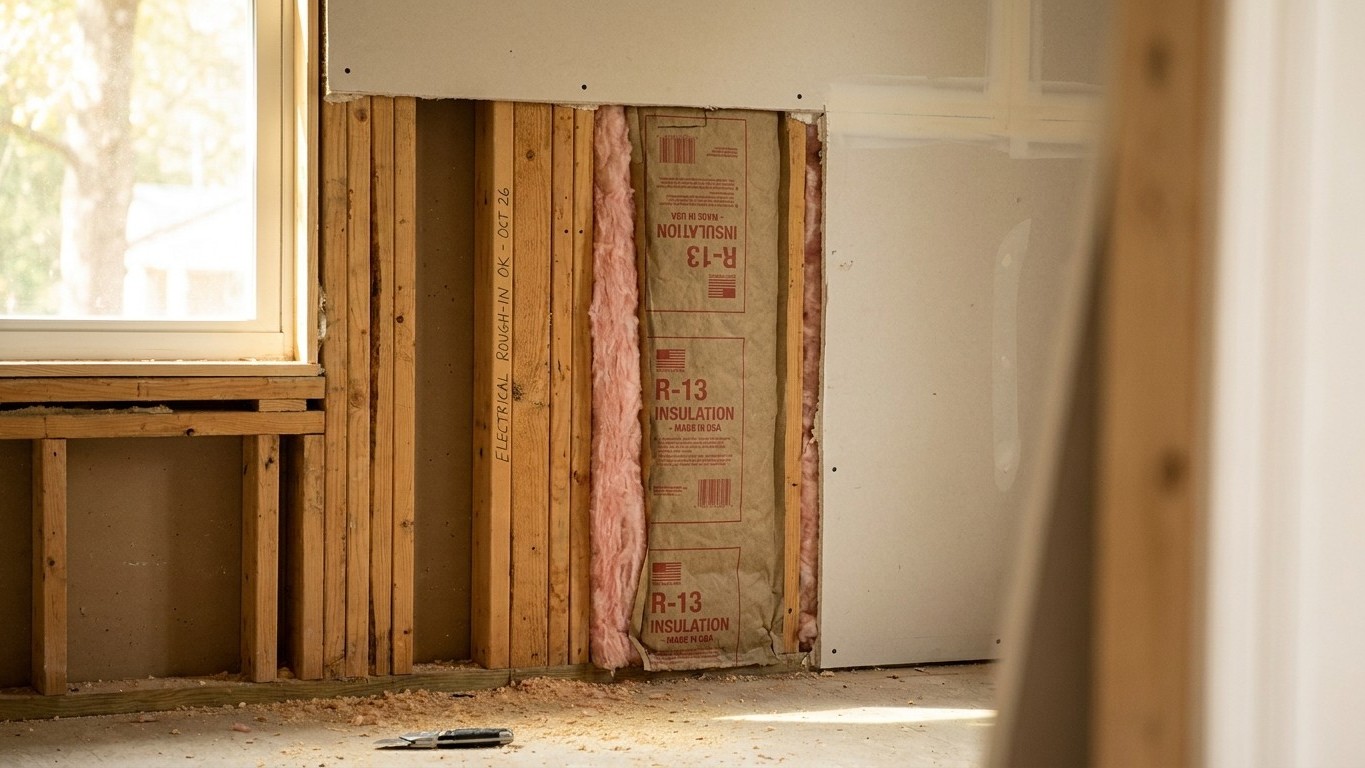

In Minnesota, the answer is yes. The 2021 International Residential Code requires a vapor retarder on the interior side of framed walls, and the code’s one climate-based exception (Zones 1, 2 and 3) doesn’t touch this state at all. Every Minnesota county sits in Zone 5A, 6A or 7, so the requirement applies statewide, though the details of class and installation still depend on the local code adopted by your jurisdiction.
What the code asks for in Minnesota

Section R702.7 of the 2021 IRC states it plainly: a vapor retarder of the class listed in Table R702.7(2) “shall be provided on the interior side of frame walls.” That’s the baseline rule for the entire country, and it comes with four exceptions, one of which excuses Climate Zones 1, 2 and 3 from the requirement altogether. Minnesota never touches that exception, and that’s the detail that settles the question here.
The state’s 87 counties split across three IECC climate zones: 61 counties sit in Zone 6A, 23 counties in Zone 7, and 3 counties in Zone 5A. None of those is Zone 1, 2 or 3. So while a state that straddles a warm zone and a cold zone genuinely has no single answer, one where a reader in one county owes something their neighbor two counties over doesn’t, Minnesota isn’t that state. A homeowner in a 6A county along the Iowa border and one in a 7 county up near the Canadian line are both, in principle, under the same interior vapor retarder requirement. The zone spread here changes which insulation R-value table row applies and how the assembly is expected to perform. It doesn’t change whether a vapor retarder is required.
That’s worth sitting with for a second, because it’s the opposite of what a lot of readers expect when they hear “it depends on your zone.” In Minnesota’s case, the zone lines drawn across those 87 counties all fall on the same side of the code’s one relevant exception. The requirement doesn’t disappear at the county line. What changes, county to county, is climate severity and design detail, not the underlying obligation.
None of this means every wall assembly in the state has to use the same material. “Required” only tells you a vapor retarder must be present; it says nothing about which class, and Minnesota’s own amendments or local building department interpretations can add detail the model code doesn’t spell out. A wall that’s technically compliant on paper can still fail if the wrong class goes in the wrong place, and that failure won’t show up at final inspection. It shows up years later, inside the wall cavity, as rot nobody can see until the drywall comes off.
Why the answer is the opposite in a warm climate
Understanding why Minnesota’s answer is “yes” means understanding why the same code says “no” somewhere else, and the mechanism is water vapor moving toward cold. In a Minnesota winter, warm moist air sits inside the house while the sheathing on the other side of the wall cavity runs cold. That air wants to move outward through the wall assembly, and if it reaches cold sheathing it can condense there, soaking the insulation and the framing from the inside. A vapor retarder on the interior side blocks that migration before it starts. That’s the entire logic behind R702.7 in a cold climate: stop the damp air before it reaches the cold surface.
Flip the climate and the physics flips with it. In a warm, humid region, the outdoor air carries the moisture, and it’s pushing inward, toward the air-conditioned interior. The cold surface in that scenario isn’t the exterior sheathing anymore, it’s whatever cool, impermeable layer sits on the inside of the wall. Install a Class I vapor retarder there and you’ve built the exact condensing surface the wall didn’t need. The U.S. Department of Energy’s Building America program spells out what happens next: “If the wall contains a vapor retarder on the interior side of the insulation, the water vapor will condense on this cool, impermeable surface,” and the result is “ruined insulation, mold, and structural rot of framing members.”
That single sentence is why the code doesn’t write one rule for the whole country. It’s not a bureaucratic quirk or a regional preference. It’s a description of which direction the water is traveling. In Minneapolis, the moisture drive is overwhelmingly outward-to-inward-cold in winter, so an interior retarder does its job for most of the year. In a Gulf Coast county, the moisture drive reverses for long stretches, and that same interior retarder becomes the problem it was meant to solve. Minnesota’s homeowners never have to think about that reversal, but it’s worth knowing it exists, because it’s the reason a builder who worked in Houston before moving north can’t just repeat what they did there.
The three classes, and why the word matters
Once you know a vapor retarder is required, the next question is which class, and the code answers that by permeance, not by brand name or by habit. Table R702.7(2) groups materials into three classes based on how much moisture vapor passes through them.
| Class | Example materials | Perm rating |
|---|---|---|
| Class I | Sheet polyethylene, nonperforated aluminum foil | 0.1 perm or less |
| Class II | Kraft-faced fiberglass batts, vapor retarder paint | Above 0.1, up to 1.0 perm |
| Class III | Latex or enamel paint | Above 1.0, up to 10.0 perm |
Polyethylene sheeting is the material most people picture when they hear “vapor barrier,” but calling it that without qualification skips the part that actually matters: it’s a Class I retarder, the least permeable of the three, and that’s precisely why it’s the one the DOE warns against installing on the interior side in a warm-humid climate. The disagreement between a builder in Minnesota and a builder in coastal Florida was never about whether to use a vapor retarder. It’s about which class belongs on which side of the wall, in which climate.
There’s a detail here that surprises a lot of homeowners: ordinary latex or enamel wall paint is a Class III vapor retarder. Anyone who’s ever painted an interior wall already has a vapor retarder on it, whether they meant to or not. That’s a much lighter-touch material than sheet polyethylene, and in some Minnesota assemblies it can be enough to satisfy the code’s intent without adding a separate membrane.
One distinction worth keeping straight: a vapor retarder is not an air barrier. They’re two different jobs, one slowing moisture diffusion through a material, the other stopping bulk air movement through gaps and seams, and while some products (certain sheet membranes) do both at once, plenty of Class III paints do neither of the air-sealing work. Knowing the class tells you about moisture. It doesn’t tell you whether the wall is airtight.
Where the rule stops
R702.7’s interior vapor retarder requirement comes with exceptions, and three of them apply regardless of climate zone:
- Basement walls
- The below-grade portion of any wall
- Construction in which moisture or the freezing of moisture will not damage the materials
The basement exception is the one most Minnesota homeowners actually run into, because it isn’t intuitive at first. A concrete foundation wall holds groundwater moisture and releases it slowly, sometimes for years after the pour. That means the assembly built against it needs a path to dry inward, toward the conditioned space, rather than being sealed on both sides. Wrap that concrete in an interior polyethylene sheet and you’ve trapped moisture between the concrete and the vapor retarder, with nowhere for it to go. It’s the same principle as the warm-climate wall, applied underground: the retarder that helps in one location becomes the trap in another. For the specifics of how a compliant basement assembly is built in a cold climate, the basement wall guide on this site walks through the framing and insulation sequence in more detail.
The third exception, construction where moisture accumulation won’t damage the materials, covers assemblies built from materials that simply don’t rot or corrode from moisture exposure, and it’s applied case by case rather than by a fixed list. None of these three exceptions ban a vapor retarder from being used. They remove the obligation to install one in that specific location, which is a different thing from prohibiting it.
Who actually decides, in Minnesota
The 2021 IRC is a model code. States and municipalities adopt it, sometimes with amendments, sometimes years after it’s published, and the version actually enforced at your address is the one your local building department has adopted, not necessarily the edition cited in a national guide. For any wall being built or remodeled in Minnesota, the local building department is the only source that can confirm the exact requirement in force for that address, and the inspector who signs off on the permit is working from that local code, not from R702.7 in the abstract.
That check matters more here than it might in a milder state, because Minnesota’s winters are genuinely long. Minneapolis-St. Paul averages roughly 7,399 heating degree days a year against a base of 65°F, a figure that measures accumulated heating demand across the whole year, not a single cold snap. Compare that to the same station’s roughly 830 cooling degree days, and the imbalance is stark: this is a climate built around keeping heat in, for months at a stretch, which is exactly the condition R702.7’s interior vapor retarder requirement was written to address.
None of that changes the basic advice: this page describes what the model code requires and why, not what belongs in any specific wall. A wall assembled with the wrong class of vapor retarder in the wrong place doesn’t announce the mistake at the final inspection. It shows up years later, in framing that’s soft to the touch or insulation that’s lost its R-value to trapped moisture, and by then the fix means opening the wall back up. The local building department, and the code edition it has actually adopted, is where that question gets answered correctly the first time.