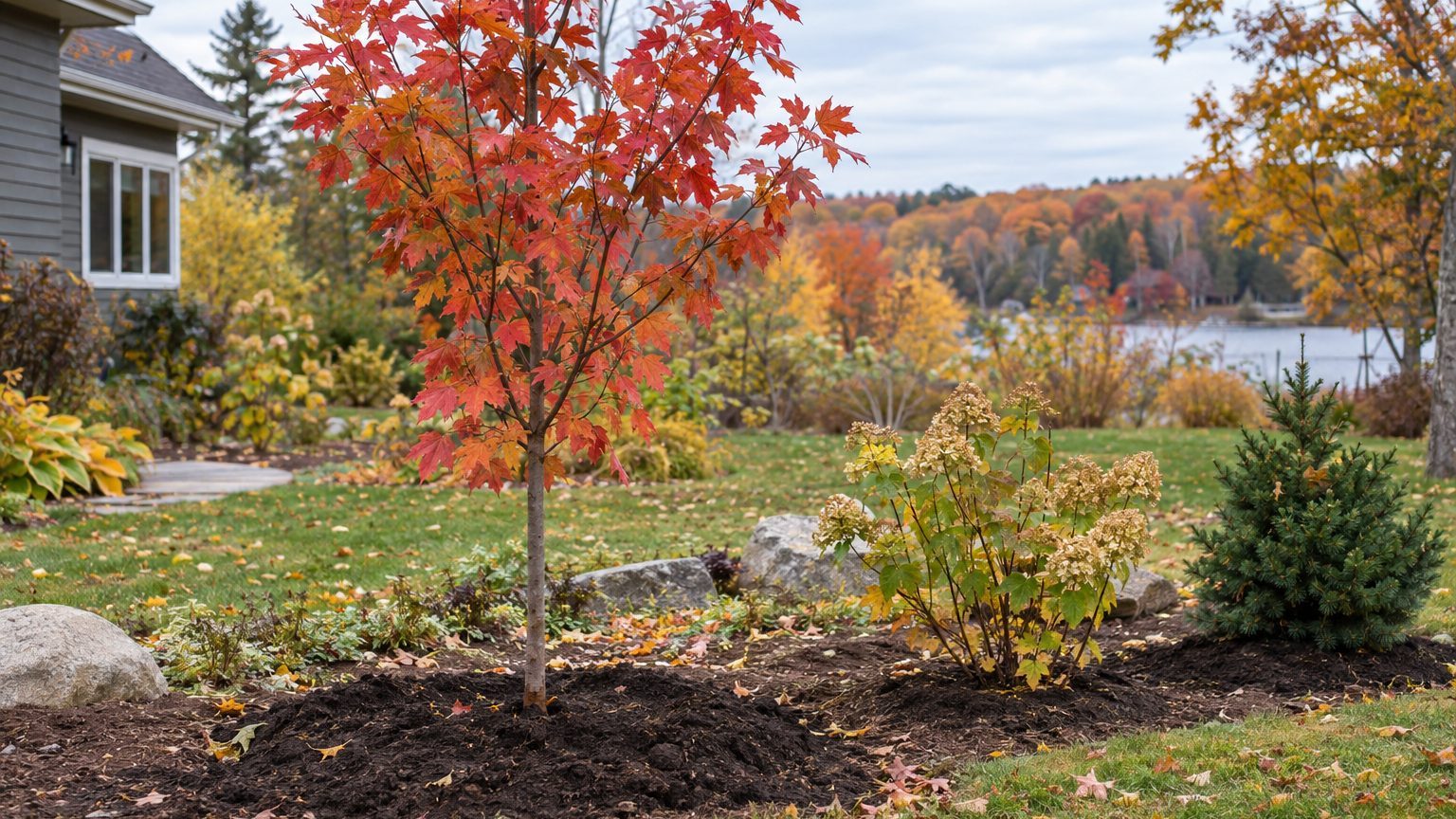

Minnesota’s frozen ground, not the first frost, is what actually stops root growth, and that comes weeks later than most gardeners assume. The safe window for fall planting closes about six weeks before that freeze, which lands between August 30 and September 11 near the Twin Cities. Get container-grown or balled-and-burlapped stock into the ground by then, water it on through the fall, and mulch it properly before winter sets in.
The deadline in Minnesota
Roots don’t stop working just because the air turns cold. A tree or shrub keeps building root mass for as long as the soil stays workable and above freezing, and in this state that window runs well past the first hard frost of autumn. NOAA’s NCEI 1991-2020 Climate Normals, measured at the Minneapolis reference station, put the first fall frost between October 11 and October 23. That figure describes air temperature. The soil underneath cools far more slowly, because it holds summer heat long after the leaves have dropped.
Why the safe deadline lands earlier than the freeze itself
Cornell Cooperative Extension’s rule for fall transplanting calls for getting new plants into the ground “at least 6 weeks before the ground freezes, allowing them time to establish roots before winter dormancy.” Applied to this state’s frost window, counting six weeks back from the October 11 to October 23 range gives a conservative safe planting deadline of August 30 to September 11 near Minneapolis. That is not the day the ground actually locks up. It is a built-in buffer, because the true freeze date usually arrives later still, and no forecast can pin down exactly how much later in any given year.
Treat August 30 to September 11 as the target if you want a comfortable margin. Plant after that window and a hardy shrub still might make it through, especially in a mild autumn, but every week past the deadline trades certainty for whatever nursery stock happens to still be available. The USDA Plant Hardiness Zone Map places Minnesota across zones 3a to 5a, and a plant that is only borderline hardy for its zone needs every one of those six weeks to root in before facing its first winter here.
The reason the margin matters shows up once winter arrives. NOAA’s 1991-2020 climate normals put Minneapolis’s coldest month at a mean daily minimum of 8.8°F. A plant with an established root system handles that without trouble. A plant still busy growing roots when that cold sets in has far less capacity to take up whatever water is left in the soil, and dieback or outright loss is often the result.
None of this applies evenly across the state. Northern Minnesota’s ground freezes two to three weeks earlier than the Twin Cities figures above, so a gardener near Bemidji or International Falls should move the deadline earlier by roughly that same margin. Southern Minnesota, closer to the Iowa border, tends to get a bit more room. Check the record for your own county against the First and Last Frost Dates in Minnesota before counting backward from it, and browse the wider Minnesota guides for how this fits the rest of the planting calendar. Contrast that with a state where the ground never freezes at all: How Late Can You Plant Trees and Shrubs in Fall in Florida? covers a climate where fall and winter planting are simply the best time of year.
What to plant late, and what to wait on
Not every plant handles a late-season planting the same way. Container-grown and balled-and-burlapped trees and shrubs that are solidly hardy for the local zone are the safest late choice, because their root systems are already intact and only need to spread into the surrounding soil. Something rated hardy well within the USDA Plant Hardiness Zone Map’s 3a to 5a range for Minnesota can go in right up to the safe deadline without much worry.
Borderline plants are a different matter. Anything rated at the edge of hardiness for your spot, or anything you’re not sure about, needs the full six weeks and then some, because a half-established borderline plant is exactly the kind that won’t make it through a winter with a coldest-month mean minimum of 8.8°F at the Minneapolis reference station (NOAA NCEI normals). If a nursery tag lists something as marginal for your zone and you garden in a colder pocket of the state, treat late fall as the wrong season for it and hold it for spring instead.
Evergreens deserve their own caution. Broadleaf and needled evergreens keep losing water through their foliage all winter long, even while the roots below sit dormant or barely active. A newly planted evergreen that hasn’t had time to grow anchoring roots before the soil firms up is set up for winter burn and root desiccation, the two problems that show up as browned needles or dead patches by late winter. Hold evergreen planting to the early part of the safe window, or push it to spring, rather than squeezing it in during the last week before the deadline.
| Plant type | Root form | Late-fall risk in Minnesota |
|---|---|---|
| Fully hardy deciduous shrub or tree (rated within 3a-5a) | Container or balled-and-burlapped | Low, up to the safe deadline |
| Borderline-hardy shrub or tree | Container or balled-and-burlapped | Moderate to high once past the deadline |
| Needled or broadleaf evergreen | Balled-and-burlapped, often a smaller root ball relative to top growth | High if planted late, since water loss continues all winter |
| Bare-root stock | No soil around the roots | Highest, generally better reserved for spring in this climate |
General guides on Planting and Caring for Trees, Shrubs and Perennials cover the basics of matching root form to season. What makes the evergreen caution specific to Minnesota, rather than a rule that applies everywhere, is how early this state’s ground freezes compared to milder parts of the country.
Watering and mulch until the ground freezes
A newly planted tree or shrub spends its first Minnesota winter doing nothing you can see above ground and everything that matters below it. Top growth stops for the season, but roots keep working as long as the surrounding soil stays unfrozen. Keeping that soil moist through the fall is not optional. Water deeply and on a regular schedule right up until the ground actually locks up, not just until the calendar hits your planting deadline.
Mulch does the other half of the job. NC State Extension’s guidance calls for “a 2-inch to 3-inch layer of mulch” to suppress most annual weed seeds, and separately recommends, for trees specifically, “a 3-inch layer of mulch to reduce water loss and maintain uniform soil moisture and temperature around roots.” Keep that layer in a flat ring a few inches out from the trunk or main stems, never piled up against the bark in the cone-shaped mound sometimes called a mulch volcano, which traps moisture against the trunk and invites rot and rodents over winter.
The point of mulch this late in the year isn’t decorative. It buffers the soil against the swing between a mild afternoon and a hard overnight freeze, which is exactly the kind of freeze-thaw cycling that damages a root system that hasn’t had a full season to spread out. For anything planted during the last weeks of the safe window, that buffering matters more than it would for a plant that went in back in spring with months to establish.
This is also why fall planting works at all in a climate this cold. A fall-planted tree isn’t being asked to leaf out, flower, or push new top growth before winter arrives. It only has to do the one thing the soil still allows, which is grow roots. That is a lower bar than spring planting, when a plant has to build roots and support new leaves at the same time, drawing on the same limited reserves. Keep watering until the soil surface stays frozen for good, which in the Minneapolis area comes some weeks after the October 11 to October 23 first frost recorded in NOAA’s normals. The full case for getting mulch depth and placement right, including what a volcano actually does to bark over time, is laid out in Mulching Without Killing the Plant.
What goes wrong
Most fall-planting failures in Minnesota trace back to one of a handful of predictable mistakes, and each one is avoidable once you know what to watch for.
- Planting too late for the climate: stock going into the ground well after the safe window, especially anything borderline-hardy, often hasn’t grown enough new root to handle the coldest-month lows around 8.8°F recorded at the Minneapolis reference station (NOAA NCEI normals).
- Winter burn on evergreens: foliage keeps losing water through the winter, and a root system that hasn’t spread into the surrounding soil can’t replace it, leaving needles or leaves scorched brown by late winter or early spring.
- Frost heave: a root ball planted late, before the surrounding soil has had time to settle around it, is more exposed to the freeze-thaw cycling that pushes shallow-rooted plants partway out of the ground over winter.
- Drying out in a dry fall: gardeners who stop watering once the weather turns cool often lose plants to drought stress that has nothing to do with the cold itself, because soil keeps losing moisture long after top growth stops needing much of it.
The fix for all four is the combination the sections above already lay out. Plant within the safe window, choose genuinely hardy stock for anything going in on the late side, keep watering through the fall, and mulch at the right depth in a flat ring rather than a mound against the trunk. Skipping any one of those steps is usually what turns a plant that should have made it through winter into one that doesn’t.
Common questions
Can I still plant a tree in Minnesota in October?
It’s past the safe window Cornell Cooperative Extension’s rule points to for this state, which runs from August 30 to September 11, so you’re taking on more risk. If the fall has been mild and the ground is still workable, a fully hardy, container-grown tree can still root in some, but hold off on anything borderline-hardy or evergreen until spring instead.
Is fall or spring better for planting trees in Minnesota?
Fall has the advantage of roots that can establish without the plant also having to support new leaves, as long as you plant early enough to hit the safe window. Spring is the safer default for evergreens and for anything only marginally hardy for your zone, since it gives a full growing season before the plant faces winter.
Does the six-week rule apply to perennials too, or just trees and shrubs?
The Cornell rule and the deadline calculated from it are built around woody plants establishing roots before dormancy, which is the scope of this page. Perennials root differently and many go dormant on a different schedule, so don’t assume the same August 30 to September 11 window applies to them without checking guidance specific to the species.
How do I know if the ground has actually frozen where I garden?
The simplest check is mechanical: try pushing a trowel or a soil probe into the ground at planting depth. If it goes in without much fight, roots can still spread even past your target deadline. Keep in mind that northern Minnesota freezes solid two to three weeks earlier than the Twin Cities, so the same test can give a different answer depending on where in the state you’re gardening.