
In the Twin Cities area, potatoes get a full growing season, not a race against the calendar. Minneapolis averages just 10.6 days a year above 90 F, well under the threshold that stalls tuber growth, and the last spring frost typically clears by late April. That combination means most of southern and central Minnesota can plant early and let the crop run its full course rather than rushing to dig before summer heat arrives.
The short answer

Two numbers decide how a potato season plays out anywhere, and Minnesota’s numbers work in the gardener’s favor. The first is heat load: Minneapolis reaches 90 F or higher on an average of 10.6 days per year, according to NOAA NCEI Climate Normals covering 1991 to 2020. That is a modest count. Compare it to states where triple-digit stretches run for weeks, and Minnesota’s potato patch simply doesn’t spend much time above the temperature that matters most for tubers.
That temperature matters because of a mechanism Utah State University Extension documents clearly: tuber set and fill shut down once soil temperatures climb above 90 F. Below that ceiling, the plant keeps building starch and bulking tubers. Above it, growth stalls no matter how much water or fertilizer goes down. In a state like Minnesota, with barely more than ten days a year that even reach 90 F in the air, let alone in the soil, this ceiling rarely becomes the limiting factor. Soil temperature lags behind air temperature, so even on the handful of hot days, the root zone often stays under the danger line.
The second number is the frost window. NOAA NCEI puts the last spring frost for the Twin Cities region between April 17 and April 30, based on 32 F freeze probabilities in the 30 to 70 percent band. That window is the anchor for every planting decision that follows, and it applies to the milder southern part of the state. Northern Minnesota runs two to three weeks tighter on both ends of the season, a gap wide enough to shift planting into May and pull harvest earlier in fall.
What this means in practice: a Minnesota gardener isn’t choosing between a spring crop dug early to dodge heat, and a full-season crop that risks stalling in July. The heat load here is low enough that a full season works almost everywhere in the state. The real planning question isn’t “will it get too hot,” it’s When to Plant Potatoes in Minnesota, and that’s a soil temperature and frost-date calculation, not a heat-avoidance one. With that long, mild growing window secured, choosing among Potato Varieties That Suit Minnesota becomes the next decision, since full-season types can finally bulk up without racing summer heat. Getting that timing right on the front end also sets the stage for Harvesting and Storing Potatoes in Minnesota later in the season.
When to plant here
Planting date isn’t a fixed day on a calendar. It’s a calculation that starts from the last frost date and works backward through soil temperature. Here’s how that arithmetic plays out for the Twin Cities window.
- Start with the last frost date. For the Minneapolis area, NOAA NCEI puts that window between April 17 and April 30.
- Subtract 14 to 21 days. Utah State University Extension and University of Maine Cooperative Extension both note that potatoes go in the ground as soon as soil reaches 50 F, which lands 14 to 21 days before the last frost date, not after it.
- Count back from April 17. Fourteen days earlier lands on April 3. Twenty-one days earlier lands on March 27. That gives a planting window roughly from late March into mid-April for the earliest plantable soil.
- Count back from April 30 for a more conservative estimate. Fourteen days earlier is April 16, twenty-one days earlier is April 9, pushing the window into mid-April.
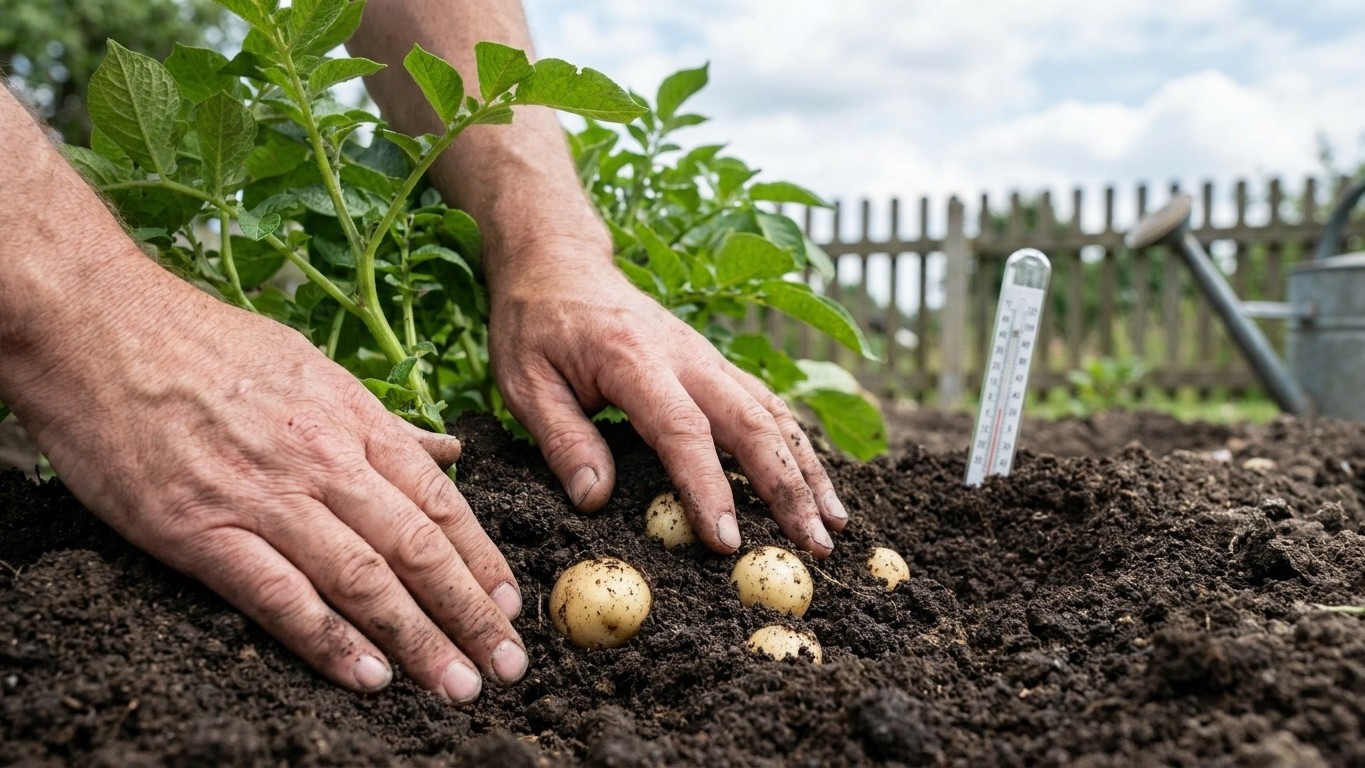
- Confirm with a soil thermometer. Calendar math gets you close, but a thermometer at 4 inches deep, checked over a few consecutive mornings, tells you whether the ground has actually reached 50 F. Cold, wet springs push this later than the math suggests.
Gardeners in northern Minnesota should shift this whole sequence later by two to three weeks, since their frost-free window opens later and closes earlier than the Twin Cities reference dates. The backward-counting method still applies. It’s just anchored to a different frost date.
What the heat does to the crop
The mechanism is straightforward, and it’s the single most useful thing to understand about growing potatoes anywhere. Tubers form and fill underground, and that process depends on soil temperature staying under 90 F. Utah State University Extension documents this directly: once soil crosses that line, tuber set and fill are inhibited. The plant doesn’t die. It just stops putting on size and starch, and no amount of irrigation reverses that. Watering keeps the plant alive through a hot stretch, but it does not restart tuber growth once the soil has crossed the threshold.
In a state where the reference city averages 10.6 days a year at 90 F or above, that ceiling almost never becomes a binding constraint for soil at typical planting depth. Air temperature spikes on a handful of summer afternoons, but the soil several inches down, especially under mulch or hilled rows, rarely tracks that closely. This is why Minnesota gardeners can plant in early-to-mid April and let the crop run through a full season without engineering an early harvest to dodge a heat wave.
That doesn’t mean heat is irrelevant here. A stretch of unusually warm, dry weather in July can still stress plants and reduce yield through drought stress, which is a separate issue from the soil-temperature ceiling. Consistent moisture during tuber bulking matters regardless of the state. But the specific failure mode that plagues hot-summer states, where soil temperature itself climbs past 90 F and shuts down tuber fill for weeks at a stretch, is a rare event in Minnesota’s climate, not the default risk to plan around.
What goes wrong here
- Planting uncertified seed potatoes. Seed sold without certification can carry viruses that stunt plants and reduce yield with no visible symptoms until the crop is already compromised. Buying certified seed potatoes each season is the single most reliable safeguard against a mystery poor harvest.
- Planting into cold, wet soil before it reaches 50 F. Seed pieces sitting in cold, saturated ground are prone to rot before they ever sprout. Waiting for the soil thermometer to confirm 50 F, rather than planting on a fixed calendar date, avoids this loss entirely.
- Skipping the hilling and ending up with green tubers. Tubers that push up near the soil surface and get exposed to light turn green and develop solanine, which makes them unfit to eat. Hilling soil up around the stems as plants grow keeps developing tubers covered and prevents this.
- Digging too early out of impatience. Pulling plants before they’ve finished bulking sacrifices size and yield. Watching the foliage for the natural end-of-season dieback, rather than digging on a guessed date, gives tubers the full time they need to size up.
Checking this against your own county
The dates above are anchored to the Minneapolis reference station, and they describe the mild southern part of Minnesota. They are a starting point, not an instruction for the whole state. Elevation changes, and the north-south spread across Minnesota, can shift both the last frost date and the count of hot days by two to three weeks in either direction. A garden in the Iron Range or near the Canadian border is working with a noticeably shorter, cooler season than one in the southern river valleys.
The reliable way to pin down local numbers is to check with University of Minnesota Extension, available at extension.umn.edu. County-level frost data and planting guidance there will be closer to what actually happens in a specific backyard than any statewide average can be.
Common questions
Can Minnesota gardeners grow a full-season potato crop, or is a spring-only crop safer?
With Minneapolis averaging only 10.6 days a year at 90 F or above, the soil-temperature ceiling that forces a spring-only strategy in hotter states rarely applies here. A full season, planted in April and harvested in fall, works across most of the state.
What season class of potato should I choose for Minnesota?
Since summer heat isn’t the limiting factor here, early, mid-season, and late types can all fit within Minnesota’s frost-free window, though northern gardeners with a shorter season may lean toward earlier types to be safe. Choose based on intended use, such as boiling or baking, rather than trying to dodge heat.
Does mulching help keep soil temperature down in Minnesota?
Mulch helps retain soil moisture and moderate temperature swings, which supports steady tuber development, though it isn’t solving a heat problem that barely exists at Minnesota’s 10.6-day count of 90 F afternoons.
Why does certified seed matter more than the variety name?
Uncertified seed potatoes can carry viruses invisibly, undermining yield regardless of which variety or season class is chosen. Starting with certified seed protects the investment in planting date, hilling, and watering that the rest of the season depends on.