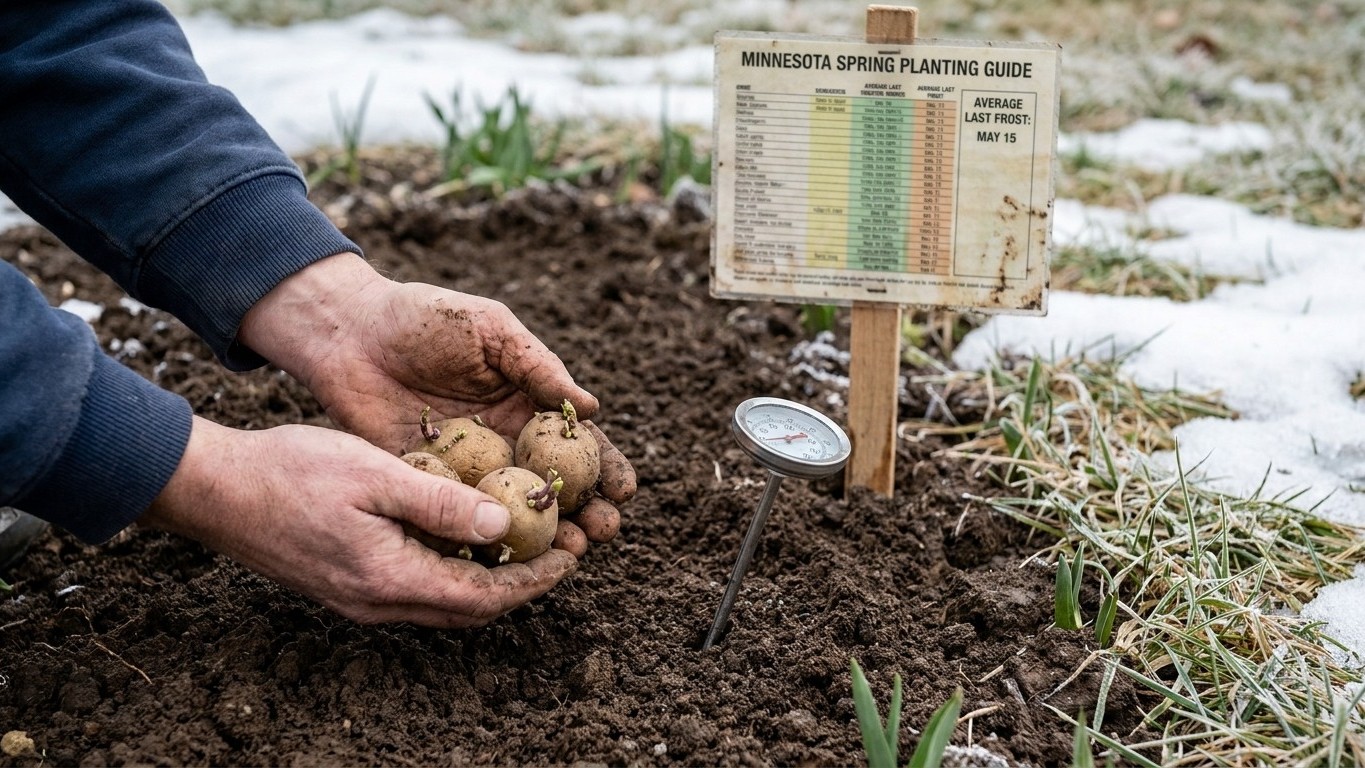

Plant potatoes in the Twin Cities metro area between late March and mid-April, working backward from a last spring frost that falls April 17 to April 30 according to NOAA NCEI’s 1991-2020 Climate Normals. Northern Minnesota gardeners should push that window two to three weeks later, since frost risk there lingers longer at both ends of the season.
The short answer
NOAA NCEI’s 1991-2020 Climate Normals, drawn from the Minneapolis-St Paul station record, put the 30 to 70 percent probability band for a 32 F freeze between April 17 and April 30. That’s the reference window for the Twin Cities, not for the whole state, and it’s the number this whole calculation hangs on.
Potatoes don’t wait for a frost-free calendar day. Utah State University Extension and the University of Maine Cooperative Extension both describe the same trigger: soil that has warmed to 50 F, which typically happens 14 to 21 days before the last frost date. Do the arithmetic against the Twin Cities range and the planting window lands somewhere between late March and mid-April, depending on how early that particular spring warms up.
Run the math on the early end. April 17 minus 21 days puts you at March 27. April 17 minus 14 days puts you at April 3. On the late end, April 30 minus 21 days is April 9, and April 30 minus 14 days is April 16. Stack those together and the realistic Twin Cities planting window runs from late March through the middle of April, with the actual date in any given year decided by how fast the soil itself warms rather than by what the calendar says.
That’s the number worth remembering: not a single planting day, but a window bounded by two facts, the frost date range and the 14-to-21-day soil lag. A gardener near Duluth or International Falls is working from a different frost date entirely, one that NOAA NCEI’s Twin Cities station doesn’t measure, so the same math shifts later by two to three weeks. The mechanism doesn’t change. The inputs do.
What actually decides it
Soil temperature, not the calendar
Neither Utah State nor the University of Maine tells gardeners to circle a date on the wall calendar. They tell gardeners to check the dirt. Seed potatoes go in once soil reaches 50 F, because below that threshold the seed piece sits in cold, often wet ground where it’s more likely to rot than sprout. That 50 F mark is what actually starts the clock, and it’s why the 14-to-21-day range exists in the first place. Some springs warm the soil fast; some crawl. A thermometer pushed a few inches into the bed tells you more than any date on a seed packet.
The 90-degree ceiling on the other end
The frost date isn’t the only edge that matters. Utah State University Extension notes that soil temperatures above 90 F inhibit tuber set and fill, meaning the plant stops sizing up the potatoes underground even if the foliage above still looks fine. Watering more doesn’t reverse it. This is the mechanism that should reshape how a gardener thinks about timing, because it works from the other direction: instead of asking only “how soon can I plant,” the better question in a hot summer stretch is “how early do I need to plant to finish before the soil overheats.” In a region where 90 F soil days stack up through midsummer, the answer favors an early-planted spring crop dug before peak heat, not a crop nursed through July and August hoping conditions hold.
Reference city vs. your actual garden
The April 17 to April 30 window belongs to the Minneapolis-St Paul station specifically. It is a real, sourced range, and it is also not universal across Minnesota. NOAA NCEI’s own caution built into the data is that northern parts of the state run two to three weeks tighter at both ends, meaning both a later last frost in spring and an earlier first frost in fall. A gardener in Bemidji or Grand Rapids reasoning from the Twin Cities number alone would plant too early and risk exactly the cold, wet soil that invites rot. The mechanism to carry forward: find the frost data for a station near your own garden, then apply the same 14-to-21-day soil-warming logic to that local range, not to the metro figure.
How to do it
- Source certified seed potatoes rather than grocery-store tubers or last year’s saved stock. Uncertified seed carries virus, and that single fact does more to protect a crop than any amount of careful timing.
- Identify the last spring frost range for the station closest to your garden, remembering that the Twin Cities figure of April 17 to April 30 doesn’t apply as-is north of the metro.
- Check actual soil temperature with a soil thermometer a few inches deep rather than relying on air temperature or the calendar.
- Once soil reads at or near 50 F, count backward: this point should fall 14 to 21 days ahead of your local last frost date, confirming you’re in the right window rather than jumping the gun.
- Cut larger seed potatoes into pieces with at least one or two eyes each, then let cut surfaces callus for a day or two before planting to reduce rot risk in cool soil.
- Plant seed pieces at the depth and spacing recommended for the growing method you’re using, in soil that has already reached that 50 F mark.
- Hill soil up around emerging stems as the plants grow, which protects developing tubers from sun exposure and from any late, shallow frost that nips foliage without killing the plant outright.
- Track the season toward harvest by watching foliage die-back and soil conditions rather than counting toward a fixed days-to-maturity number, since neither Utah State University Extension nor the University of Maine Cooperative Extension publishes one. Choose an early, mid-season, or late variety based on how much of the growing season you actually have before summer heat pushes soil past that 90 F ceiling.
What goes wrong
- Planting straight from the last-frost date without checking soil. A gardener who plants exactly on the last frost date, ignoring soil temperature, often lands in ground still well under 50 F. The fix is simple: push a thermometer into the bed before planting, regardless of what the date says.
- Using leftover grocery-store potatoes as seed. These aren’t certified and often carry virus that certified seed programs are specifically built to screen out. The remedy is buying certified seed potatoes each season rather than reusing tubers of unknown origin.
- Applying the Twin Cities frost window to northern Minnesota. NOAA NCEI’s April 17 to April 30 range comes from the Minneapolis-St Paul station. A gardener near the Iron Range or the Canadian border who plants on that same schedule is working from data that doesn’t describe their own last frost, which typically runs two to three weeks later. Pull frost data for a station closer to home instead.
- Nursing a late-season crop through peak summer heat. Once soil climbs above 90 F, tuber set and fill stall, and no amount of irrigation restarts it. Where hot summer stretches are common, the fix is planting as early as soil conditions allow and treating the harvest as a spring-timed crop rather than a summer-long project.
- Skipping the curing step on cut seed pieces. Planting freshly cut seed potatoes straight into cool, damp soil invites rot before sprouting even starts. Letting cut surfaces callus for a day or two first gives the piece a better shot at surviving those early, cooler weeks.
Common questions
Can I plant potatoes before the last frost date in Minnesota?
Yes, and that’s actually the point of the 14-to-21-day soil-warming rule described by Utah State University Extension and the University of Maine Cooperative Extension. Potatoes go in once soil reaches 50 F, which normally happens before the last frost, not after it.
Does a late frost after planting kill the potatoes?
Seed potatoes planted below the surface are generally insulated from a light frost that damages emerged foliage. Hilling soil around young stems adds another layer of protection. Neither source used here publishes a separate frost-damage threshold, so treat frost timing as a planting-window guide rather than a guarantee against every cold snap.
Why does the frost date differ across Minnesota?
The April 17 to April 30 range comes from the Minneapolis-St Paul station in NOAA NCEI’s Climate Normals. Northern Minnesota’s climate runs colder later into spring and colder earlier into fall, shifting the local last frost date two to three weeks later than the Twin Cities figure.
Should I choose an early, mid-season, or late potato variety?
That choice depends on how much cool growing season you have before summer soil temperatures climb past the 90 F ceiling that stalls tuber development, according to Utah State University Extension. Neither Utah State nor the University of Maine publishes exact days-to-maturity figures, so plan around the season class rather than a specific number.