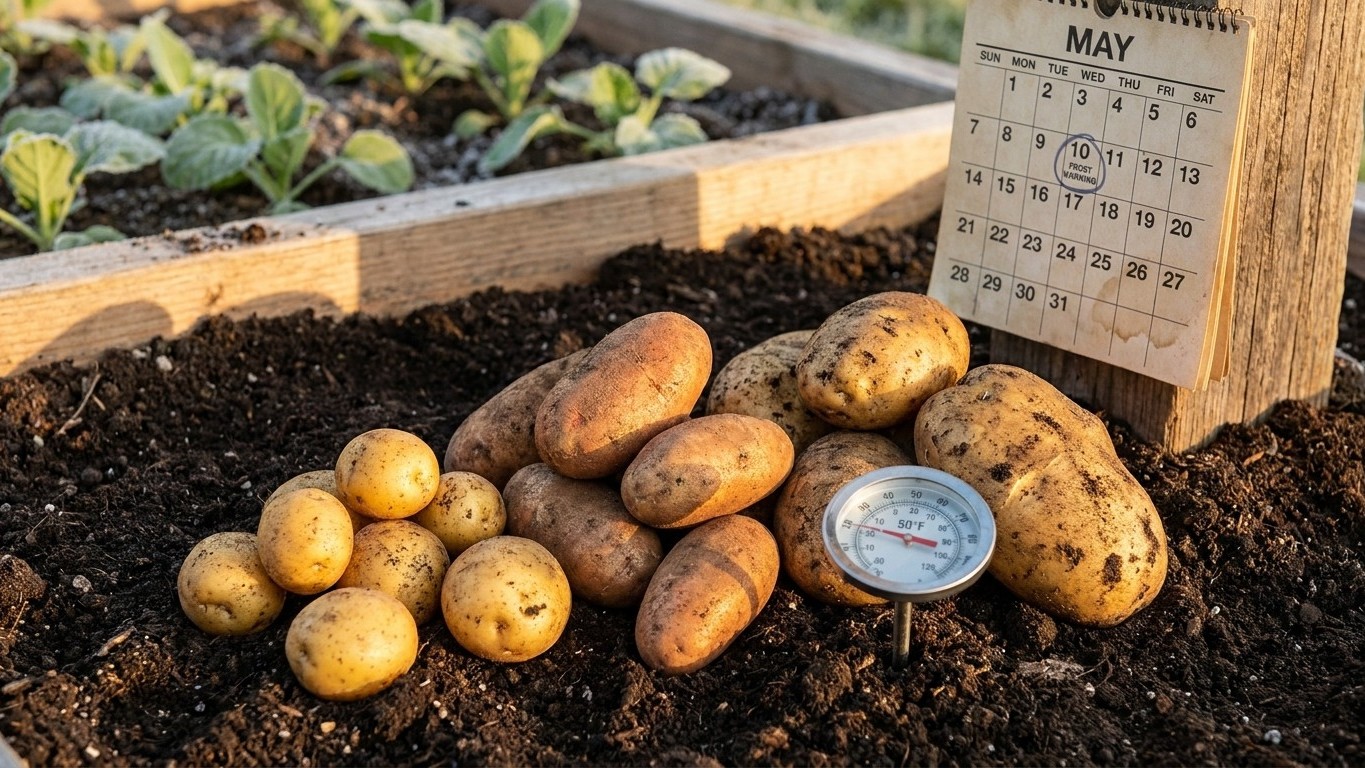

Minnesota’s growing conditions favor early and mid-season potato classes planted from certified seed as soon as soil hits 50°F, a window that falls 14 to 21 days before the last spring frost. In the Twin Cities that frost date runs April 17 to April 30, according to NOAA NCEI’s 1991-2020 climate normals. That early start matters because tuber set and fill stall once soil temperatures climb past 90°F, a ceiling that late-season varieties risk hitting before they’ve finished sizing up.
The short answer
The figure that actually drives variety selection in Minnesota is the state’s last spring frost window: April 17 to April 30, measured at the Twin Cities station and published by NOAA NCEI. That’s the reference city most Minnesota gardeners plan around, but it isn’t the whole state. Northern Minnesota runs two to three weeks tighter at both ends of the season, which shortens the window a gardener in Bemidji or International Falls has to work with compared to someone in the Twin Cities metro.
What that means for variety choice is straightforward once you set aside days-to-maturity numbers, which neither Utah State University Extension nor the University of Maine Cooperative Extension publishes for individual varieties. Both sources instead classify potatoes by season length: early, mid-season, and late. In a state where the frost-free window is already compressed in the north and where soil can climb past the 90°F threshold during a hot Minnesota July, early and mid-season classes have an easier time finishing before either end of the season closes in on them.
Late-season types aren’t off the table everywhere in Minnesota, but they carry more risk. A gardener in the southern part of the state, closer to the Twin Cities frost dates, has more cushion to run a late crop than someone up north working with a shorter window on both ends. The safer default, and the one both extension sources support through their season-class framework, is to lean on early and mid-season potatoes and treat late-season varieties as a bonus crop only where the local frost window allows it.
None of this is about picking a “best” variety in the abstract. It’s about matching a season class to a calendar that Minnesota, more than most states, compresses from both directions. That’s the mechanism the rest of this page walks through.
What actually decides it
Soil temperature at planting
Potatoes go in the ground when soil reaches 50°F, not when the calendar says spring has arrived. Utah State University Extension and the University of Maine Cooperative Extension both peg that 50°F mark as the planting trigger, and it typically lands 14 to 21 days before the local last frost date. That’s counterintuitive for gardeners used to waiting until frost risk has fully passed for other crops. Potatoes tolerate a light frost on emerging foliage better than they tolerate cold, wet soil that rots seed pieces before they sprout. Waiting for the 50°F soil reading, checked with a simple soil thermometer at planting depth, is the actual trigger, not the frost date itself.
The 90°F ceiling on tuber set
Once soil temperatures climb above 90°F, tuber set and fill stop, according to Utah State University Extension. Watering more doesn’t reverse that. This is the mechanism that decides the whole crop in a state like Minnesota, where summer soil can push past that threshold during a hot stretch. A gardener planting a late-season variety takes on the risk that the crop hasn’t finished sizing before the soil crosses that line. A gardener planting early or mid-season varieties, and getting them in the ground as soon as soil hits 50°F, gives the crop a head start that lets it finish its work before peak summer heat sets in.
Regional frost timing across Minnesota
The Twin Cities frost window of April 17 to April 30 is the reference most statewide guidance defaults to, but it describes the mild south of the state. Northern Minnesota runs two to three weeks tighter at both ends, per the same NOAA NCEI dataset. That compresses the total growing season for a gardener near the Canadian border more than it does for one in the metro. Combine that shorter window with the same 90°F heat ceiling, and the case for early and mid-season classes gets stronger the farther north you garden. A reader gardening in a county this page never names can apply the same reasoning: check the local last frost date, count backward 14 to 21 days for the 50°F planting trigger, and weigh how much runway remains before local summer heat risks crossing 90°F in the soil.
How to do it
- Buy certified seed potatoes rather than saving tubers from a previous crop or using grocery-store potatoes. Uncertified seed carries virus that certified stock is tested against, and that single choice affects yield more than variety selection does.
- Choose a season class, early or mid-season for most of Minnesota, based on how much runway your local last frost date leaves before summer soil temperatures risk crossing 90°F.
- Check soil temperature at planting depth with a soil thermometer starting in early spring, rather than relying on the calendar or air temperature alone.
- Plant seed pieces once soil reaches 50°F, which lands 14 to 21 days before your local last frost date according to Utah State University Extension and University of Maine Cooperative Extension guidance.
- Hill soil around the emerging plants as they grow, keeping developing tubers covered and protected from light.
- Monitor soil temperature through midsummer. If it approaches 90°F while tubers are still filling, mulch to moderate soil temperature; watering alone will not restart tuber sizing once that threshold is crossed.
- Harvest early and mid-season varieties before the hottest stretch of summer sets in, and reserve any late-season planting for regions and years where the frost-free window comfortably supports it.
What goes wrong
- Planting uncertified seed. Saved or grocery-store tubers often carry virus that reduces yield and vigor. Buy certified seed potatoes each planting season instead.
- Choosing a late-season class in northern Minnesota. A shorter frost-free window, two to three weeks tighter than the Twin Cities on both ends, leaves late varieties less room to finish. Switch to an early or mid-season class matched to the local frost dates.
- Planting before soil reaches 50°F. Cold, wet soil rots seed pieces before they sprout. Check soil temperature at planting depth with a thermometer and wait for the 50°F mark rather than guessing from the calendar.
- Letting soil temperature climb past 90°F during tuber fill. Once that threshold is crossed, tuber set and sizing stop, and extra watering does not reverse it. Mulch to buffer soil temperature and favor early season classes that finish before peak summer heat.
- Choosing a variety by texture label instead of published use. Neither Utah State University Extension nor the University of Maine Cooperative Extension classifies potatoes as waxy or floury. Match the variety to its published use, baking or boiling, instead of a texture term that isn’t part of either source’s guidance.
Common questions
What potato varieties are best for Minnesota home gardens?
Rather than naming a single “best” variety, both Utah State University Extension and the University of Maine Cooperative Extension organize recommendations by season class. Early and mid-season classes generally suit Minnesota’s compressed frost-free window better than late-season types, particularly in the northern part of the state.
When should I plant potatoes in Minnesota?
Plant once soil reaches 50°F, which lands 14 to 21 days before your local last frost date. In the Twin Cities, that frost date runs April 17 to April 30 according to NOAA NCEI’s 1991-2020 climate normals; northern Minnesota gardeners should expect that window to shift two to three weeks earlier on the frost side.
Do I need certified seed potatoes?
Yes. Uncertified seed, including saved tubers or grocery-store potatoes, can carry virus that certified seed stock has been tested against. Starting with certified seed each season protects yield more reliably than any single variety choice.
Can I grow late-season potatoes in northern Minnesota?
It’s riskier there than in the southern part of the state. Northern Minnesota’s frost-free window runs two to three weeks tighter at both ends than the Twin Cities reference dates, which leaves late-season classes less margin to finish before fall frost returns. Early and mid-season classes are the safer default for that region.