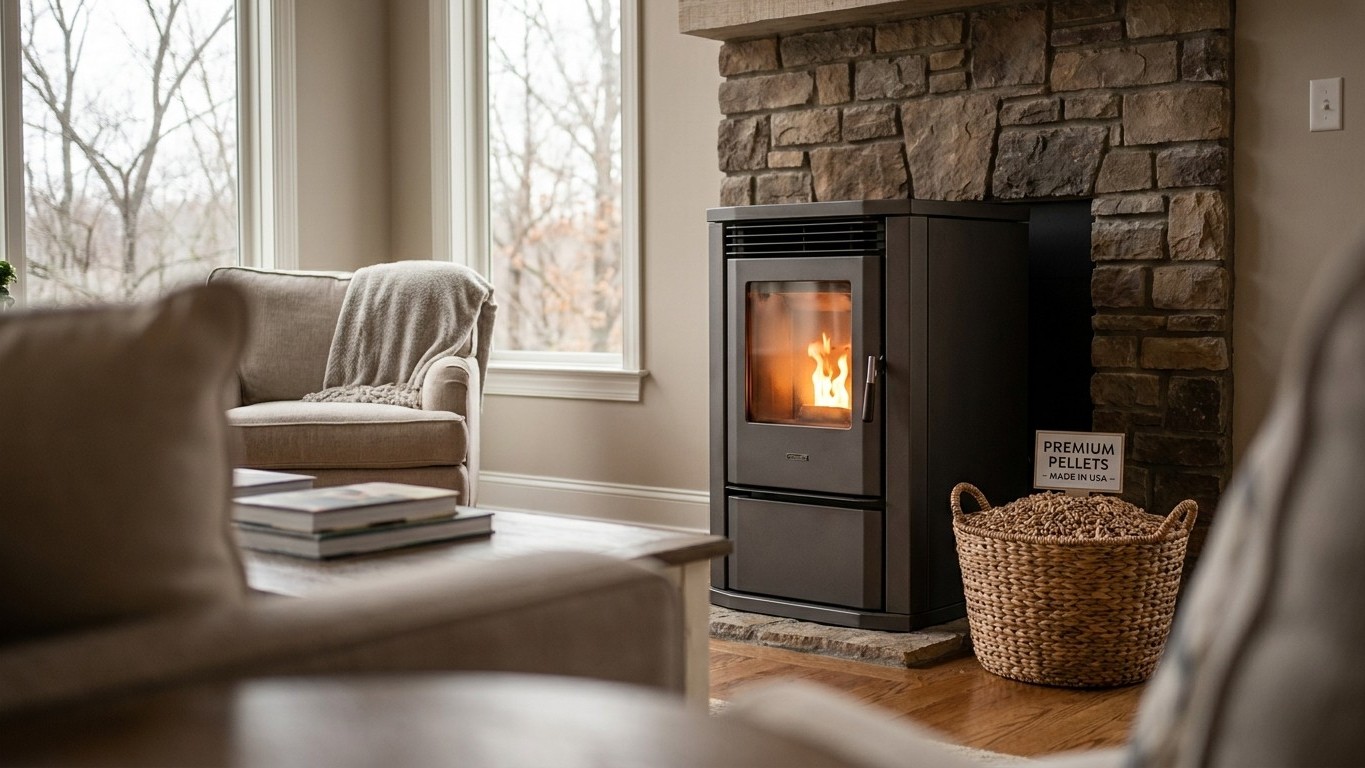

In Jackson, Mississippi averages about 2,222 heating degree days a year, one of the lowest totals in the country outside the Deep South and Florida. That number sets the whole conversation: a pellet stove here almost never carries the full heating load on its own, and buying decisions, storage habits, and outage planning all follow from how short and mild the season really is.
How hard the winter works here

The 2,222 heating degree days measured at Jackson Intl AP (NOAA’s 1991-2020 Climate Normals) come from adding up, for every day of the year, how far the average temperature sat below 65 F. It’s a fuel-demand number, not a temperature reading, and it’s the one figure that lets you compare a Mississippi winter honestly with a winter somewhere else. For scale, that total sits far below what a house in Minnesota or Vermont racks up, and even well below neighboring states to the north. A pellet stove burning against 2,222 degree days is doing a fraction of the work it would do in a harder climate.
The season also has a shape worth separating from its depth. Heating demand at Jackson starts in November, the first month whose normal mean temperature (55.4 F) drops below the 65 F base NOAA uses for the degree-day count. It climbs through December (500 degree days), peaks in January (562 degree days), then tapers through February (404), March (253), and April (94) before the mean climbs back above 65 F in May. That’s roughly six months where a stove could reasonably run, but only two of them, January and December, carry any real heating load. The rest is light-duty: mornings and evenings, not all-day burning.
That combination, a long calendar window but a shallow heat demand, matters for how you should think about the appliance. A pellet stove in Jackson is not competing with a furnace for total BTUs delivered over a winter. It’s more honest to call it what most owners in this climate actually use it for: comfort heat for a den or open living space, ambiance on the handful of nights each January when the mercury drops into the 20s, and a way to trim the furnace’s runtime rather than replace it. Anyone shopping for a pellet stove in this state expecting it to function as a primary heat source, the way it might in the upper Midwest, is buying for a winter Mississippi doesn’t have.
One caution worth repeating: Jackson is a single station in a state that stretches from the Gulf Coast to the Tennessee line. The Delta and the hill country in the north run measurably colder in January than the coastal counties near Gulfport and Biloxi. A household in DeSoto or Marshall County should expect a somewhat harder winter than this figure describes, and a household near the coast should expect a milder one. The Jackson number is a solid reference point for the state’s middle, not a promise for every county.
How many tons a winter takes here
Nobody can hand you a tons-per-winter number that fits your house, and any source that tries is guessing. What you can do is work the math yourself, using the same degree-day logic that drives the figure above. A standard bag of pellets weighs 40 pounds, and a ton is 50 bags. From there, consumption tracks the heat your house actually needs to replace, which is exactly what heating degree days measure: more degree days, more fuel burned to hold the same indoor temperature.
Three things move that number more than anything else, and they can shift the total by close to double even between two houses in the same Jackson neighborhood:
- How well the house holds heat. Attic insulation, window quality, and how tight the building envelope is all determine how much of the stove’s output leaks back outside.
- Whether the stove is the only heat source or a supplement. A stove backing up a furnace in the shoulder months burns far less than one asked to hold a whole house at 70 F through a January cold snap.
- The setting it runs at. A stove left on a low or medium setting for ambiance uses a fraction of what the same unit burns wide open to knock down a cold spell.
Given how mild and short the Jackson heating season runs, most households using a pellet stove as supplemental heat in a reasonably sealed house will land on the low end of what’s possible for the appliance, simply because there isn’t much winter here demanding otherwise. But “reasonably sealed” and “how you actually run it” are variables specific to your house, not to the state.
The honest approach, and the one worth actually doing, is to buy a modest supply for the first winter, mark down every bag you burn, and treat that count as your baseline going forward. One measured season in your own house beats any estimate built from state averages or degree-day math, because it captures your insulation, your thermostat habits, and your actual burn setting all at once. For the fuller breakdown of how the national averages are built and how to size a first-year purchase, see our guide on how many pellets a winter takes.
Buying and storing them in this climate
Timing matters more than most buyers expect. With heating demand at Jackson starting in November, the window to buy ahead is the stretch before that, late summer through early fall, when demand is low and supply is steady. Wait until a cold snap actually arrives, especially a hard one that hits the whole region at once, and local shelves can empty fast while everyone else has the same idea. Buying in the off-season isn’t just about avoiding a scramble. It’s also when pellets tend to run cheapest, since dealers aren’t selling into a spike. Whatever you’re comparing, compare by the ton, not by the bag or by brand name, since that’s the only unit that lets you weigh one offer against another fairly.
What humidity does to a bag
Storage is where Mississippi’s climate actually bites, more than its winters do. Pellets are compressed sawdust held together by nothing but pressure and the wood’s own lignin, no added glue. That means moisture is the enemy, not cold. Mississippi summers run humid for months at a stretch, and a bag left in a garage, shed, or carport across July and August can pull in enough ambient moisture to start swelling and crumbling before you ever burn it. A concrete garage floor that sweats in summer humidity is a particular risk: pellets stacked directly on that surface can wick moisture up from below even if the room above feels dry.
The practical fix is straightforward: keep bags off bare concrete on a pallet or shelving, keep them under cover away from rain intrusion, and don’t buy so far ahead that a full year’s supply sits through two humid summers before it’s burned. For the deeper mechanics of why moisture ruins pellet quality and how to judge it before you buy, our national pages on pellet storage and pellet quality cover the details that apply regardless of state.
What a winter outage means here
A pellet stove isn’t a wood stove with a hopper bolted on. It needs an electrical supply to run the auger that feeds fuel into the firebox and the fan that pushes heated air into the room. Cut the power, and the stove goes cold within minutes, no matter how much fuel is stacked next to it. That’s the one limitation a wood-burning stove doesn’t share, and it’s worth knowing before you count on a pellet stove for anything beyond comfort heat.
How much that matters depends entirely on the degree-day figure above. In a state with 6,000 or 7,000 heating degree days, a multi-day outage during a cold snap is a genuine emergency. In Jackson, with about 2,222 degree days and a season that’s mostly mild, an outage on a January evening usually means an evening without the stove, not a crisis. The stakes rise only during the handful of hard cold nights the state does get, and even then, most Mississippi homes aren’t depending on the pellet stove as their main defense.
What most households actually fall back on
According to EIA’s Residential Energy Consumption Survey for Mississippi, the equipment mix leans heavily toward central systems rather than standalone stoves as primary heat:
| Heating equipment or fuel | Share of Mississippi homes |
|---|---|
| Furnace | 54% |
| Central heat pump | 28% |
| Natural gas (as heating fuel) | 32% |
| Electricity (as heating fuel) | 56% |
| Propane | 10% |
Steam or hot-water boiler use and fuel oil or kerosene use were both too low for EIA to publish a reliable estimate in Mississippi’s state tables, which means the data isn’t there to confirm or deny meaningful use, not that nobody heats that way. Practically, this tells you most Mississippi homes running a pellet stove are pairing it with an electric or gas-fired furnace or a heat pump, which means a power outage often knocks out the backup system too, since heat pumps and forced-air furnace blowers both need electricity to move air. Rather than guess at a generator size or battery capacity here, check the wattage draw printed on your stove’s data label and compare it against your household’s actual backup setup. Our national guide on what a power outage means for a pellet stove walks through sizing that decision properly.