
Search for a documented list of carrot pests specific to Mississippi and the trail runs short: the verified data behind this page doesn’t carry a named inventory of insects feeding on carrots in this state. What’s established instead is the soil that shapes how a carrot root grows, the calendar that decides when a root is exposed, and the office that actually keeps the county-by-county pest records this page can’t invent.
Which pests attack carrot in Mississippi
No dedicated, named inventory of carrot-feeding insects for Mississippi sits in the sourcing behind this page, and that gap is worth stating plainly rather than papering over with a generic garden-pest list borrowed from somewhere else. A state-specific record is exactly what a home gardener needs, and a made-up one can’t deliver it. What’s present in a Delta garden built on river-bottom ground doesn’t have to match what’s present in a hill-country garden two counties over, and only a local survey settles that.
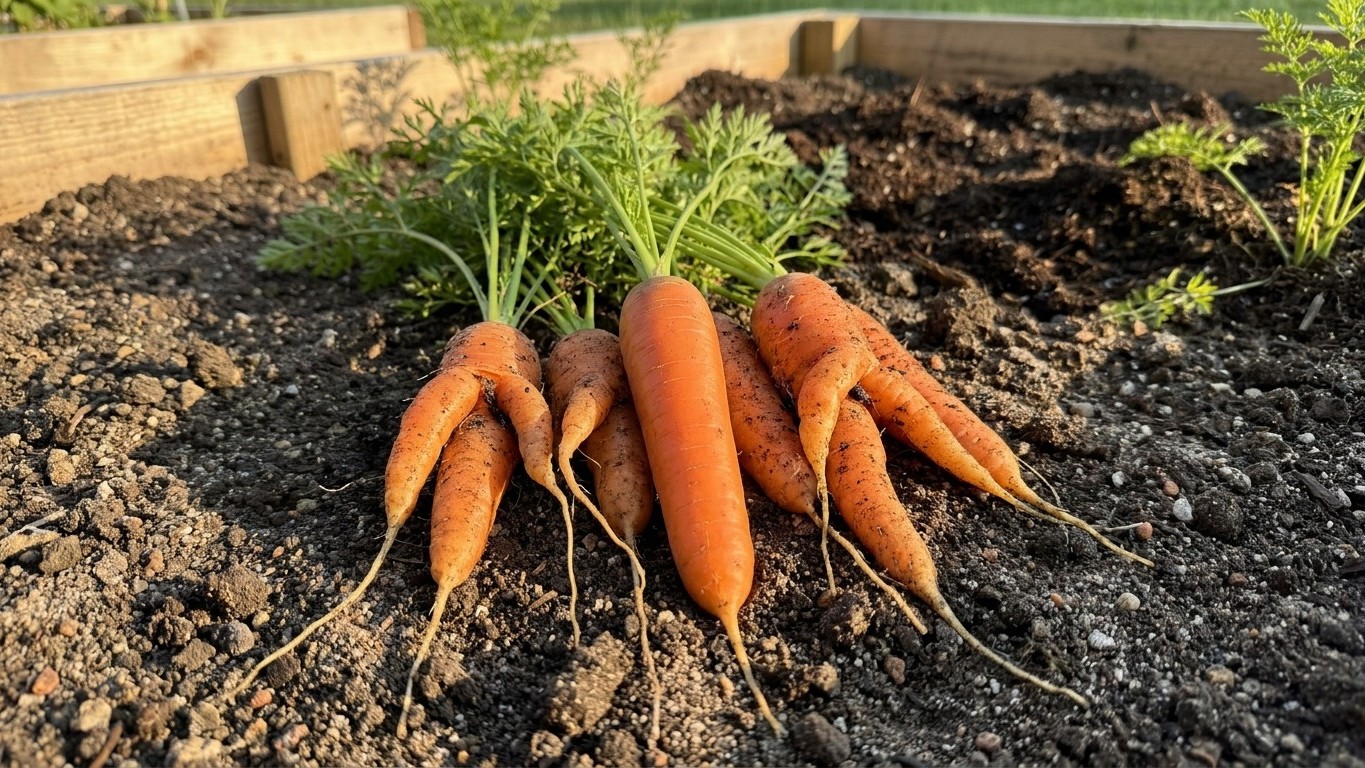
What the sourced facts do establish is the ground carrots are growing in statewide. Mississippi’s official state soil, the Natchez series, runs 5 percent sand, 13 percent clay and 82 percent silt at the surface, with a pH near 6.2 and organic matter around 1.8 percent. That’s a silt loam, not the deep, loose, sandy ground carrots actually want. Utah State University Extension is direct about what heavy or rocky soil does to a carrot root: it forks. A forked, split root isn’t proof of an insect underneath it. It’s frequently proof of resistance the root met on the way down.
That distinction carries more weight than a species name would anyway. A gardener who pulls a twisted, stunted carrot and assumes something chewed it below ground may spend a season treating a problem that was never there, while the real fix, working compost deep into the bed or building a raised bed with looser fill, never gets tried. The Natchez series is a representative statewide value, not a reading of any one yard; a garden on river alluvium or on fill dirt behind a new build can run completely differently, and the gap can be wide.
The honest version of this section is a redirect rather than a species list. Mississippi State University Extension runs the plant pathology and entomology diagnostics that put an actual name on whatever is present in a given county, and that’s the source to check before treating a carrot bed for anything with legs. A soil test through the same office settles the texture and pH question at the same visit, since both drive what a pulled root looks like.
When each one shows up, and what it does first
Without a named species list, the growing window itself is the more useful anchor, because whatever feeds on a carrot does it during that stretch and nowhere else. Carrots go into the bed as seed directly, with no transplant date to count from. Utah State University Extension puts full maturity at 70 to 100 days from seeding, while Clemson Cooperative Extension marks harvest earlier, at 65 to 75 days after planting. Either way, the vulnerable stretch runs from the week seed goes into loosened soil straight through to pulling.
Right after the first true leaves appear, damage shows on the foliage, not the root. Ragged leaf edges or leaves disappearing faster than the row is filling in are the first sign anything is feeding above ground, and they turn up while the taproot is still thin and mostly cosmetic. This stage covers roughly the first few weeks after seeding.
Once the root starts to bulk, somewhere in the middle of that 65-to-100-day window, trouble moves underground and out of sight until harvest. Tops that wilt or yellow without a dry spell to explain it are the signal, since a compromised root can’t move water up the way an intact one can. This is also the stage where forking from heavy soil becomes visible if you pull a test root, and it can look enough like feeding damage that the two get mixed up constantly.
By harvest, whatever the ground or anything living in it has done to the root is fixed and finally visible. That’s the only point a gardener can actually see the whole root, and the latest point to catch a problem before it goes into storage. A root pulled with surface tunneling or soft patches is a weak storage candidate no matter what caused the damage, and it’s worth setting aside rather than mixing in with the rest of the crop.
Telling the damage apart from everything else
Three separate problems can produce roots that look alike at a glance, and only one of them is an insect. Sorting them out before reaching for any treatment saves a wasted season.
| What you see | Likely cause | What tells it apart |
|---|---|---|
| Split or forked root, two or three prongs | Heavy or rocky soil deflecting the taproot | Shows up on nearly every root in the bed rather than a scattered few; Utah State University Extension names heavy soil directly as the cause |
| Wilting tops with no dry spell to explain it | Underground feeding or root rot cutting off water uptake | Soil at the base is moist when you check, and only plants over one patch of row are affected |
| Soft, rubbery roots after storage | Storage temperature too warm, not a field pest | Roots were firm at harvest; softening happened over days sitting in storage |
| Pale, stunted tops across a whole row | Nutrient shortfall or compacted, poorly drained ground | Uniform down the row instead of patchy, with no surface damage on pulled roots |
The storage line deserves its own note, since it’s the easiest one to pin on the wrong cause. Clemson Cooperative Extension specifies 33°F for stored carrots, and that’s just above freezing, not a mild garage or basement temperature. A batch held warmer than that will soften and sprout in a fraction of the time, and a gardener who finds mush a week later may blame rot or pests from earlier in the season when the actual failure happened in the storage bin.
None of this replaces an actual look at the plant. A pulled root with tunneling, sliminess, or an off smell is worth a call to the local extension office rather than a guess from a chart, because the same symptom can point to more than one cause depending on the soil and the week.
What actually works here, and what is a waste of time
Given a soil profile like the Natchez series, mostly silt with only 5 percent sand, the highest-value move happens before seed ever goes in the ground. Utah State University Extension is specific about the fix for heavy ground: work in plenty of compost and double dig the bed well beyond the depth a root will reach. A raised bed filled with looser mix does the same job without the digging. Either approach addresses forking directly, and forking is what most Mississippi carrot growers are actually fighting, not insects.
Timing the harvest tightly against the 65-to-75-day window Clemson names is the second real lever available. A root left in the ground past maturity has more time for surface cracking, for a heavy rain to reopen the soil around it, and for whatever local pressure exists to find it. Pulling on schedule rather than by the calendar month shortens that exposure at no cost.
What doesn’t help: treating a forked or split root as an insect problem. No treatment fixes a shape the soil already decided, and time spent chasing that guess is time not spent amending the bed for next season. Storing a full harvest at garage or countertop temperature and then blaming the resulting soft roots on the field wastes the actual lesson. Cutting the tops off before storage, rather than leaving them on, removes the leaves that keep pulling moisture out of the root, and that five-minute step does more for storage life than anything applied at pull.
Beyond soil prep and harvest timing, this page has no standing to name a specific treatment, and that’s deliberate. What’s labeled for use on carrots in Mississippi is a question for Mississippi State University Extension, since labeling and local pest pressure both shift by year and by county.
Where to check this for your own county
Mississippi State University Extension is the source that actually tracks what’s feeding on carrots county by county, through its plant diagnostic lab and county offices, and it’s the right first call for anything this page couldn’t name. A statewide soil series or a general growth calendar tells a gardener what to expect in broad terms, but neither one substitutes for a look at an actual root or leaf pulled from an actual garden.
Pest presence inside one state varies enough that a record from one county says little about the next one over. A Delta county built on river-bottom alluvium and a hill-country county sitting on something closer to the Natchez series don’t necessarily share the same insect pressure, drainage, or planting window, even though both fall under the same statewide averages used on this page. Treat the soil and timing figures here as the starting point they’re built to be, not as a reading of any one yard.
A county extension office typically handles both ends of the question in one visit: a soil test that settles the pH and texture a bed is actually working with, and a diagnostic submission for a damaged root or leaf that puts a name on whatever caused it. Bringing a soil sample and a sample of the damage to the same appointment gets a fuller answer than either one alone.
The next useful step for anyone seeing damage right now isn’t another search for a species name. It’s a call or visit to the county office, sample in hand, since that office is the only one positioned to say what’s actually present this season rather than what’s typical across the state on average.
Common questions
Does Mississippi publish a list of carrot pests?
Not in the sourcing behind this page. County-level identification runs through Mississippi State University Extension’s diagnostic lab, not through a fixed statewide list.
Why did my carrots come out forked or split?
Most likely heavy or rocky soil deflecting the root as it grows down, per Utah State University Extension, rather than insect damage. Work compost in deep and consider double digging or a raised bed before the next planting.
How long will harvested carrots keep?
Clemson Cooperative Extension notes that bunched carrots with the tops still attached keep for about 10 to 14 days, stored at 33°F with high humidity. Cutting the tops off before storing removes the leaves that keep drawing moisture out of the root, which extends that window well past the bunched figure.
When should I pull carrots to avoid problems?
Somewhere inside Clemson’s 65-to-75-day window, or by Utah State’s wider 70-to-100-day range at the latest, counted from seeding since carrots are never transplanted. Leaving roots in the ground past maturity adds time for cracking and for whatever pressure exists in that particular soil.