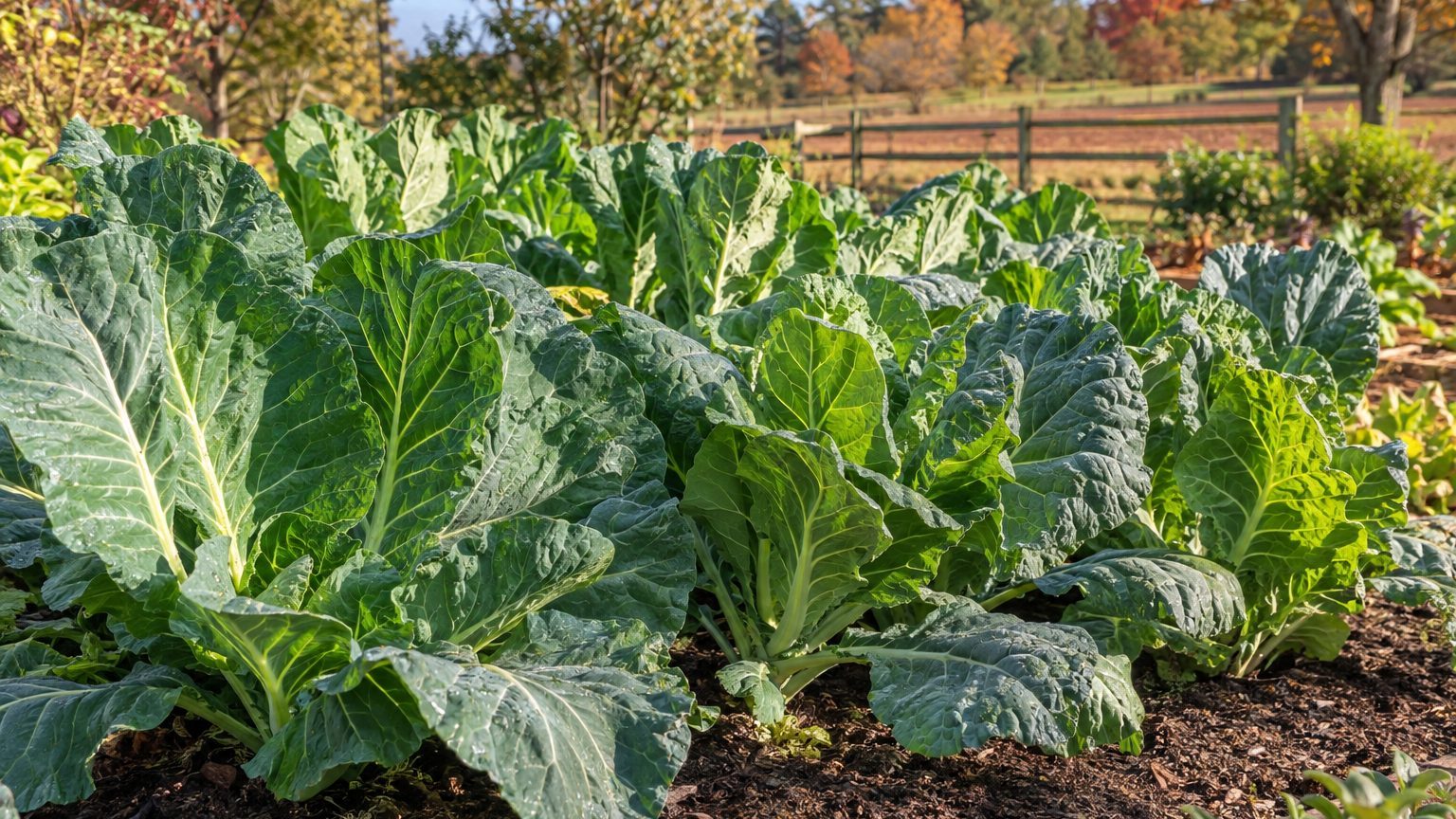

Most Mississippi gardens do best with an open-pollinated, non-heading, upright collard such as Georgia Southern, Vates or Champion. Plant it for fall and winter harvest, which is when the leaves taste sweetest. A spring planting gives a shorter second crop. Mustard, turnip and kale fill the gaps, each in its own season.
The short answer for Mississippi
The calendar explains why fall wins. At the Jackson airport reference station, the last spring 32°F freeze falls between March 6 and March 22, and the first fall freeze between November 7 and November 22. Both ranges come from NOAA’s 1991-2020 normals and describe probability, not a promise. On those dates the chance of a 32°F freeze sits between 30 and 70 percent, so a late cold snap in April is not unusual. That leaves more than seven months between the two bands, long enough for any collard to finish. Heat, not cold, is the limit.
Winter is mild by comparison. The mean daily minimum of the coldest month at the Jackson reference station is 36.6°F, above freezing on an average night. Collards shrug off frost and often sweeten after it, so a fall planting can be picked through winter in much of the state. The heat of July and August is what stalls them.
Choosing by type
Start with the type, then pick a named variety. The table compares the main groups on the criteria that matter in a long, hot, humid season.
| Type | Handles Mississippi heat | Best window | Verdict |
|---|---|---|---|
| Upright, non-heading collards (Georgia Southern, Vates, Champion) | Good, though growth slows in midsummer | Fall through winter; early spring | The default choice |
| Cabbage-type heading collards | Fair; heads can be fussy | Fall | Worth a row if you like the tender, milder leaf |
| Mustard and turnip greens | Poor; bolt and turn sharp in warm weather | Fall and late winter | Quick fillers around the collards |
| Kale | Poor in summer, strong in cool months | Fall through early spring | A cool-season partner |
Within the upright group, differences are small compared with planting date. Choose a variety sold as uniform and slow to bolt, and put your effort into timing. The When to Plant Collards in Mississippi guide turns those frost ranges into sowing and transplanting windows.
What will not work here
Planting in June. Seedlings set out into soil that stays warm all night grow fast and thin. They draw aphids, cabbage loopers and harlequin bugs, and they get little payoff. Collards started in that stretch rarely beat ones set out in late summer for fall, and they cost more water and spraying.
A spring crop planted too late fails the same way. If transplants go in after the March 6 to March 22 band has passed and the weather has warmed, the plants have only a few weeks of cool growth before heat sends up a flower stalk. Leaves from a bolting collard turn tough and bitter. Because the reference dates are airport figures, a garden outside town may see its last freeze a week or two later, which pushes the spring window even tighter.
Close spacing is the quieter mistake. Mississippi summers are humid, and leaves that overlap stay wet after rain or dew. That invites leaf spot, downy mildew and black rot, and in heavy clay soils that drain slowly the roots suffer as well. Plants set about 18 inches apart in rows with room to walk, watered at the base in the morning, dry out faster and stay healthier than a crowded bed.
Treating the frost dates as guarantees causes trouble too. A freeze probability of 30 to 70 percent is nearly a coin flip, so transplants set out on March 10 with no cover plan may take a hit. Keep a sheet or row cover handy until the odds drop well below even.
The remaining failures are the delicate greens. Mustard and turnip greens sown in April mature into a bolting, peppery mess, and kale sulks through summer. Heading cabbage collards are more demanding of cool weather to form tight heads. None of this makes them bad crops. They belong in the cool months, with upright collards carrying the garden through the shoulder seasons.
What changes across Mississippi
Mississippi is not one garden. The USDA Plant Hardiness Zone Map, built on a single variable (the average annual extreme minimum temperature), puts the state in a range from 7b to 9a. There is no single answer, only a spread, and it separates the northern hills from the Gulf Coast.
In the northern counties, expect later spring freezes and earlier fall freezes than the Jackson figures, often by one to two weeks, and more at elevation. Shift spring transplanting later by a week or two. Move fall planting earlier so the plants are well sized before the first hard freeze arrives. Mulch heavily in winter, because a cold night in the north can go lower than the mild Jackson average suggests. Low spots hold cold air, so a collard bed at the bottom of a slope is likelier to suffer than one on higher ground.
Toward the Gulf, the pattern reverses. Winters are gentler and the fall harvest can last well into the cool months with few interruptions. Summer heat and humidity arrive early and linger, so the spring crop has less room and disease pressure builds sooner. Gardeners there can set out fall transplants a little later and rely on cut-and-come-again picking through winter.
Where your own garden falls is a question for the map, not for this article. Look up your location on the USDA Plant Hardiness Zone Map and read the zone for your county. Then adjust the dates above in the direction the zone points: colder means later spring, earlier fall; warmer means a longer winter harvest and a shorter spring one.
Where to check this for your own county
A county recommendation beats a state one. The advice here is the state view, and it sits on one reference station. Your county’s extension office knows your soils, your typical last freeze and which varieties have actually grown well nearby.
Start with Mississippi State University Extension. Two things are worth looking for there. The first is the local vegetable planting calendar, which lists spring and fall windows for cool-season crops such as collards, often by region of the state. The second is the list of varieties trialled in your area, including leaf-spot resistance, bolt tolerance and yield. If your county has an extension agent, a phone call or visit with a soil sample gets you a pH reading and fertilizer advice for your own ground.
Collards like a soil pH around the upper 6s, and many Mississippi soils run acidic enough to need lime. A soil test tells you how much, which beats guessing.
For the full growing picture, from soil prep through harvest, see Growing Collards in Mississippi. Use it alongside the extension’s local calendar, not in place of it.
Checking this against your own garden
Every date in this article is an average, and your yard has its own weather. Three observations outrank any calendar.
- Soil warmth by feel. Push your hand a few inches into the bed in the morning. Cold, clammy soil means seeds will sit and rot or seedlings will stall. Soil that feels barely cool and crumbles in your fingers is ready. A bed that warms earlier than a neighbor’s shaded one tells you your spring window opens sooner.
- The first true leaves. The first pair after the seed leaves are the real test. If seedlings reach them quickly, the site is warm enough. If they hold at the seed-leaf stage for weeks, the spot is cooler, shadier or wetter than you assumed, and transplanting should wait.
- Frost on the grass at dawn. Walk the yard on a cold morning. White grass in the low corner and clear grass by the house wall maps your microclimate for free. Plant tender transplants near the warm spot and save the frosty corner for hardy fall plants.
Write down what you see and the dates, year over year. After two or three seasons, your own notes will be more precise than any reference station.
Common questions
What is the best collard variety for Mississippi?
Upright, non-heading, open-pollinated types such as Georgia Southern, Vates and Champion are the usual starting point for the state. Planting in the right season matters more than which of the three you pick.
Can collards survive Mississippi winters?
Generally yes. The mean daily minimum of the coldest month at the Jackson reference station is 36.6°F, and collards tolerate frost. In the northern counties, a hard freeze can still burn leaves, so mulch and a cover on the coldest nights help.
When should I plant for fall?
Aim for late summer, so plants are well established before the first fall freeze, which falls between November 7 and November 22 at the Jackson reference station. Gardens in the north or at elevation should plant earlier, because their first freeze comes earlier.
Are collards better planted in spring or fall?
Fall is better for flavor and length of harvest. A spring planting works if you set transplants out as soon as the freeze odds drop and harvest before summer heat triggers bolting.