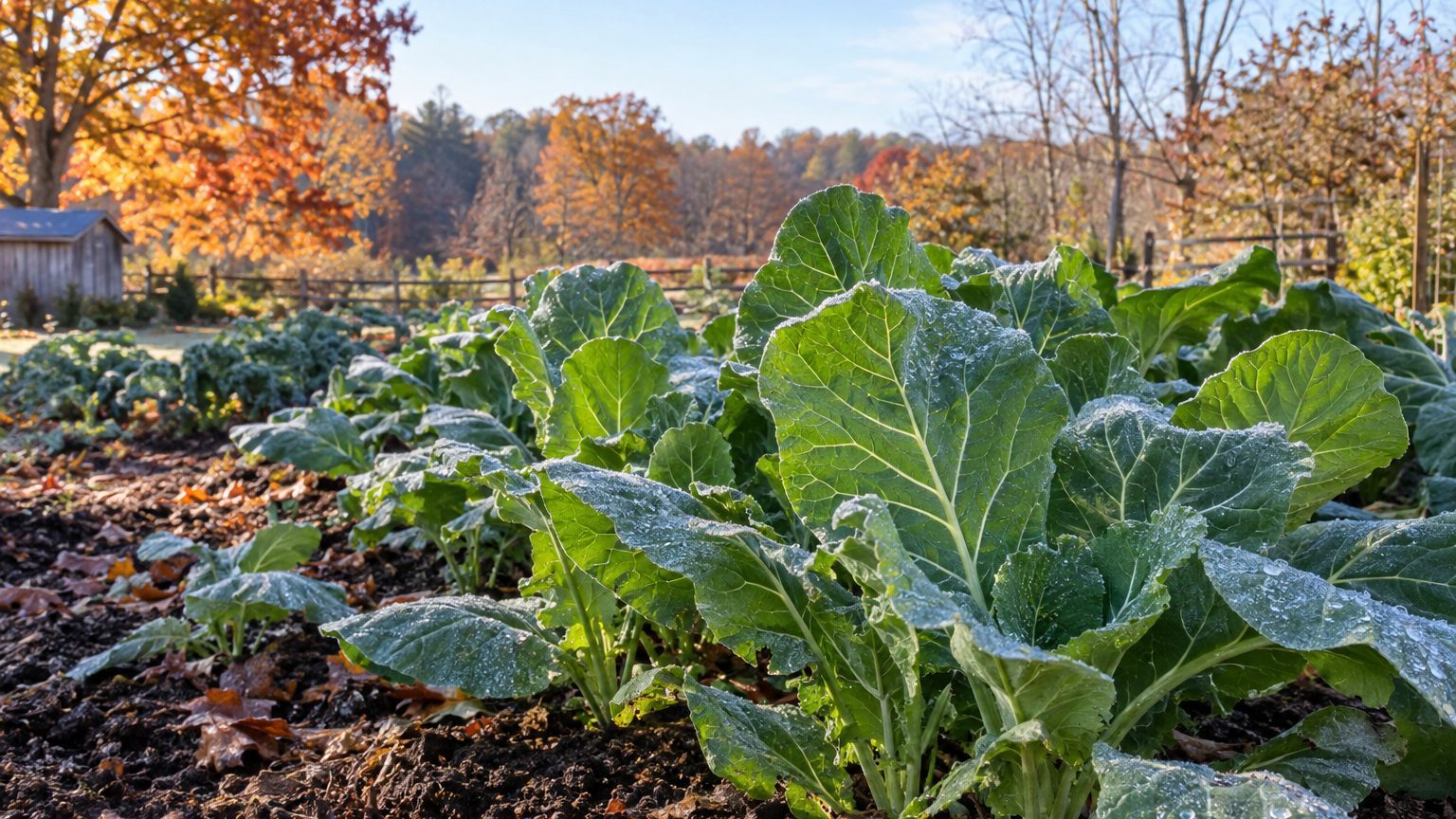

Collards go into Minnesota gardens in mid-spring for a spring crop and in midsummer for a fall crop. In the Twin Cities, the last 32°F freeze of spring falls between April 17 and April 30, and the first of fall between October 11 and October 23. Collards take light frost, so transplants can go out near the spring window. A second sowing, timed backward from October, gives the sweetest leaves.
The short answer for Minnesota
Both date ranges are probabilities of a 32°F freeze. They come from NOAA’s 1991-2020 Climate Normals for the Minneapolis station and mark the band where the odds of that freeze run between 30 and 70 percent. They are not promises. A freeze on May 3 is a real possibility, and a mild October 25 is too. The Twin Cities sit in the mild south of the state, so treat these dates as the best case.
Spring planting
Start seed indoors about a month before the spring window opens. Harden the seedlings off for a week, then set them out in the window itself, or a few days ahead of it if the forecast looks calm. Established collard plants shrug off a light frost, which is why they beat tomatoes and peppers into the garden by weeks. If a harder freeze is forecast, a sheet or row cover over the bed is enough. Direct sowing works as soon as the soil crumbles in your hand instead of smearing, but transplants give a head start that matters in a northern season.
Fall planting
Work backward from October 11 to 23. Take the days to maturity on the seed packet, which count from sowing for seed put straight into the garden and from transplanting for starts, and add a couple of weeks. Growth slows as days shorten, so a plant that needs eight weeks in July needs noticeably longer in September. For most gardeners, that points to sowing or transplanting in midsummer. Leaves picked after a few frosty nights taste milder and sweeter because the plant converts starch to sugar as protection against the cold. The harvest can run through light freezes, until a deep freeze finishes the planting.
What will not work here
Overwintering fails. The mean daily minimum of the coldest month in the Twin Cities is 8.8°F, and that is the average low, not the record. Collards behave as a winter crop in warmer parts of the country, where gardeners sow in late summer and pick all winter. Those plants sit in mild weather. In Minnesota, even a thick mulch of straw will not carry a collard plant through January, so plan on an annual crop and a final harvest in late fall.
The slowest varieties are the next casualty. From the last spring freeze to the first fall freeze, the Twin Cities get roughly five and a half to six months. Subtract the weeks a seedling spends indoors or in cold soil, and a variety that wants a long, steady stretch of warm weather runs out of calendar. Farther north, with two to three weeks lost at both ends, the shortfall is worse. The Best Collards and Greens for Minnesota sorts varieties by how much season they need.
Treating the average last frost as a safe date is another common mistake. Since the April 17 to April 30 band is a 30 to 70 percent chance of a 32°F freeze, planting on those dates is roughly a coin flip for the tenderest transplants. Collards handle that coin flip well if hardened off, and badly if they came straight from a warm windowsill. Seedlings carried outdoors without a week of gradual exposure suffer leaf scorch and stall for weeks.
Seeding into cold, wet April soil also disappoints. Seed sits, rots, or comes up unevenly, and the bed ends up with gaps that you fill with transplants anyway. Sowing the fall crop in late summer, on a Deep South schedule, backfires too. A sowing made in early September has barely a month and a half of useful growing weather before the freeze band arrives, which yields small plants rather than harvestable leaves.
A last failure: following a calendar written for another climate. Planting guides for the Southeast tell gardeners to sow in late summer for harvest through winter. Nothing in that schedule fits a state where the ground is frozen in January. For the basics on the crop itself, Growing Collards in Minnesota covers the full season.
What changes across Minnesota
Minnesota is not one garden. The USDA Plant Hardiness Zone Map (2023 edition, built on 1991-2020 normals) runs from 3a to 5a across the state. That spread covers several full zones, so no single answer exists. The zone system rests on one variable, the average annual extreme minimum temperature. It tells you how cold the worst winter nights get, which matters for perennials and shrubs. For an annual like collards, it is a rough proxy for how far north you are, and frost dates do most of the practical work.
The dates above describe the mild south. Northern Minnesota runs two to three weeks tighter at both ends of the season: spring arrives later and the fall freeze arrives earlier. Combined, that shortens the growing season by roughly four to six weeks compared with the Twin Cities.
| Location | Last spring 32°F freeze | First fall 32°F freeze |
|---|---|---|
| Twin Cities (reference station) | April 17 to April 30 | October 11 to October 23 |
| Northern Minnesota | Two to three weeks later | Two to three weeks earlier |
A northern gardener should shift the whole schedule. Start seed indoors later but still set strong transplants out as early as the weather permits. Choose faster varieties, and skip direct sowing in favor of transplants for the main crop. Since the fall window is short, sow the fall planting earlier in midsummer, and keep a row cover on hand for the first hard freezes.
To find your own zone, use the USDA Plant Hardiness Zone Map and enter your ZIP code. Nearby towns, and even different parts of the same county, can fall into different zones, especially near Lake Superior and in low, frost-prone valleys.
Where to check this for your own county
University of Minnesota Extension is the place to go next. As the state’s land-grant extension service, it publishes gardening guidance written for Minnesota conditions and staffs local offices that answer questions by phone or email. Start with the vegetable growing guides and look for the cole crop or leafy greens material, since collards belong to the cabbage family and share its timing.
Two items are worth pulling up. The first is a local planting calendar, ideally one broken out by region of the state, which will show earlier or later dates than the Twin Cities. The second is a list of the varieties trialled in your county or nearby. Trials show which collard and kale types grew well in local soil and weather, and which bolted, sulked, or ran out of season. Local frost dates for the nearest weather station also help, since the dates quoted above reflect only one reference city.
A county recommendation beats a state one. A statewide calendar is an average across a very long state, with a climate range that stretches from the Twin Cities to the Canadian border. If the county office says to wait a week longer than the dates above, or names a variety that has done better locally, follow the county. The Master Gardener volunteers attached to many local offices are especially good at the microclimate details a statewide calendar can never capture.
Checking this against your own garden
Your own observations outrank every date here. Three are worth watching, and none needs any equipment.
- Soil warmth by feel. Push your hand a few inches into the bed. Cold, sticky soil that clumps means the seed will sit. Soil that crumbles and feels merely cool is ready. If one bed reaches that point a week before another, you have found a warmer microclimate, often a south-facing slope or a spot beside a wall.
- The first catkins. The dangling male flowers on willows, birches, or hazel mark the end of deep winter in your neighborhood. If they open early where you live, spring is running ahead of the regional average, and the start of your indoor sowing can shift earlier.
- The first true leaves. After the rounded seed leaves, the first true leaves on collard seedlings show whether growth is steady. Seedlings that reach this stage quickly are ready to harden off. If it takes much longer than expected, the spot is probably cooler or shadier than the rest of the yard.
Write the dates down for a season or two. Two or three years of notes on when the soil warmed, when the catkins opened, and when the first frost hit your bed beat any calendar, because they describe your yard rather than a weather station.
The Moon calendar is a separate, older custom: see when to plant collard greens by the moon, written as tradition rather than fact.
Common questions
Can collards survive a Minnesota winter?
No. The coldest month’s average daily low in the Twin Cities is 8.8°F, and that is too cold for collards to come back. They survive light frosts and some hard freezes in fall, but a Minnesota winter ends the plant. Treat them as an annual.
When should I start collard seeds indoors?
About a month before the spring window, which for the Twin Cities runs April 17 to April 30. Farther north, count from a later date, since frost lingers two to three weeks longer.
Can I plant collards before the last frost date?
Yes, once the seedlings are hardened off. Collards tolerate light frost, and since the last-frost window is a 30 to 70 percent chance of a 32°F freeze, not a guarantee, keep a sheet or row cover handy for colder nights.
Is it too late to plant collards in August?
Often, yes, though it depends on the variety and region. Check the packet’s days to maturity against the first fall freeze (October 11 to October 23 in the Twin Cities, earlier in the north) and add a couple of weeks for slower autumn growth. A late sowing may still give small, tender leaves.