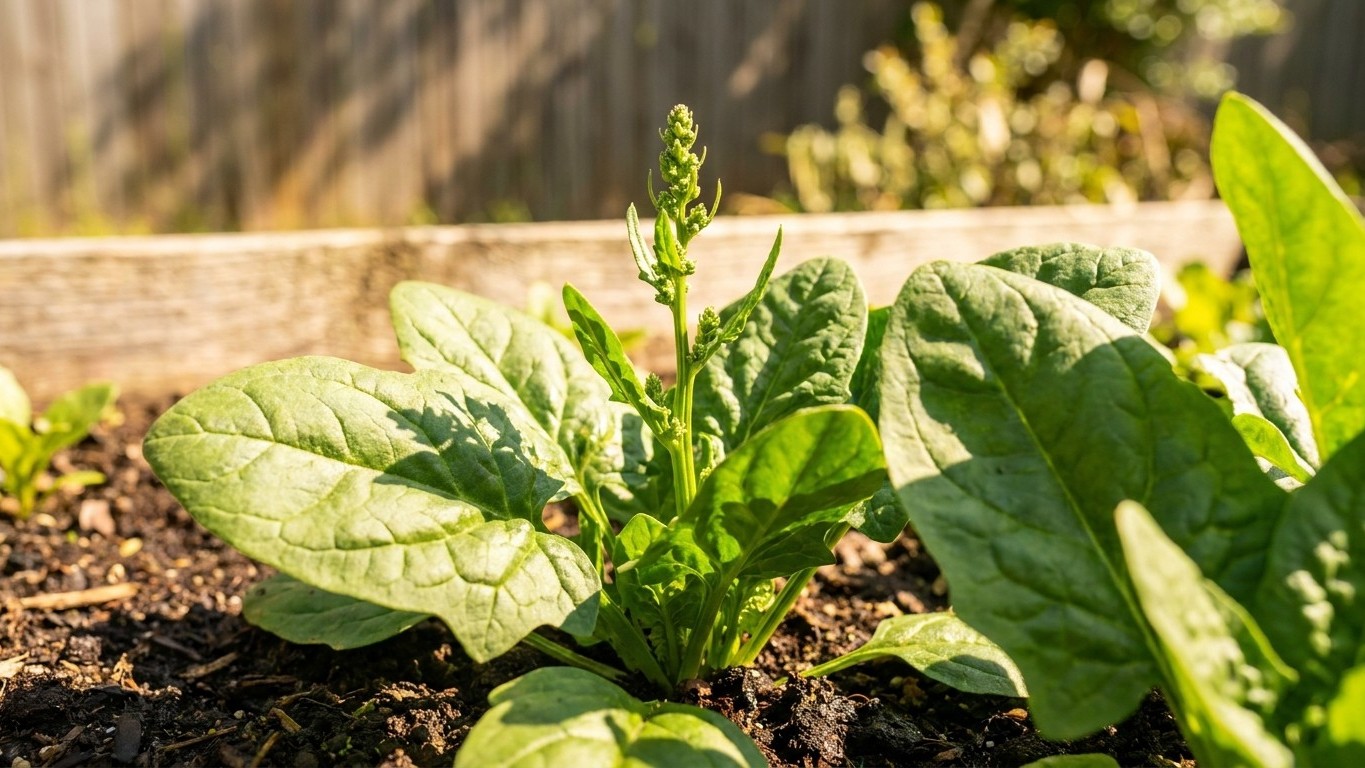

In Mississippi, cut spinach from late winter through spring, while afternoons stay under 75 F, or in autumn once the soil cools and before the first frost. Harvest young leaves as you need them, and take the whole plant when a center stalk starts to rise. Once cut, spinach keeps up to two weeks at best, and only at 32 F. For sowing and variety basics, see Growing Spinach in Mississippi.
The short answer
Fourteen hours and seven minutes. That is the daylight Jackson gets on the longest day of the year, counted to the geometric horizon (atmospheric refraction adds roughly seven more minutes of real light). For spinach, that number matters. Utah State University Extension notes that spinach bolts during long days and warm temperatures, which means long days alone can push a plant to flower. A cool summer would not rescue it here, because the day length is the same whatever the thermometer says.
Both limits apply
So the limit in Mississippi is both day length and heat. The days stretch every week after winter, and the heat arrives on top of them. At Jackson, 71.1 days a year reach 90 F or more, which is a heavy load for a cool-season leaf crop. Spinach grows best where temperatures do not exceed 75 F, and the same figure is where the leaves turn bitter. That is a growth ceiling with a flavor penalty attached, not a date on the calendar. It shows up when your own afternoons start to feel warm, and no almanac can tell you the day.
What that means at the cutting board
Cut early and cut often. Take the outer leaves while they are still young and tender, and leave the center to keep producing. When a stalk begins to climb from the middle of the plant, stop being gentle and cut the whole thing at the base, because flavor declines from there. The source publishes no days-to-maturity for spinach, so size and stage are your guide, not a countdown. Our page on Will Spinach Bolt Early in Mississippi? covers the warning signs in more detail.
How long it keeps once cut
The UC Davis Postharvest Technology Center puts the optimum at 32 F with 95 to 98 percent relative humidity. It also says spinach is highly perishable and will not maintain good quality for more than 2 weeks. Read that as a ceiling, not a plan. Wilting, yellowing and decay increase after 10 to 14 days, and they come faster at 41 to 50 F (the range a typical home fridge door actually holds). Put it at the back of the bottom shelf, the coldest spot, not in the door, and eat it sooner than you think you need to. The full figures are on the UC Davis spinach fact sheet.
How long the spring window really is
Sow spinach two to three weeks before the last frost, and growth stops being good above 75 F. Between those two rules sits your spring. Here is how to work it out for Jackson, step by step.
- Start with the frost range. For the Jackson airport station, the last spring frost falls between March 6 and March 22 (NOAA NCEI 1991-2020 Climate Normals, the 30 to 70 percent probability band).
- Count back two to three weeks. From March 6, that lands on about February 13 to February 20. From March 22, it lands on about March 1 to March 8. The usable sowing window therefore runs from mid-February to early March, depending on how your own year is behaving.
- Adjust for where you garden. Suburban and rural gardens usually see the last spring frost one to two weeks later than an airport station, and more at elevation. Shift everything above by that margin, and check your own county rather than trusting one city’s figure.
- Find the other end by weather, not by date. The 75 F ceiling is not a calendar date, and no verified date for it is published here. It arrives when your afternoons say so, and a thermometer in the shade tells you more than any chart.
- Do the arithmetic. As an illustration only: a plant sown around February 13 that meets its first stretch of 75 F afternoons on April 1 has had about seven weeks. If those afternoons hold off until the end of April, it has about eleven. A sowing from March 8 has less room, because the same warm afternoons arrive sooner after it comes up.
What the arithmetic leaves you
A spring crop in Mississippi is a matter of weeks, not months, and the shape is lopsided. The front end is flexible, since a late-winter cold snap only delays you. The back end is not, because the 14 h 07 summer day and the 71.1 days at 90 F or above both press on it from the same side. Sowing at the early edge of the window, a cool-season crop starts working on a calendar that still has room, instead of racing warm afternoons.
A practical habit follows from that. Start cutting as soon as leaves are big enough to eat, rather than waiting for a full-size plant. Every week you wait is a week taken from the narrow stretch before bolting and bitterness. And if pests start nibbling in the cool weeks, What Eats Spinach in Mississippi, and When explains what to expect and in which months.
The autumn crop, and when the soil lets you sow
The autumn crop is a mirror image of spring, with a different obstacle at the front. Spring is limited by cold at the start and heat at the end. Autumn is limited by warm soil at the start and frost at the end, and the window between them is where the crop lives.
Obstacle one: soil that is still too warm
Seed germination is reduced when soil is above 80 F, according to Utah State University Extension. In Mississippi, that is the real gate on an autumn sowing, and the cold has nothing to do with it. The sun can feel gentler in September while the soil stays hot, and spinach seed sown into it comes up poorly or not at all. The source gives no date for when Mississippi soil drops below 80 F, so the only honest method is to measure. A soil thermometer pushed a couple of inches down, read in the morning, is cheap and settles the question. Wait for the reading to fall under 80 F, then sow. Watering the bed lightly and shading it before sowing can help cool the surface, though that is a gardener’s habit and not a figure from the source.
Obstacle two: the frost that ends the season
The first fall frost at the Jackson reference station falls between November 7 and November 22 (NOAA NCEI 1991-2020, 30 to 70 percent band). The source rule for a fall crop is to plant 50 to 75 days before the date you want to harvest. Take the frost as a cautious harvest deadline and count back from it:
- From November 7, 75 days back is about August 24, and 50 days back is about September 18.
- From November 22, 75 days back is about September 8, and 50 days back is about October 3.
On paper, then, sowing could run from late August to early October. In practice the early end of that range lands in the middle of the hot season, with soil well above 80 F, so the soil reading usually opens the window later than the calendar does. The date you sow is whichever comes last: the soil falling under 80 F, or the start of your 50 to 75 day count.
Adjust for your location, too. Suburban and rural gardens typically see the first fall frost one to two weeks earlier than the airport, and more at elevation, which pulls the whole count earlier. Check your own county’s dates before you commit.
The source names four varieties, Bloomsdale, Melody, Teton and Olympia, but publishes no data on any of them, so there is nothing here to say about how they differ in timing or heat tolerance.
Common questions
Is there a date when I should stop cutting spring spinach?
No calendar date applies. The 75 F ceiling is a weather condition, and long days push the plant toward flowering as well. Stop when a center stalk rises or the leaves taste bitter, and cut the whole plant at that point.
Will a cool summer let me keep spinach going longer?
Not in Mississippi. Jackson gets 14 h 07 of daylight on the longest day, and long days alone can trigger flowering in spinach. A cool season takes heat out of the problem but leaves the day length where it is.
How long does cut spinach keep in the fridge?
UC Davis says it will not keep good quality for more than two weeks, and that is at 32 F with 95 to 98 percent humidity. At 41 to 50 F, the range a fridge door holds, quality drops faster. Store it at the back of the bottom shelf and treat two weeks as an upper limit.
Which variety should I grow?
Utah State University Extension names Bloomsdale, Melody, Teton and Olympia, but it publishes no data on any of them. Without that, there is no verified basis for ranking them, so choose by what your seed source describes for your area. Whichever you pick, the dates and the 75 F ceiling are the same.